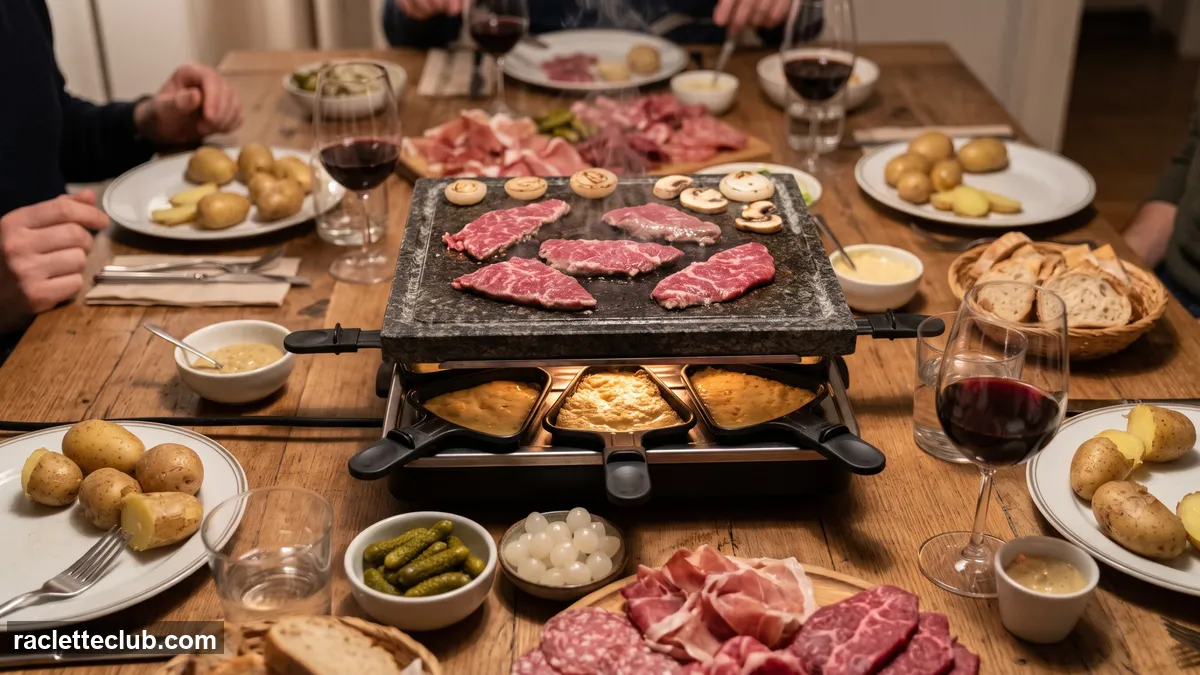
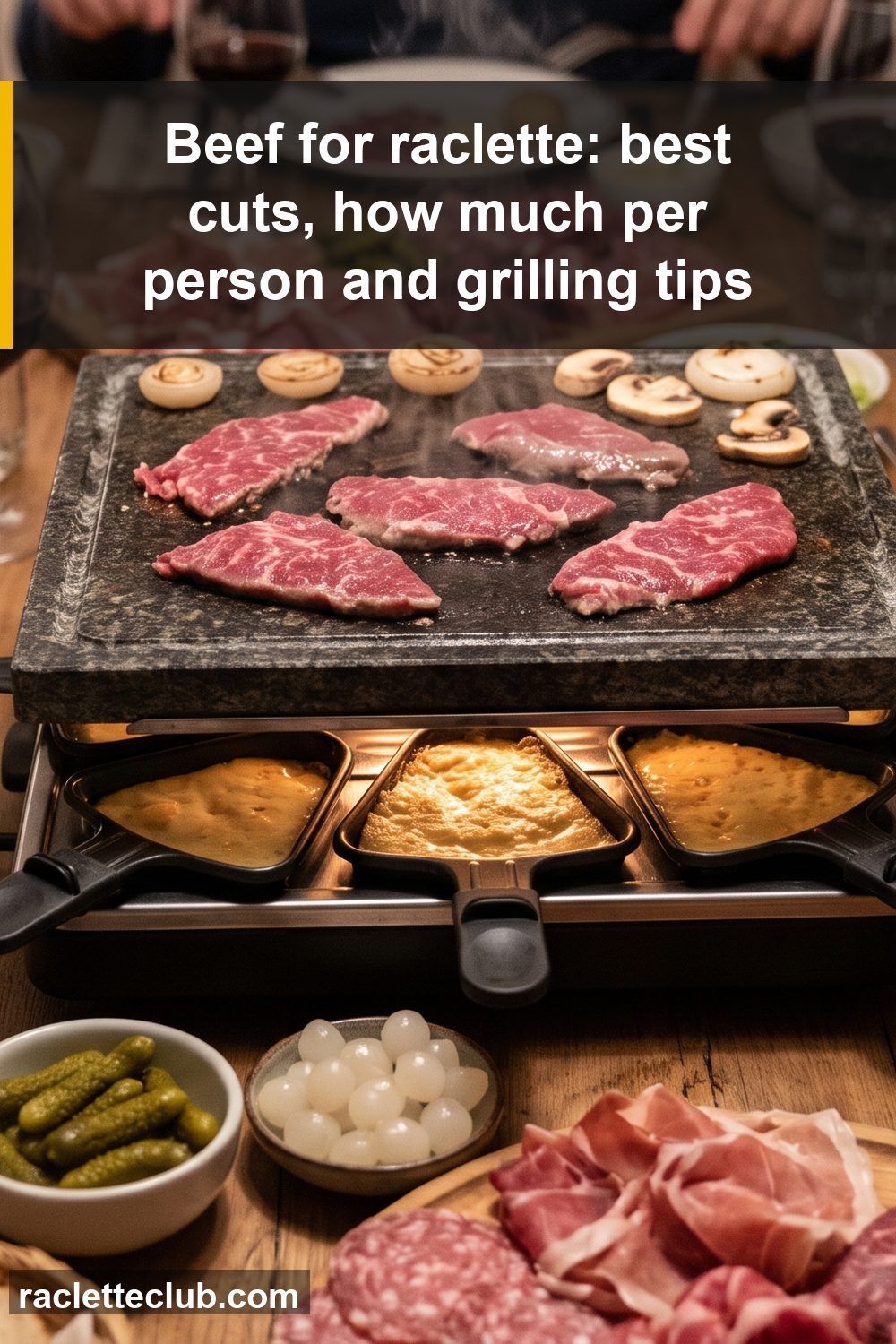
In short: beef at a raclette night is the “stone grill” version of the evening: very thin slices or strips that everyone sears on the top plate while the cheese melts underneath. Pick a tender cut (the French meat industry body suggests flank or hanger steak cut into strips, or slices sold specially for “stone cooking”), plan on 100 to 150 g per person if the beef replaces the cured meats, and stick to one simple rule: a slice of beef can stay pink, ground beef gets cooked all the way through.
This article contains Amazon affiliate links: if you buy through these links, Raclette Club earns a small commission at no extra cost to you. Learn more.
Beef at a raclette: what exactly are we talking about?
Most raclette machines have a cast-iron plate or a stone above the little cheese pans. Usually, that’s where the potatoes stay warm. But you can also grill meat on it, just like on a hot stone. Beef works really well, on one condition: it has to be sliced very thin so it cooks in a few dozen seconds, about the time it takes for a pan of cheese to be ready.
La-viande.fr, the website of the French livestock and meat industry body (Interbev), even has a page on “stone cooking” that calls for “tender and tasty” slices of beef. Its stone-grill recipes use either slices sold for stone cooking (400 g for 4 people) or 600 g of “beef in thin strips (flank, hanger…)” for 4 people.
| ID card | Beef for raclette and stone grilling |
|---|---|
| Cuts | Tender cuts in thin slices or strips (flank and hanger steak named by Interbev, slices sold for “stone cooking”) |
| Origin label to look for | Viande Bovine Française (VBF) logo |
| Quantity | 100 to 150 g per person (based on Interbev’s stone-grill recipes) |
| Cooking | A few seconds to one minute per side on the hot plate |
| Safety rule | Ground beef always cooked through; a whole-cut slice can stay pink, except for vulnerable people |
Why beef goes with raclette
Classic raclette is fat on fat: melted cheese, cured ham, dry sausage. A slice of lean beef seared at the last second brings something different. It’s hot, juicy and a little charred, with a real meaty flavor. We like to roll it in a pan of Raclette du Valais AOP or Raclette de Savoie IGP: the cheese coats the meat like a sauce. With a peppercorn raclette, you get an Alpine take on steak au poivre. A smoked raclette gives it a little barbecue vibe.
Another plus: beef lets you serve an evening that’s lighter on cured meats, which some guests appreciate. Nobody’s forcing you to choose, though: a mixed platter does the job just fine.
How to choose your beef
- The cut: ask your butcher for a grilling cut, sliced very thin. The flank or hanger steak strips suggested by Interbev have plenty of flavor. A lean, tender cut also works great as long as you don’t overcook it.
- Thickness: the thinner, the better. A thick slice cooks on the outside and stays cold inside, and it hogs the plate while everyone else waits.
- Origin: Interbev’s VBF (Viande Bovine Française) logo has meant, since 2010, meat from animals born, raised, slaughtered, cut and processed in France (Réussir, 2010).
- Freshness: buy the meat the same day or the day before, keep it in the fridge and take it out at the last minute.
How much to plan and how to cook it
Interbev’s two stone-grill recipes call for 400 g and 600 g of beef for 4 people, so 100 to 150 g per person. That’s a good benchmark if beef is the only meat. With a cured meat platter on the side, cut that roughly in half: that’s our advice, not an official rule.
For cooking, let the machine heat up properly before you start, lightly oil the plate, then lay the slices flat. A thin slice gets flipped as soon as it changes color. Add salt and pepper after cooking.
Food safety rules you should know
- Whole cut and ground beef are not the same thing. According to the UK Food Standards Agency (FSA), bacteria on a whole cut sit on the surface and searing kills them, while grinding spreads them through the whole piece of meat: that’s why a steak can be served rare and a burger has to be cooked through. In France, ANSES therefore recommends that vulnerable groups (young children in particular) have “ground meat and ground meat products cooked through (70°C)” (Santé.fr).
- Temperature benchmarks: Health Canada gives 63 °C internal temperature for a medium-rare steak and 71 °C for ground meat.
- Vulnerable people: for pregnant women, Santé publique France advises against raw or undercooked meat (risk of toxoplasmosis). For them, the slices stay on the plate until there’s no red left.
- Keep raw and cooked apart: ANSES advises cleaning “the cutting board, the dish and the utensils” that touched raw meat. At the table, that means one pair of tongs to put down the raw meat and a separate fork to eat, and never putting cooked meat back on the raw meat plate.
Which wine to serve with beef and raclette
Grilled beef makes you want a red, and raclette calls for a light one. In our opinion, Pinot Noir is the best compromise: enough fruit for the meat, few tannins for the cheese. A Gamay from Savoie or a light Beaujolais, served cool, also work very well. Avoid very tannic reds, which turn harsh with melted cheese.
In the pantry
Back to the pantry, where we keep everything that ends up on the table on raclette night. To mix up the grill plate, try thinly sliced duck breast, pork or chicken. And for the cold platter, air-dried beef from Graubünden and the Valais is still beef, Alpine style.
Frequently asked questions
Which cut of beef should you choose for raclette?
A tender cut sliced very thin. The French industry body Interbev suggests strips of flank or hanger steak, or slices sold for stone cooking.
How much beef should you plan per person?
Interbev’s stone-grill recipes call for 100 to 150 g per person when beef is the only meat. With cured meats on the side, about half is enough, in our experience.
Can you eat beef pink at a raclette?
A slice from a whole cut can stay pink, because the bacteria are mostly on the surface. Ground beef must be cooked through (70 °C according to ANSES for vulnerable groups). Pregnant women should avoid undercooked meat.
Which wine goes with beef and raclette?
In our opinion, a light red with low tannins, served cool: Pinot Noir, Gamay from Savoie or Beaujolais.
Sources
- La-viande.fr (Interbev): beef stone-grill recipe (in French)
- La-viande.fr (Interbev): beef stone grill with pears and roasted squash (in French)
- La-viande.fr (Interbev): stone cooking (in French)
- Réussir Les Marchés: change in the use of the VBF logo (October 2010, in French)
- Santé.fr: avoiding food poisoning (ANSES recommendations, in French)
- ANSES: campylobacteriosis (meat hygiene and cooking, in French)
- Food Standards Agency (UK): why a burger is not a steak
- Health Canada: safe internal cooking temperatures chart (in French)
- Santé publique France (Manger Bouger) via Santé.fr: foods to avoid during pregnancy (in French)