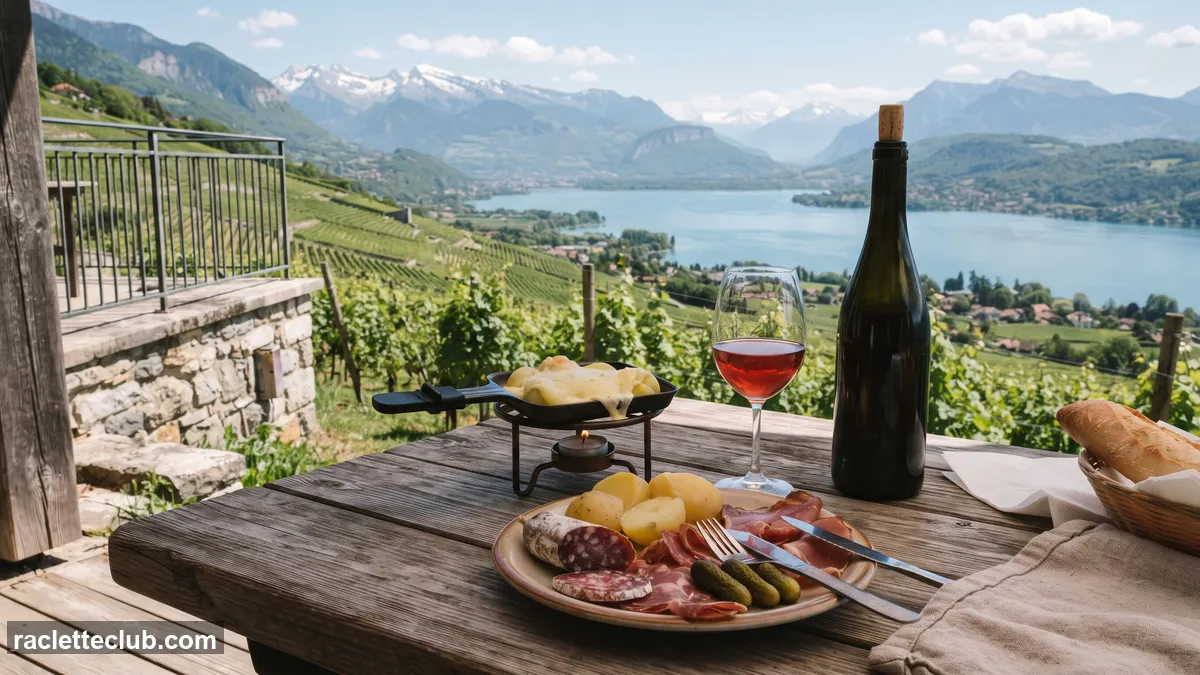
In short: Savoie Gamay is the light red of the French Alps, and the natural terroir pairing for a Savoie-style raclette. The AOC Savoie specification describes it as supple and very fruity, with raspberry, strawberry and cherry. Look for it mainly in Chautagne and Jongieux. For raclette, we prefer it young and cool: aim for the 2025 and 2024 vintages.
This article contains Amazon affiliate links: if you buy through these links, Raclette Club earns a small commission at no extra cost to you. Learn more.
Why Savoie Gamay goes with raclette
You’ve got the Savoie cheese out, the potatoes, the mountain charcuterie, and the grill is already heating up. It would be a shame to fetch your wine from 500 kilometers (300 miles) away. Savoie Gamay is the red that grows a few valleys over from your cheese. A true terroir pairing.
And it’s not just a postcard thing. According to the AOC Savoie specification, Gamay reds have a cherry-red color with purple glints, a very fruity nose (raspberry, strawberry, cherry) and a supple palate, with notes of red fruit, English fruit candy and licorice. On the molasse soils of Chautagne, the same text mentions supple but present tannins, some grip and lovely acidity. With raclette, that’s just the right balance: enough freshness to cut through the fat, enough fruit to stand up to the charcuterie, and no harsh tannins to spoil the melted cheese.
It shines with a classic Savoie raclette and with a peppercorn raclette, whose spicy side it carries forward. With a smoked raclette, it brings a welcome fruity counterpoint.
Where to find the best Savoie Gamay
Gamay isn’t alone in Savoie. The specification of the AOC “Vin de Savoie” or “Savoie” (recognized in 1973, text approved in June 2023) lists three main grapes for reds: Gamay, Mondeuse and Pinot Noir. One rule worth knowing: when the label names a grape, for example “Savoie Gamay,” the wine must come exclusively from that grape. So a label that says “Gamay” guarantees you a pure Gamay wine.
Chautagne: Gamay’s stronghold
North of Lake Bourget, Chautagne is an additional geographical name within the AOC Savoie. The specification describes mild winters and hot summers there, under the influence of the lake and the Rhône, and names Gamay as the grape of choice for its molasse soils. It’s the first place to look for a raclette Gamay.
Jongieux: Gamay with a hint of spice
On the western side of the vineyards, Jongieux can also make reds under its own name. On its limestone and marl, the specification mentions reds with spicy notes. Farther south, on limestone moraines, the reds lean more toward ripe fruit. The Guide Hachette also notes the intense color and the fruit of Jongieux Gamays. A slightly spicy Jongieux Gamay served with a peppercorn raclette: now that’s a pairing you’ll remember.
Chignin: careful, it’s beefier
Chignin also makes reds from Gamay, Pinot Noir and Mondeuse. The specification, however, describes them as “powerful and structured.” For raclette, the suppleness of a Chautagne or Jongieux Gamay is the better bet. As for Mondeuse, Savoie’s other great red, the same specification gives it a structured, tannic palate, with a few spicy or peppery notes: that’s another story.
Which Savoie Gamay vintage to choose
Savoie Gamay is a fruit-driven wine: for raclette, we prefer recent vintages, even though the Guide Hachette gives Savoie reds in general 2 to 6 years of aging. Bad news for chart lovers: we found no reliable quality assessment by vintage for Savoie reds. So we give no opinion on the taste of each year: the table is limited to the last two vintages and the harvest estimates.
| Vintage | What we know | When to drink |
|---|---|---|
| 2025 | In August 2025, the French Ministry of Agriculture’s first estimates, reported by Pleinchamp, described well-formed bunches and healthy grapes in Savoie, with production expected to be well above 2024. | Right now: the first choice |
| 2024 | The Savoie harvest was down about 5% due to spring frost and mildew (Agreste estimates reported by iDealwine). | Now |
In practice, grab the youngest bottle available at your wine shop. For a raclette, that’s the right call in our opinion.
Serving Savoie Gamay with raclette
- Temperature: cool, to our taste. The Guide Hachette gives 16 to 18 °C (about 61 to 64 °F) for Savoie reds in general, but for a young Gamay against melted cheese, we prefer to go lower. For the same grape, Inter Beaujolais recommends 13 to 14 °C (about 55 to 57 °F) for red Beaujolais and Beaujolais-Villages, a good baseline for a Savoie Gamay. Allow just under half an hour in the fridge if the bottle comes from a heated room.
- Glass: a simple stemmed red wine glass, filled a third of the way.
- Decanter: no need. Young Gamay is ready as soon as you open it.
- How much: about half a bottle per wine-drinking adult over the evening. If you’re also serving a Savoie white, open it first, and switch to the Gamay when the charcuterie arrives.
The other raclette wines
Back to the complete guide to wines for raclette. To stay in Savoie with a white, discover Apremont and its Jacquère grape or Chignin-Bergeron. And if Gamay has won you over, its big brother, light Beaujolais, is waiting for you.
Frequently asked questions
Is Savoie Gamay a good wine for raclette?
Yes, in our opinion. It’s a supple, very fruity red with soft tannins that leaves room for the melted cheese. With a Savoie raclette, it’s a terroir pairing on top of that.
Where is Savoie Gamay produced?
Look for it mainly in Chautagne, north of Lake Bourget, which the specification names as Gamay’s favorite terroir, and in Jongieux. Chignin also makes Gamay reds, but in a more structured style.
Is a “Savoie Gamay” 100% Gamay?
Yes. According to the AOC Savoie specification, a wine that names a grape on the label must come exclusively from that grape.
Which Savoie Gamay vintage should I choose?
The most recent one available, currently 2025 or 2024. For raclette, we prefer Savoie Gamay young, for its fruit and freshness.
Sources
- French Ministry of Agriculture (BO-Agri): specification of the AOC “Vin de Savoie” or “Savoie” (2023, in French)
- Pleinchamp: first estimates of the 2025 harvest (August 2025, in French)
- iDealwine: the 2024 harvest in France (Agreste estimates, in French)
- Inter Beaujolais: Gamay serving temperatures
- Guide Hachette des Vins: AOC Savoie (aging, temperature, Jongieux Gamay)
- NPR / NHPR: the Dijon study on wine and cheese (November 2016)