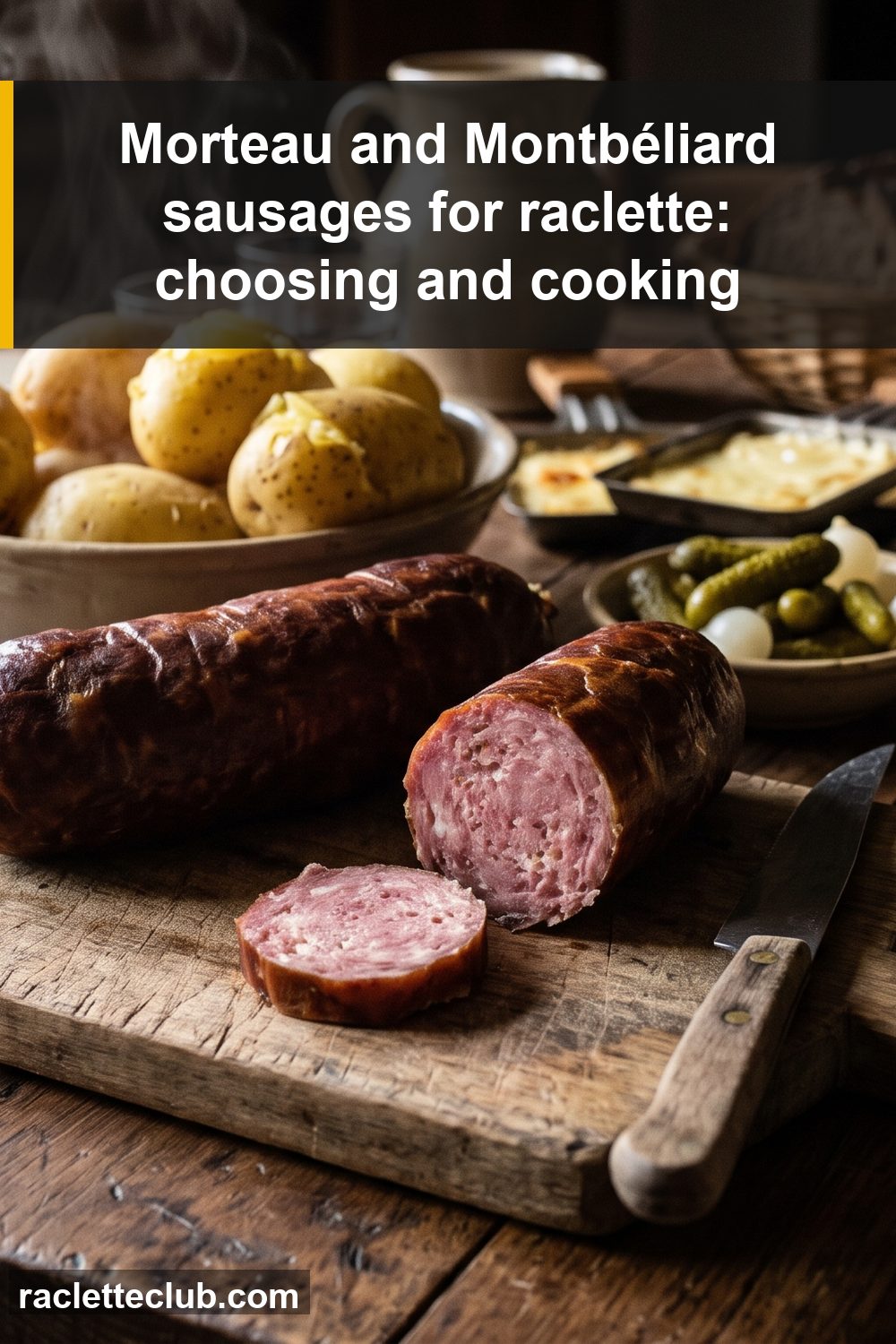
In short: Saucisse de Morteau and Saucisse de Montbéliard, two IGP sausages from Franche-Comté, turn a raclette into a real mountain meal. Morteau is recognizable by its wooden peg and its slow smoking over softwood. Montbéliard, slimmer, must be seasoned with cumin. Both are poached in water, starting from cold water, without pricking them. Diots de Savoie, on the other hand, are cooking sausages with no protected name. As a rule of thumb, plan on half a Morteau or one Montbéliard per person.
This article contains Amazon affiliate links: if you buy through these links, Raclette Club earns a small commission at no extra cost to you. Learn more.
Morteau, Montbéliard and diots: who’s who?
Saucisse de Morteau IGP
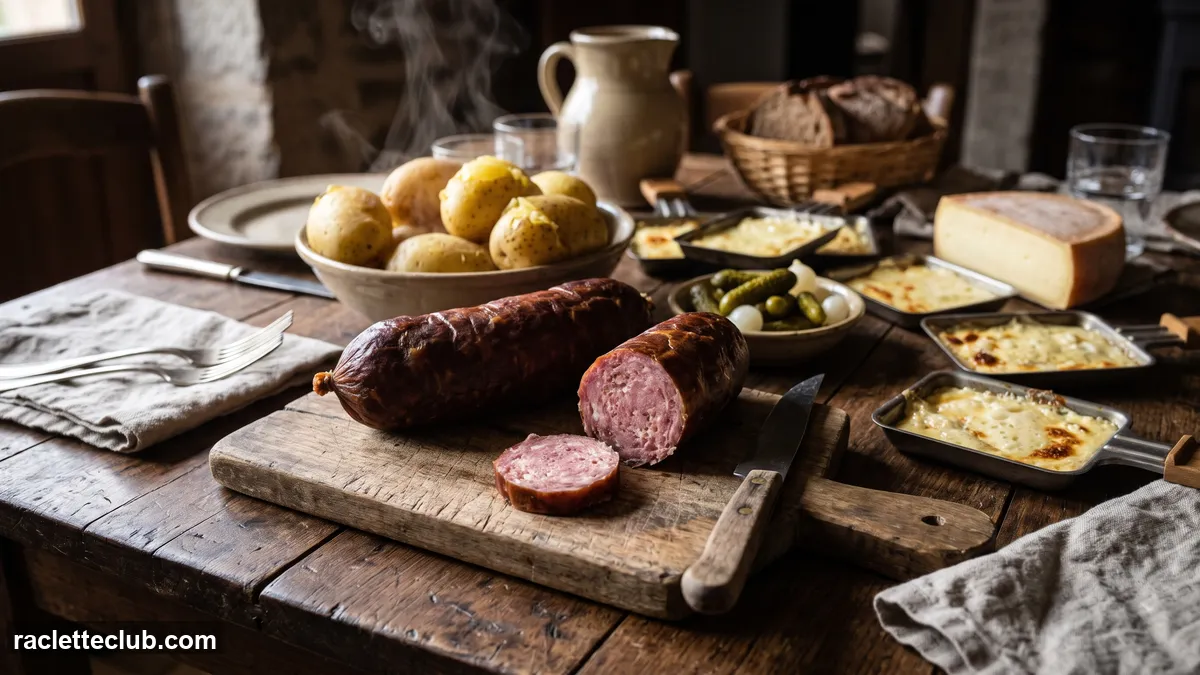
Recognized as an IGP in 2010, Saucisse de Morteau (and its giant version, Jésus de Morteau) is made in the Doubs, the Jura, Haute-Saône and the Territoire de Belfort. Its specifications are precise: coarsely ground pork, a natural pork casing closed at one end with a wooden peg and at the other with natural-fiber string, and a minimum diameter of 34 to 40 mm depending on weight. The pigs are fed dairy products, including whey from cheese dairies, for 15 to 35% of the dry matter in their fattening diet. Smoking is done slowly with softwood sawdust and wood: in a tuyé, the big chimney of Franche-Comté farmhouses, it lasts at least 24 to 48 hours depending on the case, and never more than 7 days. The color is amber, between brown and golden.
Saucisse de Montbéliard IGP
Registered as an IGP at EU level in 2013, Montbéliard is Morteau’s little sister. It’s slimmer, shorter, slightly curved, and its seasoning must include pepper and cumin. Gault&Millau notes that it’s smoked in a tuyé, over softwood sawdust. It’s the ideal sausage if you want individual portions.
Diots de Savoie
Diots are typical Savoie sausages, usually pork, sometimes with veal, according to the Haute-Savoie tourist office. They aren’t in the EU’s eAmbrosia register of protected names, so there’s no common specification. They’re traditionally cooked in Savoie white wine, with onions, and served with polenta or potatoes.
| Saucisse de Morteau | Saucisse de Montbéliard | Diots de Savoie | |
|---|---|---|---|
| Status | IGP (2010) | IGP (2013) | No protected name |
| Area | Doubs, Jura, Haute-Saône, Territoire de Belfort | Franche-Comté | Savoie |
| Distinctive feature | Wooden peg, large diameter | Slim, curved, with cumin | Pork sausage, sometimes with veal |
| Smoking | Slow, softwood and sawdust | Softwood sawdust | No common rule |
| Cooking | Poached 30 to 45 min | Poached 20 to 25 min | Simmered in white wine |
On the Swiss side, Saucisson vaudois IGP is a cold-smoked cousin, eaten cooked with traditional dishes or dry with bread, according to the Swiss AOP-IGP Association.
Why they go with raclette
Smoked sausage brings what cold cured meats don’t: warmth, juiciness and a real smoky aroma. Sliced into rounds and laid on the potato before the cheese, it makes a complete, hearty dish. INAO even notes that Morteau goes nicely with cancoillotte, another Franche-Comté cheese specialty: proof that it loves melted cheese. To our taste, it pairs very well with a blend of Morbier, a Franche-Comté match, or with a Raclette de Savoie IGP. With a smoked raclette, watch out for smoke overload: a plain cheese is more balanced.
How to choose them
- The wooden peg: it’s required by the IGP for Saucisse de Morteau, with light-colored natural string at the other end. Clips are banned.
- The IGP logo: it guarantees the production area, the pigs’ diet and the smoking.
- Raw or cooked: Morteau can be sold raw or already cooked, whole or sliced, according to its specifications. Read the label: the cooking time isn’t the same.
- For diots: with no protected name, rely on the ingredient list and your butcher.
How much to plan and how to cook them
Our team’s benchmark: one Saucisse de Morteau for two people, or one Montbéliard per person, if it comes with a platter of cold cured meats. If it’s the only meat, plan on one Morteau for two big appetites, even if it means leftovers. As a reminder, Santé.fr recommends limiting cured meats to 150 g per week.
- Morteau: put it in a pot of cold water, heat until it’s just simmering without ever boiling, and cook for 30 to 45 minutes, according to tips published by the Franche-Comté news site macommune.info. Don’t prick it, or it will lose its smoky flavor.
- Montbéliard: same principle, always starting cold to keep the casing from bursting, and 20 to 25 minutes of cooking, without pricking.
- Diots: the Savoyard recipe browns them, then simmers them in white wine with onions. Like any sausage sold raw, they must be cooked all the way through.
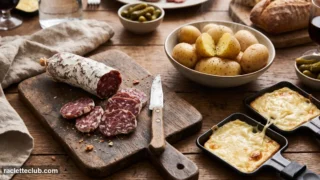
- At the table: slice into one-centimeter rounds, keep them warm, and let everyone lay some on their potato. A turn on the top plate browns them nicely.
Safety: France’s national health insurance (ameli.fr) recommends cooking meat thoroughly, especially if it’s ground, which is the case for sausages. For a sausage sold raw, don’t skip the full cooking step. During pregnancy, a sausage that’s well cooked and served hot is the safest option on the charcuterie platter.
Which wine to serve with smoked sausages?
Smoke calls for fresh, fruity wines. For diots, the Haute-Savoie tourist office suggests an Apremont: our Apremont guide tells you everything. For Morteau and Montbéliard, a white from Savoie like Chignin, or a light red like Gamay from Savoie or Pinot Noir, make very good companions in our opinion.
In the pantry
Back to the raclette pantry. To round out the table, read our guides to cooked ham, saucisson sec and coppa, pancetta and speck.
Frequently asked questions
How long do you cook a Saucisse de Morteau?
Start in cold water, then 30 to 45 minutes in water that simmers without boiling, depending on the size. Don’t prick it.
What’s the difference between Morteau and Montbéliard sausage?
Morteau is straight, large, closed with a wooden peg and slowly smoked over softwood. Montbéliard is slimmer and curved, and its seasoning must include cumin and pepper. Both are IGPs from Franche-Comté.
Are diots de Savoie an IGP?
No, they aren’t in the EU’s eAmbrosia register. They’re pork cooking sausages, traditionally cooked in Savoie white wine.
How many sausages should you plan per person?
Our benchmark: one Saucisse de Morteau for two people, or one Montbéliard per person, with a platter of cold cured meats on the side.
Sources
- French Ministry of Agriculture: Saucisse de Morteau / Jésus de Morteau IGP specifications (2017, in French)
- INAO: Saucisse de Morteau or Jésus de Morteau fact sheet (in French)
- European Commission: eAmbrosia register of geographical indications
- Gault&Millau: how to recognize Saucisse de Montbéliard (in French)
- macommune.info: how to cook Saucisse de Morteau properly (October 2023, in French)
- macommune.info: cooking tips for Saucisse de Montbéliard (January 2023, in French)
- Haute-Savoie Tourism: diots in white wine with polenta (in French)
- Swiss AOP-IGP Association: Saucisson vaudois IGP (in French)
- French national health insurance: bacterial infections during pregnancy (in French)
- Santé.fr: limiting cured meats to protect your health (in French)