In short: cooked ham is the crowd-pleaser of raclette cured meats, the one kids ask for and grandparents approve of. To choose it well, read the label: “supérieur” is the best of the three categories in France’s charcuterie code of practice, with no polyphosphates or gelling agents and no more than 1% sugar. Terms like “au torchon” or “à l’ancienne” don’t require anything in particular. As a rule of thumb, plan on one to two slices per person if it shares the platter with other cured meats.
This article contains Amazon affiliate links: if you buy through these links, Raclette Club earns a small commission at no extra cost to you. Learn more.
What is cooked ham (jambon blanc)?
Jambon blanc, or cooked ham, comes from the pig’s hind leg, salted and then cooked. Unlike cured ham, it isn’t dried: cooking is what makes it ready to eat. In France, its quality is governed by the Code des usages de la charcuterie (the charcuterie code of practice), which defines three categories, in ascending order: standard, choix (choice) and supérieur (superior).
According to the consumer association CLCV, “choix” and “supérieur” hams must be made from the noix, a defined group of thigh muscles. Added sugar can reach 3% in standard, 2% in choix and 1% in supérieur. According to Que Choisir, supérieur allows 5 additives, versus 11 for choix and 12 for standard, and it bans polyphosphates, gelling agents and surface caramel. Standard, which allows blood proteins for example, is rarely found in stores. The Label Rouge goes further, with stricter limits on additives, fat and sugar.
| Label term | Maximum added sugar | What’s banned or allowed |
|---|---|---|
| Standard | 3% | Polyphosphates, gelling agents and blood proteins allowed |
| Choix | 2% | Polyphosphates and caramel allowed, gelling agents banned |
| Supérieur | 1% | Polyphosphates, gelling agents and surface caramel banned |
| Label Rouge | Stricter | Additives, fat and sugar even more limited |
Why cooked ham belongs at a raclette
It won’t set off fireworks at a tasting, but it has two precious qualities on raclette night. First, to our taste, it’s milder than cured ham or saucisson, which makes it the cured meat for kids and cautious palates. Second, it handles heat very well. A slice slipped into the cheese pan under the cheese, or rolled around a potato before being smothered, gives you a croque-monsieur-style raclette. To our taste, it goes with every cheese, and especially with a blend of Tomme de Savoie or Morbier, milder than pure raclette.
How to choose your cooked ham
- The category: aim for “supérieur”, or Label Rouge if your budget allows. Que Choisir estimates that supérieur accounts for more than 70% of the market: so it’s not hard to find.
- Recipe terms: “au torchon” (cloth-wrapped), “au bouillon” (in broth) or “à l’ancienne” (old-fashioned) don’t guarantee any particular quality standard, Que Choisir points out.
- “Nitrite-free” claims: read the rest of the label. Some hams replace nitrite with nitrate-rich vegetable broths, which turn into nitrites, or with plant extracts. Truly nitrite-free hams with no substitute are gray, and Que Choisir says they keep for 24 hours after opening.
- Rind on or off: a “découenné” ham has had its rind and top layer of fat removed. For raclette, since the cheese already brings the fat, that’s our choice.
How much to plan and how to serve it
Our team’s benchmark: 100 to 150 g of cured meats in total per adult. If the cooked ham shares the platter with cured ham and saucisson, one to two slices per person are enough, a little more for kids who eat nothing else. Santé.fr recommends limiting cured meats to 150 g per week, or about 3 slices of cooked ham, and advises favoring cooked ham and poultry ham among cured meats.
ANSES confirms a link between exposure to nitrites and nitrates and the risk of colorectal cancer, and notes that cured meats provide more than half of our exposure to nitrites. All the more reason to make it a party treat, not an everyday habit.
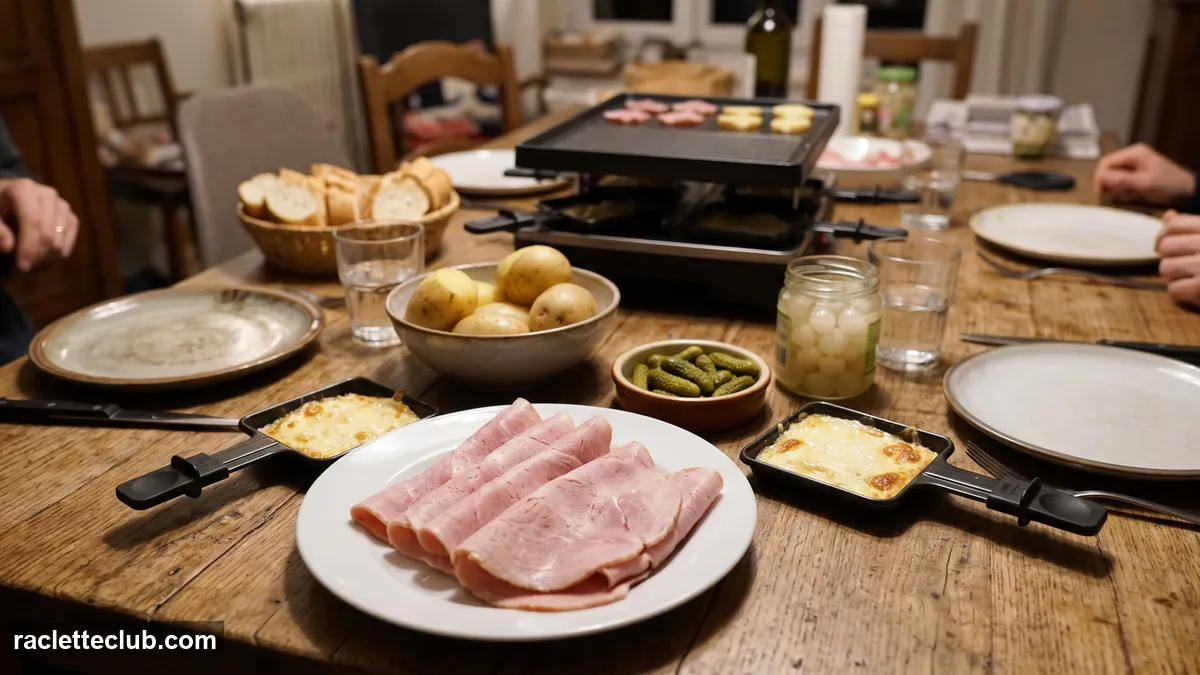
For serving, roll the slices into cigars on a plate or cut them into strips for the cheese pan. Keep the ham in the fridge until it’s time to sit down, and put the leftovers away right after.
Pregnant women: France’s national health insurance (ameli.fr) lists cooked ham among the cooked charcuterie to avoid during pregnancy, because of listeriosis. It generally advises choosing pre-packed products over those sliced at the counter, and eating them soon after purchase.
Which wine to serve with cooked ham?
Cooked ham doesn’t call for a great wine, but it likes fresh, fruity ones. An Apremont or a Chignin from Savoie bridges the gap with the cheese. For red, a light Beaujolais served cool remains our simplest pairing. And for kids and designated drivers, sparkling apple juice does the job just fine.
In the pantry
Back to the raclette pantry. To vary the platter, read our guides to cured ham, saucisson sec and Morteau and Montbéliard sausages.
Frequently asked questions
What’s the difference between “supérieur” and “choix” ham?
Supérieur ham bans polyphosphates, gelling agents and surface caramel, and limits added sugar to 1%. Choix ham allows polyphosphates and caramel, and up to 2% sugar.
How much cooked ham should you plan per person for a raclette?
Our benchmark: one to two slices per person if it’s served with other cured meats, within a total of 100 to 150 g of cured meats per adult.
Is “nitrite-free” ham really nitrite-free?
Not always. According to Que Choisir, some use nitrate-rich vegetable broths that turn into nitrites. Truly nitrite-free hams with no substitute are gray and keep for 24 hours after opening.
Is cooked ham not recommended for pregnant women?
France’s national health insurance lists cooked ham among the cooked charcuterie to avoid during pregnancy, because of listeriosis, and advises choosing pre-packed products.
Sources
- Que Choisir: cooked ham buying guide (in French)
- CLCV: comparison sheet for cooked hams (in French)
- ANSES: reducing dietary exposure to nitrites and nitrates (July 2022)
- Santé.fr: limiting cured meats to protect your health (in French)
- French national health insurance: bacterial infections during pregnancy (in French)