In short: air-dried beef is beef that’s salted and then dried in the air, never smoked. The two big Swiss protected names are Viande des Grisons IGP (Bündnerfleisch) and Viande séchée du Valais IGP. The key difference: Viande séchée du Valais must come from cattle born, raised and slaughtered in Switzerland, while the Graubünden specifications don’t require Swiss beef. Cut into almost see-through slices, it brings a lean, spiced note to the raclette platter that makes a change from pork.
This article contains Amazon affiliate links: if you buy through these links, Raclette Club earns a small commission at no extra cost to you. Learn more.
Bündnerfleisch and Valais air-dried beef: what they are
The principle is the same in both cantons: fine cuts of beef round, trimmed, salted with spices, then air-dried for weeks. A noble mold forms on the surface during drying (in Graubünden, the specifications require it to be removed before packaging). That’s where the similarities end.
Viande des Grisons (Bündnerfleisch) has been registered as an IGP in Switzerland since 1999. Its specifications require salting, drying and pressing in the canton of Graubünden, exclusively air-drying for at least four weeks, and repeated pressing that gives it its rectangular shape. It’s never smoked. However, the text doesn’t require the beef to be Swiss. A report by Swiss TV channel SRF (2016) explained that about two thirds of production then used imported meat, mostly for export.
Viande séchée du Valais has been an IGP since 2002. Here, the cattle are born, raised, slaughtered and cut up exclusively in Switzerland, and salting, drying and curing take place in the Valais. The pieces rest 1 to 5 weeks in salt, spices and herbs, then dry for 5 to 16 weeks depending on their size. They lose 40 to 50% of their weight. It can be pressed, but never smoked, and its shape is round or rectangular.
| Viande des Grisons IGP | Viande séchée du Valais IGP | |
|---|---|---|
| Raw material | Beef round | Beef round |
| Origin of the beef | Not required by the specifications | Swiss only |
| Drying | Air-dried, 4 weeks minimum, repeated pressing | 5 to 16 weeks depending on the cut |
| Smoking | Never | Never |
| Shape | Rectangular | Round or rectangular |
| Flavor | Pronounced aroma, spices and drying | Aromatic and spiced, beefy |
The Valais also has its Lard sec du Valais IGP (2015): Swiss pork belly, salted, dried for at least 4 weeks and never smoked. It’s the fatty cousin of air-dried beef, and it fits perfectly next to it on the board.
Why it goes with raclette
After three pans of cheese, everyone is looking for a little lightness. Air-dried beef is very lean and firm, with notes of spice and drying. It works as a counterpoint: the cheese brings the fat, the beef brings the chew and the salt. It’s also the most obvious terroir pairing for a Raclette du Valais AOP, since you stay in the same canton. In our opinion, it also goes well with an Appenzeller or a Vacherin Fribourgeois in a blend.
How to choose it
- The exact name: “Viande séchée du Valais” and “Viande des Grisons” (or “Bündnerfleisch”) are protected in Switzerland. A plain “air-dried beef” with no place name doesn’t follow any particular specification.
- The origin of the beef: for Bündnerfleisch, check where the meat comes from on the package if Swiss origin matters to you. For Viande séchée du Valais, it’s Swiss by definition.
- Thin slicing: that’s the golden rule. Too thick, and it turns into shoe leather. The slices should be almost translucent.
- The look: dark red, even flesh, with no dark or dried-out areas at the edge of the slices.
How much to plan and how to serve it
Our team’s benchmark: 100 to 150 g of cured meats in total per adult for a raclette. Since air-dried beef is very dense and sliced very thin, 30 to 40 g per person is enough when it comes with other cured meats. As a reminder, Santé.fr advises limiting cured meats to 150 g per week: enjoy it on raclette night, and go easy the rest of the week.
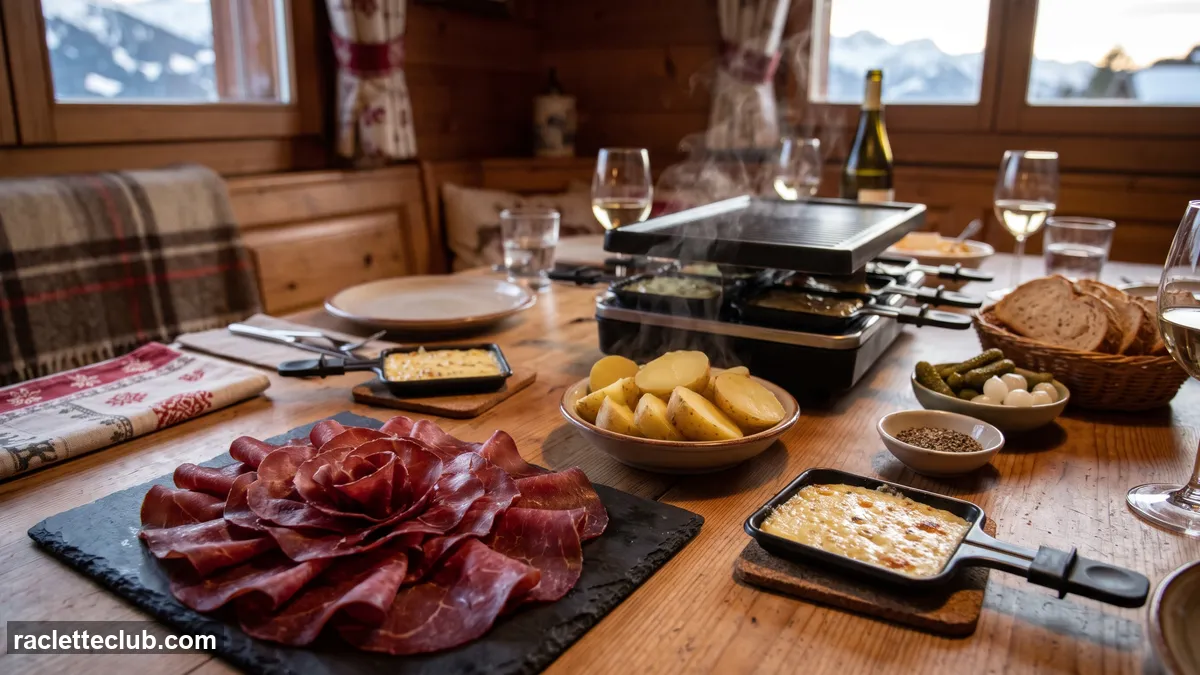
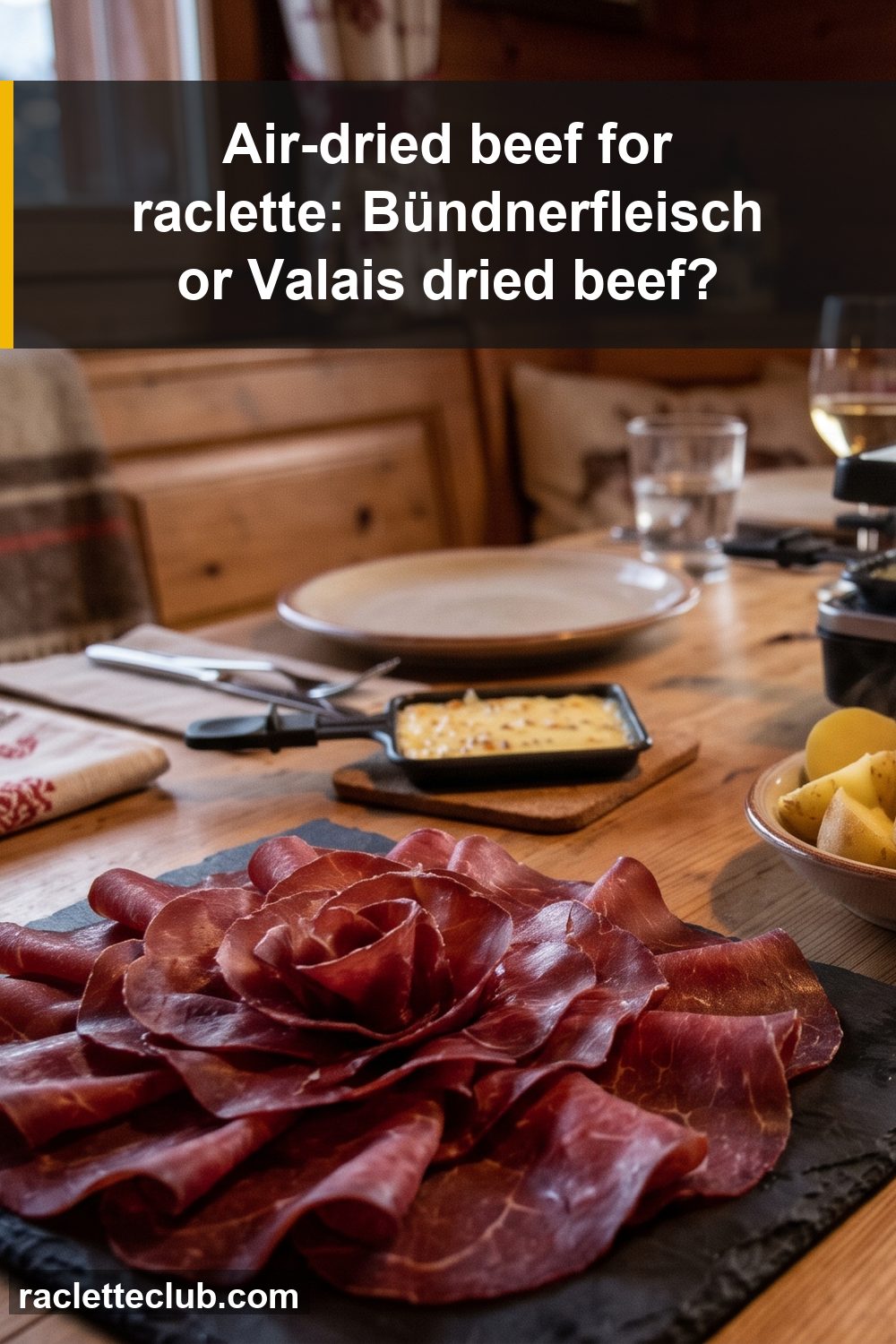
Serve it cold, on the platter, never on the grill plate: in the heat, it shrinks and hardens. Arrange the slices in rosettes, without overlapping them. A slice of air-dried beef rolled around a cornichon or a pickled onion is our little treat between two pans.
Pregnant women: air-dried beef is raw meat. France’s national health insurance (ameli.fr) asks that raw meat be avoided during pregnancy and that raw charcuterie be cooked thoroughly before eating, because of listeriosis. So it’s best to skip it and fall back on cured meats you cook yourself.
Which wine to serve with air-dried beef?
Let’s stay in the Valais. A fresh Fendant goes with the air-dried beef and the raclette in one sweep. If the table prefers red, a light Pinot Noir, why not a Dôle, has enough fruit for the spices without turning harsh with the salt. For rosé lovers, Œil-de-Perdrix also makes a lovely regional pairing. These are table opinions.
In the pantry
Back to the raclette pantry. To put together the rest of the platter, see our guide to cured ham, the one on saucisson sec and the one on coppa, pancetta and speck.
Frequently asked questions
What’s the difference between Bündnerfleisch and Valais air-dried beef?
Both are beef salted and air-dried, never smoked, under a Swiss IGP. Viande séchée du Valais must come from Swiss cattle and dries for 5 to 16 weeks. Bündnerfleisch is pressed into a rectangular shape and dries for at least four weeks, but its specifications don’t require Swiss beef.
Is Bündnerfleisch smoked?
No. Its specifications state that it is preserved only by salt and drying, and that it is never smoked. Same rule for Viande séchée du Valais.
How much air-dried beef should you plan per person?
Our benchmark: 30 to 40 g per person when it comes with other cured meats, within a total of 100 to 150 g of cured meats per adult.
Can you eat air-dried beef while pregnant?
It’s raw meat. France’s national health insurance asks that raw meat be avoided during pregnancy, because of listeriosis. So it’s best to go without.
Sources
- Swiss Federal Office for Agriculture (FOAG): Viande des Grisons IGP specifications (in French)
- Viande séchée du Valais IGP specifications (in French)
- Swiss AOP-IGP Association: Viande séchée du Valais IGP (in French)
- Swiss AOP-IGP Association: Lard sec du Valais IGP (in French)
- SRF Kassensturz: Bündnerfleisch and imported meat (January 2016, in German)
- French national health insurance: bacterial infections during pregnancy (in French)
- Santé.fr: limiting cured meats to protect your health (in French)