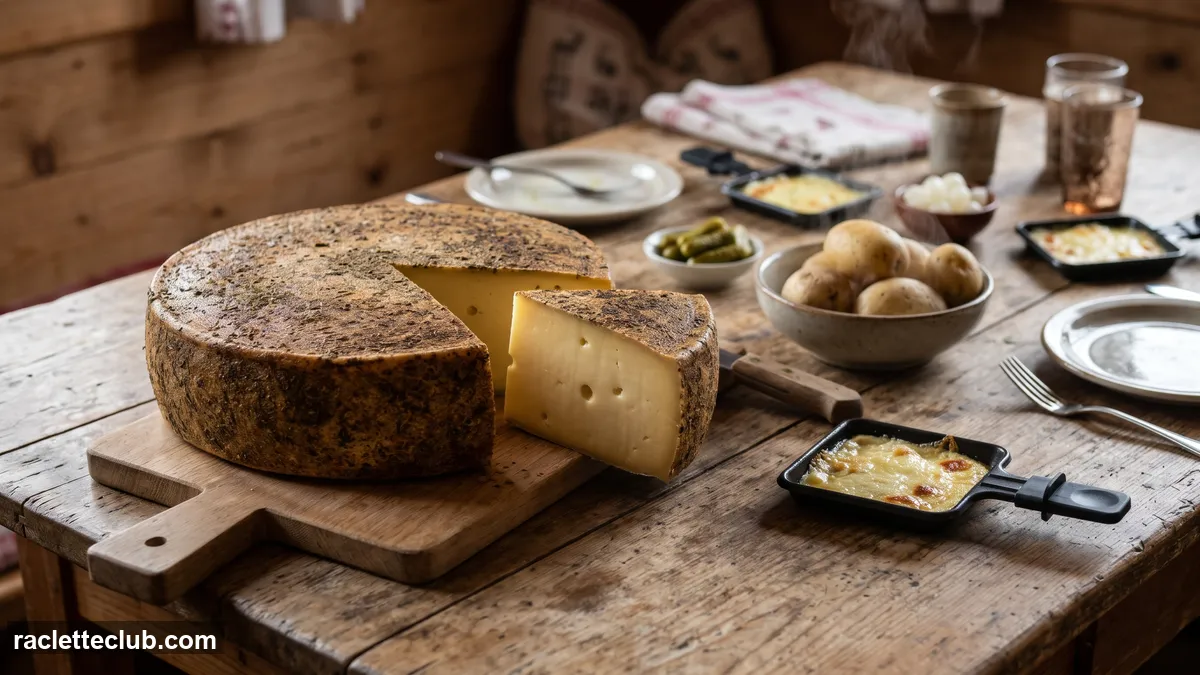
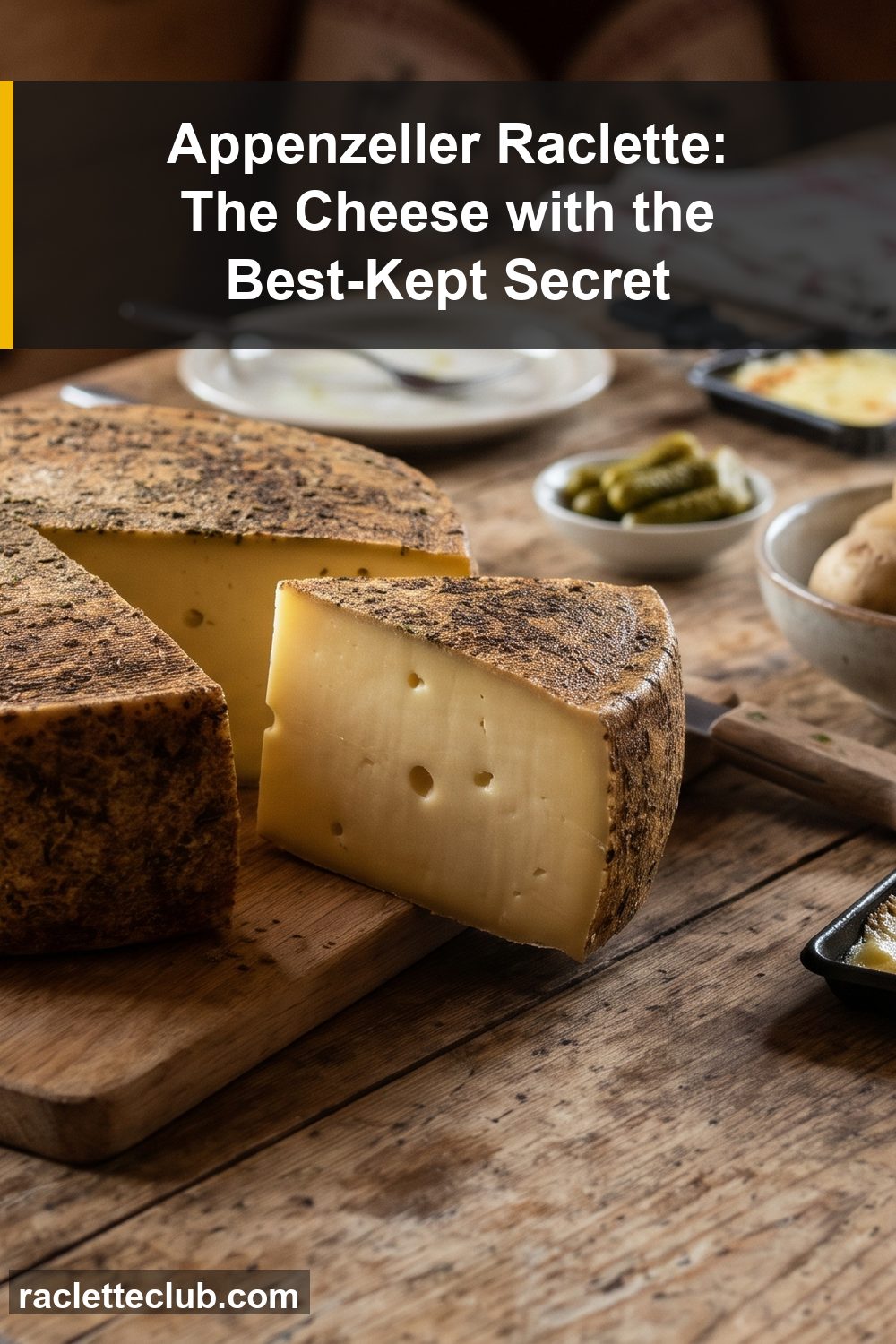
In short: Appenzeller is a semi-hard cheese from eastern Switzerland, brushed during aging with an herb brine whose recipe remains secret. In raclette, it adds a spicy note that wakes up evenings that are a little too well-behaved.
Fact sheet checked on 11/02/2026 against the official websites of producers and trade associations. Do you make this cheese? Write to us to be listed in the directory.
Fact sheet: Appenzeller
| Country | Switzerland |
|---|---|
| Region | Appenzell (Inner and Outer Rhodes), partly St. Gallen and Thurgau (trade association) |
| Designation | no PDO; protected Appenzeller® trademark managed by the trade association (Sortenorganisation Appenzeller Käse GmbH), active since 1942 |
| Milk | cow, raw, from cows fed on grass and hay (no silage) |
| Paste | pressed, semi-hard |
| Aging | at least 3 months, brushed 2 to 3 times a week with the herb brine (Sulz); Mild 3 months, Surchoix 4 to 5 months, Extra 6 months minimum, Refined 9 to 12 months |
| Size | round wheel 30 to 33 cm in diameter, 7 to 9 cm high, 6.7 kg on average (trade association) |
| Taste | fruity (Mild) to full-bodied (Extra, Refined) |
| Melt | 4/5: melts well in thin slices over moderate heat, but turns oily if heated too hard or too long |
Its history
Appenzell cheese is said to be more than seven centuries old: Wikipedia cites a document from 1282 that already mentions it. It is born in the green hills at the foot of the Alpstein, between Lake Constance and the Säntis, where the cows graze while the locals jealously guard their secrets. The most famous of them is the Sulz, a brine made from plants, herbs and spices whose recipe, according to the trade association, is known by only two people, passed down from generation to generation. Even the cheesemaker doesn’t know exactly what he’s brushing on, which must make for tricky conversations at the café. Since 1942, the trade association has watched over the brand, checked the origin and promoted the cheese. Today it brings together nearly 800 milk producers and about forty dairies. Since 1996 its headquarters have been in the Salesis house, on Appenzell’s Post Office square, a building rebuilt after the village fire of 1560.
Taste and melt: what happens in the raclette pan
On the palate, Appenzeller is a cheese that speaks loudly. The herb brine leaves spicy, almost peppery aromas on the rind, which carry through into the paste. The Mild, silver label, aged three months, stays round and aromatic. The Surchoix, gold label, four to five months, is more full-bodied but supple. The Extra, black label, at least six months, has a power that leaves nobody indifferent, and the Refined, purple label, nine to twelve months, may even hide small crystals. In raclette, the cheese melts well if it is cut thinly and heated at a moderate temperature: the trade association recommends taking it off when it turns creamy, before it releases its oil. It doesn’t have the stretch of a classic raclette cheese, but it makes up for it in flavor. What sticks with you: a pan of Appenzeller between two pans of plain raclette is like a guitar solo in the middle of a waltz.
On the nose and palate: aromatic and spicy, notes of herbs and dried fruit; mild and round in the Mild, more powerful in the Surchoix and Extra
How to serve it
Plan on 150 to 200 g of Appenzeller per person, or mix it half and half with a milder raclette cheese to go easy on sensitive palates. Cut thin slices, 2 to 3 mm, for an even melt. In the raclette pan, medium heat is enough: take it off as soon as the surface is smooth and creamy. The trade association points to an Appenzeller designed specially for raclette and presents the Extra as a good alternative for cheese lovers. As for sides, go for firm steamed potatoes, gherkins, sweet onions, raw ham or sausage. Fruit, apple or pear in slices, softens the spicy side. For drinks, a dry Chasselas, a Sauvignon Blanc or a light Pinot Noir will do, according to the trade association.
Pairings
- Wines: dry Chasselas, Swiss Sauvignon Blanc, light Pinot Noir from eastern Switzerland, local lager
- On the table: firm steamed potatoes, tangy gherkins, sweet onions, raw ham or sausage, apples and pears
Our recipes with this cheese
- Traditional raclette, the basic recipe
- The homemade raclette burger
- Raclette-style toasted open sandwiches
How much should you plan? Our guide to raclette cheese quantities per person does the math, and our comparison of the best raclette cheeses sets it against the others.
Appenzeller producers: the directory
Four families of producers, from the giants to the small alpine dairies. Contact details taken from their official websites; logos are shown from those sites, with credit.
The best known
The brands you come across in stores.

Appenzeller Schaukäserei AG
Stein (AR), Switzerland
Appenzeller show dairy, open 364 days a year, where you can watch the cheese being made every day until 3 p.m., with a shop and restaurant.
- Address: Dorf 711, CH-9063 Stein (AR), Switzerland
- Phone: +41 71 368 50 70
- Email: info@schaukaeserei.ch
- Website: schaukaeserei.ch
- Contact: form
- Social media: Facebook · Instagram · YouTube · LinkedIn
Logo: © Appenzeller Schaukäserei AG, shown from its official website.
The most renowned
Medal winners, prize winners or renowned affineurs, with a sourced award.

Appenzeller Milchspezialitäten AG
Schönengrund, Switzerland
Dairy modernized in 2014, processing about 30,000 kg of milk a day, whose Appenzeller edel-würzig was crowned best in its category.
- Address: Hauptstrasse 48, 9105 Schönengrund, Switzerland
- Phone: +41 71 360 02 11
- Website: chaeserei.ch
- Award: Winner at the Swiss Cheese Awards 2026, Appenzeller category (Sämi Mani) (source: https://www.cheese-awards.ch/fileadmin/Switzerland/SCA_2026/Gewinner_SCA_2026_def_261013.pdf)
Logo: © Appenzeller Milchspezialitäten AG, shown from its official website.

Traber Käse AG
Kirchberg SG, Switzerland
St. Gallen dairy that makes its own Appenzeller from about 3 million kg of silage-free milk a year.
- Address: Seefeldstrasse 10, 9533 Kirchberg SG, Switzerland
- Phone: +41 71 931 11 88
- Email: traberkaese@bluewin.ch
- Website: traberkaese.ch
- Contact: form
- Award: Diplomas at the Swiss Cheese Awards 2026 in the Appenzeller category and for its Appenzeller® Rahmkäse (Lucas Meier) (source: https://www.cheese-awards.ch/fileadmin/Switzerland/SCA_2026/Gewinner_SCA_2026_def_261013.pdf)
Logo: © Traber Käse AG, shown from its official website.
Small local producers
Farms, alpine pastures and village dairies.

Käserei Niederbüren AG
Niederbüren, Switzerland
Village dairy that makes Appenzeller with milk delivered daily by its farmers and ages it for several months in its aging room.
- Address: Staatsstrasse 52, CH-9246 Niederbüren, Switzerland
- Phone: +41 71 420 96 40
- Email: info@kaeserei-niederbueren.ch
- Website: kaeserei-niederbueren.ch
- Contact: form
- Award: Diploma at the Swiss Cheese Awards 2026, Appenzeller category (Kevin Rieser) (source: https://www.cheese-awards.ch/fileadmin/Switzerland/SCA_2026/Gewinner_SCA_2026_def_261013.pdf)
Logo: © Käserei Niederbüren AG, shown from its official website.
Where to buy it
Appenzeller is found in most Swiss dairies and supermarkets, as well as at many cheesemongers in France and Germany. On site, the Salesis house in Appenzell and the show dairy in Stein sell the whole range. To recognize the real thing, look for the Appenzeller® brand and the color of the label, which indicates the aging: silver for the Mild, gold for the Surchoix, black for the Extra, purple for the Refined. Appenzeller has no PDO: its protection rests on the trademark and on the trade association’s origin checks. Beware of cheeses labeled “Appenzell-style” without the brand.
More addresses in our guide where to buy good raclette cheese.
Follow on social media
- Appenzeller (trade association), channel linked from appenzeller.ch (youtube)
- Appenzeller (trade association) (instagram)
- Appenzeller (trade association) (tiktok)
- Appenzeller (trade association) (facebook)
Vote for the best raclette cheese
One vote per person, no sign-up. The ranking is visible with “View ranking”.
Frequently asked questions
Can you use Appenzeller for raclette?
Yes, in thin slices and over moderate heat. The trade association publishes raclette tips and offers a version designed for this use.
What is in the secret brine?
The trade association describes a preparation of plants, herbs and spices, the Sulz, whose recipe is known by only two people.
What do the label colors mean?
Silver for the Mild (3 months), gold for the Surchoix (4 to 5 months), black for the Extra (at least 6 months), purple for the Refined (9 to 12 months).
Is Appenzeller a PDO?
No. It is protected by a registered trademark, Appenzeller®, and by the origin checks of its trade association.
Read also: all raclette cheeses, the secrets of a successful raclette and what is raclette?
Sources
- Trade association contact details, varieties, social media : appenzeller.ch
- Trade association since 1942, nearly 800 milk producers, about 40 dairies : appenzeller.ch/fr/portrait/interprofession
- Salesis house: headquarters since 1996, fire of 1560 : appenzeller.ch/fr/portrait/maison-salesis
- Labels and aging by variety : appenzeller.ch/fr/magazine/detail/bien-choisir-son-appenzell
- Raclette tips and pairings : appenzeller.ch/fr/magazine/detail/lappenzellerr-en-raclette-
- The secret brine (Sulz), two people, brushing 2 to 3 times a week : appenzeller.ch/fr/magazine/detail/sur-la-piste-du-secret-du-
- Document from 1282 : fr.wikipedia.org/wiki/Appenzeller
- Trade association fact sheet (area, raw milk, size) : cms.appenzeller.ch/…/APP_Factsheet_Demeter-Mild-Wuerzig
- Appenzeller® range (raw milk, Appenzeller for raclette 4 to 5 months) : cms.appenzeller.ch/…/Appenzeller_Range_DE-DE.pdf
- Swiss Cheese Awards 2026 results, Appenzeller category : cheese-awards.ch/fileadmin/Switzerland/SCA_2026/Gewinner_SCA
- Show dairy: appenzeller.ch/fr/portrait/fromagerie-de-demonstration