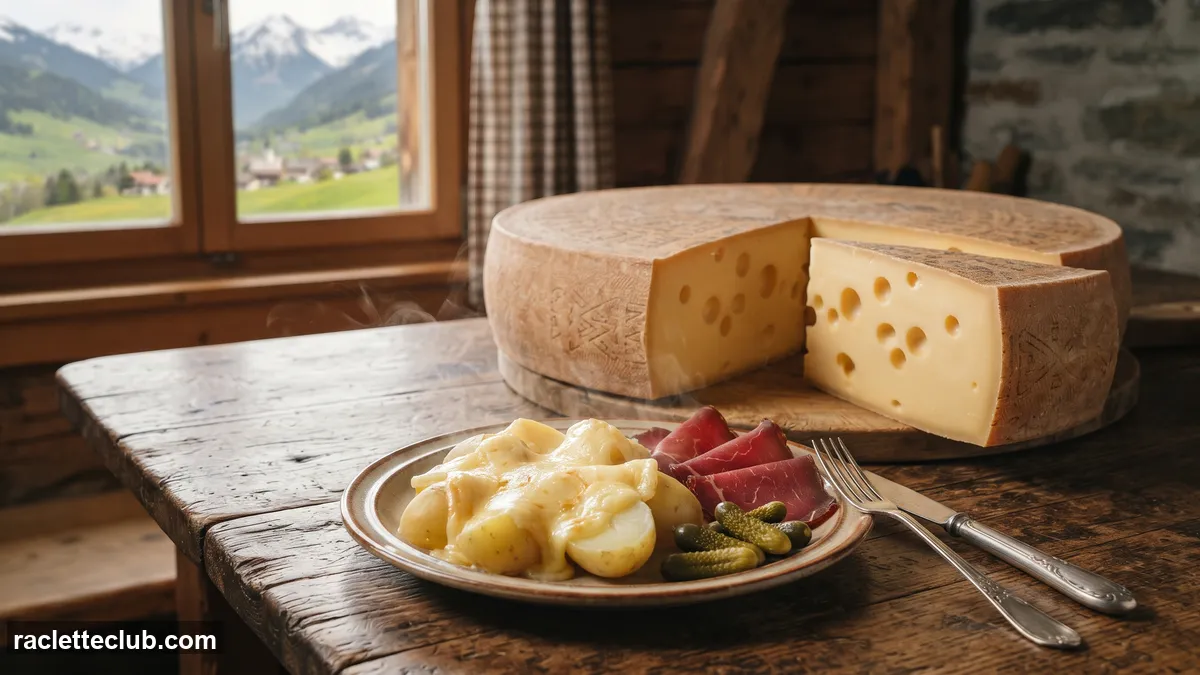
In short: Emmentaler AOP is the Swiss giant with the big holes, a 75 to 120 kg raw-milk wheel aged for at least 4 months, with a sweet-and-sour flavor. In France, two IGPs also protect Emmental: Emmental de Savoie and Emmental français est-central. All of them melt and stretch well, which is why they’re in Savoyard fondue. At a raclette, our honest take: Emmental alone makes a rather tame, very stringy raclette; blended with a raclette cheese, it adds body and mildness.
This article contains Amazon affiliate links: if you buy through these links, Raclette Club earns a small commission at no extra cost to you. Learn more.
Emmentaler AOP: ID card
| Criterion | Emmentaler AOP |
|---|---|
| Country | Switzerland |
| Region | Cantons of Aargau, Bern (excluding the Moutier district), Glarus, Lucerne, Schwyz, Solothurn, St. Gallen, Thurgau, Zug and Zurich, plus the Lake and Sense districts (Fribourg) (FOAG) |
| Designation | Swiss protected designation of origin, specifications held by the Federal Office for Agriculture; application summarized by FOAG in 2002 |
| Milk | Cow’s milk, raw, no silage, no heat treatment, delivered by farms no more than 30 km from the dairy (FOAG) |
| Paste | Hard, curd post-heated to 52 to 55 °C in a copper vat, propionic fermentation (FOAG) |
| Aging | 4 months minimum within the area; 8 months for labels such as “réserve” or “extra”; 12 months, including 6 in a cellar dug into rock, for “cave-aged” (FOAG) |
| Format | Wheel 80 to 100 cm in diameter and 75 to 120 kg, about 90 kg on average (FOAG) |
| Flavor | Sweet and sour, slightly salty, aromatic; round holes of 2 to 4 cm; pale yellow paste in summer, ivory in winter (FOAG) |
| Meltability | Good, elastic and stringy paste, a fondue classic in blends |
From the Emme valley to the whole world
Emmentaler takes its name from the Emmental valley, in the canton of Bern. According to the registration file published by FOAG, cheese has been made there since the 12th century, and the name “Emmentaler” first appeared in 1542 in a register in Langenthal. Originally made only in summer mountain pastures, it moved down to the lowlands with the first dairy in Kiesen, in 1813, then spread across German-speaking Switzerland from 1840, when exports also began.
And that unmistakable flavor? Alongside rennet and lactic bacteria, the specifications allow propionic bacteria, and it’s propionic fermentation that explains the sweet-and-sour taste, FOAG specifies. Emmentaler first ripens in a warm cellar, then in a cooler storage cellar. As for the big round holes of 2 to 4 cm, they’re part of its official description. No, it wasn’t the mice.
What about French Emmental?
Two French Emmentals have a protected geographical indication. Emmental français est-central IGP is a raw cow’s milk, cooked pressed cheese, in 80 kg wheels, aged at least 12 weeks in its region, with holes ranging from the size of a cherry to the size of a walnut (DRAAF Bourgogne-Franche-Comté). Emmental de Savoie IGP accounted for 2,800 tonnes, about 1.2% of the 230,000 tonnes of Emmental produced in France, and its producers started the process toward AOP status in 2022 (Réussir). The rest of the cheese aisle, Emmental without an IGP, isn’t covered by these specifications.
Flavor and melt: a good raclette cheese?
Emmental melts well and stretches a lot. That’s why it turns up in fondues: in Savoie, often “50-50 Beaufort and Emmental”, notes the French food guide Le Fooding, and Joseph Favre’s old fondue from Vaud, quoted in the white paper on mountain pressed cheeses, already paired Gruyère and Emmenthal. But it isn’t a raclette cheese: raclette cheeses are uncooked pressed cheeses, like Raclette de Savoie.
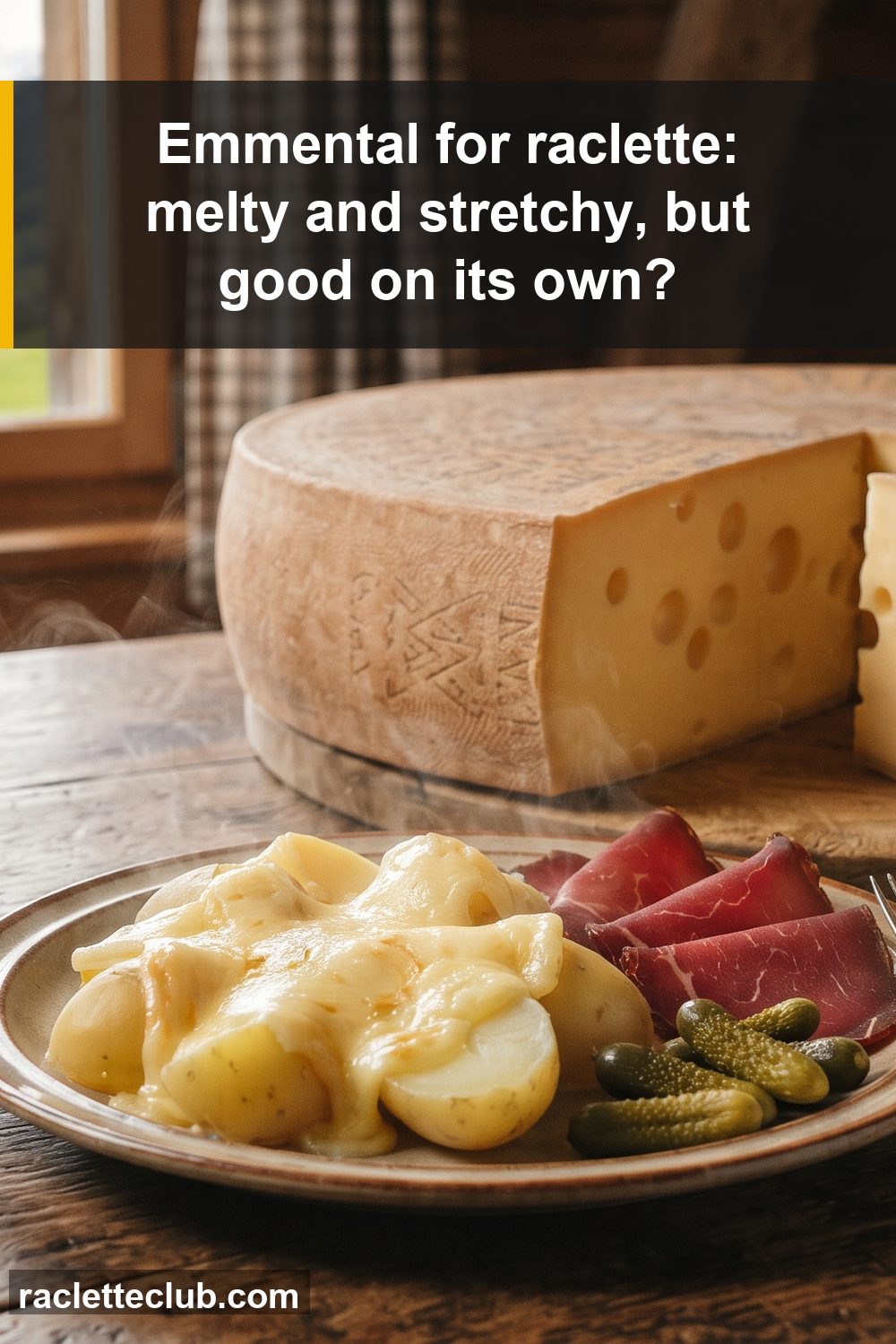
Under the machine, Emmental gives spectacular cheese pulls, and a mild flavor kids love. On its own, it’s to our taste a rather tame raclette, lacking the character of a Raclette du Valais AOP. Long-aged versions, “réserve” or “cave-aged”, are more aromatic but, like any aged cheese, they release fat more easily when melted, according to Cook’s Illustrated’s tests on old cheeses. Our verdict: blended, it’s perfect; alone, it will please palates that run from strong cheeses.
How to serve it at a raclette
- Quantity: our team’s benchmark is 200 g of cheese per person in total. One third Emmental is enough for body.
- For kids: a pan of Emmental alone, mild and stringy, avoids the faces pulled at a cheese with too much attitude.
- Blended: a slice of raclette, a sliver of Emmental on top. Or with a smoked raclette, which its mildness softens.
- In thin slices: thick Emmental melts slowly; thin slices melt at the same time as the raclette.
- On the board: a piece of long-aged Emmentaler AOP is lovely at the end of the meal.
Which wines go with Emmental
Mild cheese, light wines: that’s our rule. A Fendant from the Valais stays on Swiss soil and cleanses the palate. A Savoyard Apremont goes well with the “50-50” fondue version. And for a red, a fruity, supple Gamay from Savoie doesn’t upset the cheese’s mildness.
In the pantry
For the rest of the evening, head back to the raclette pantry. For mountain cheeses, also read our guides to Beaufort, its fondue partner, Le Gruyère AOP and Comté.
Frequently asked questions
Can you make raclette with Emmental?
Yes, it melts and stretches well, but on its own it gives a fairly mild raclette. In our opinion, it’s better blended with a raclette cheese, about one third Emmental.
What’s the difference between Emmentaler AOP and French Emmental?
Emmentaler AOP comes from Switzerland, made with raw milk and aged at least 4 months. In France, Emmental de Savoie and Emmental français est-central are IGPs; the latter is made with raw milk and aged at least 12 weeks.
Why does Emmental taste sweet and sour?
According to the Swiss specifications, this sweet-and-sour, slightly salty and aromatic taste comes from propionic fermentation during aging.
How much does a wheel of Emmentaler weigh?
From 75 to 120 kg, about 90 kg on average, for 80 to 100 cm in diameter, according to the Swiss specifications.
Sources
- FOAG: summary of the Emmentaler registration application (2002, in French)
- FOAG: Emmentaler AOP specifications (amended version, 2025, in French)
- DRAAF Bourgogne-Franche-Comté: Emmental français est-central IGP fact sheet (in French)
- Réussir: Savoie’s three IGP cheeses move toward AOP status (2022, in French)
- Le Fooding: a treatise on melted cheese (in French)
- Fromages & Chefs: white paper on mountain pressed cheeses (2016, in French)
- Cook’s Illustrated: why young cheese melts better than aged cheese