In short: Williams pear brandy (poire williams) is a brandy distilled from a single pear variety, the Williams. The Valais turned it into an appellation, “Eau-de-vie de poire du Valais AOP”, with very precise rules (40% ABV minimum, no flavoring or coloring). After a raclette, it brings the aroma of ripe fruit and real clarity. It won’t help you digest any faster, but it’s excellent company.
This article contains Amazon affiliate links: if you buy through these links, Raclette Club earns a small commission at no extra cost to you. Learn more.
Poire williams, Williamine, Valais pear brandy: who’s who?
Three names get passed around the table, and they’re not exact synonyms.
- “Williams”: under the EU regulation on spirit drinks, this name may only be used for a pear brandy made exclusively from pears of the Williams variety. A fruit brandy must be at least 37.5% ABV. It’s distilled all over the place, in Switzerland and elsewhere.
- “Eau-de-vie de poire du Valais AOP”: this is the Swiss protected designation of origin, registered in 2001 by the Federal Office for Agriculture. It sets its own, stricter rules (see below).
- “Williamine”: this is a brand, belonging to the Morand distillery in Martigny, which, according to Valais/Wallis Promotion, gave pear brandy its prestige. So it’s a brand name, not an appellation.
What the Valais AOP says
The specification for “Eau-de-vie de poire du Valais” (a 2001 decision by the Swiss Federal Office for Agriculture, amended in 2014 and 2020) leaves very little to chance:
- Everything happens in the Valais: growing the fruit, storage, fermentation, distillation and bottling.
- A single variety: the Williams pear, picked when it comes away easily from the branch, then ripened in crates until it’s yellow and juicy, without being overripe.
- Fermentation takes place between 15 and 25 °C (59 and 77 °F), and distillation must happen no later than the end of June of the year after the harvest.
- Distillation is done in a pot still; column stills are excluded. The distillation “heads” are separated, and the heart must average at least 60% ABV.
- In the bottle: at least 40% ABV, sweetening limited to 5 g/l, and no coloring or flavor enhancers.
- Resting in tank before bottling: three months minimum.
- A control tasting: aroma and purity, character and fruit, flavor and purity, harmony. A batch judged inadequate loses the right to the appellation.
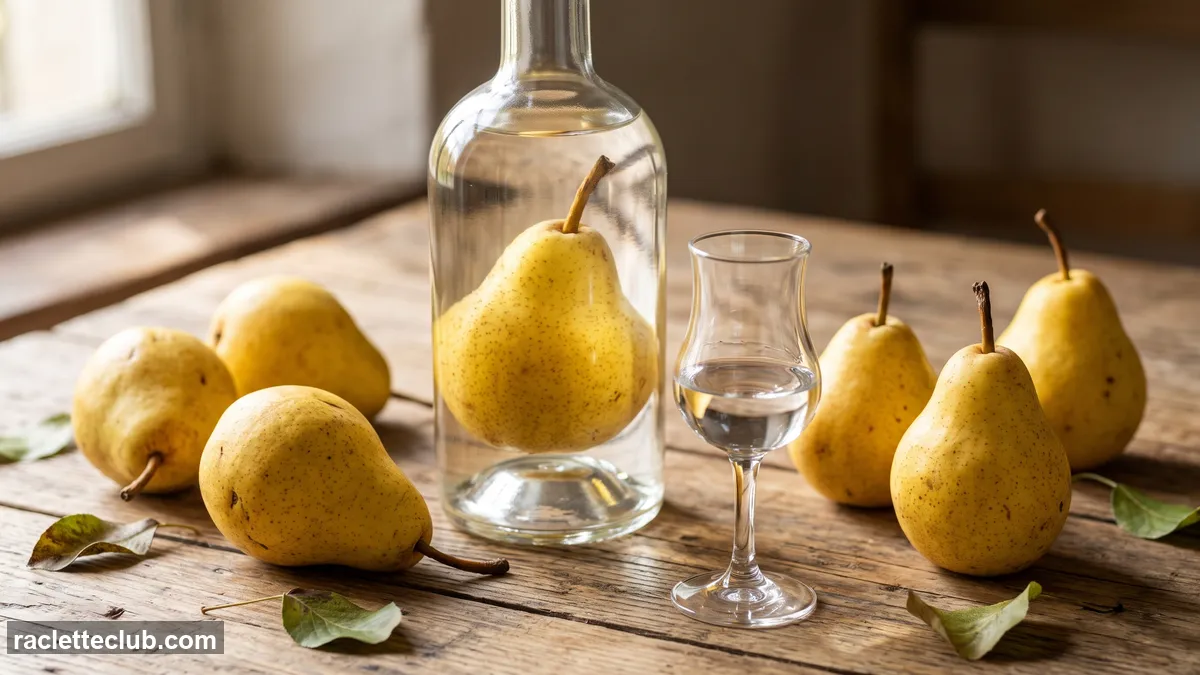
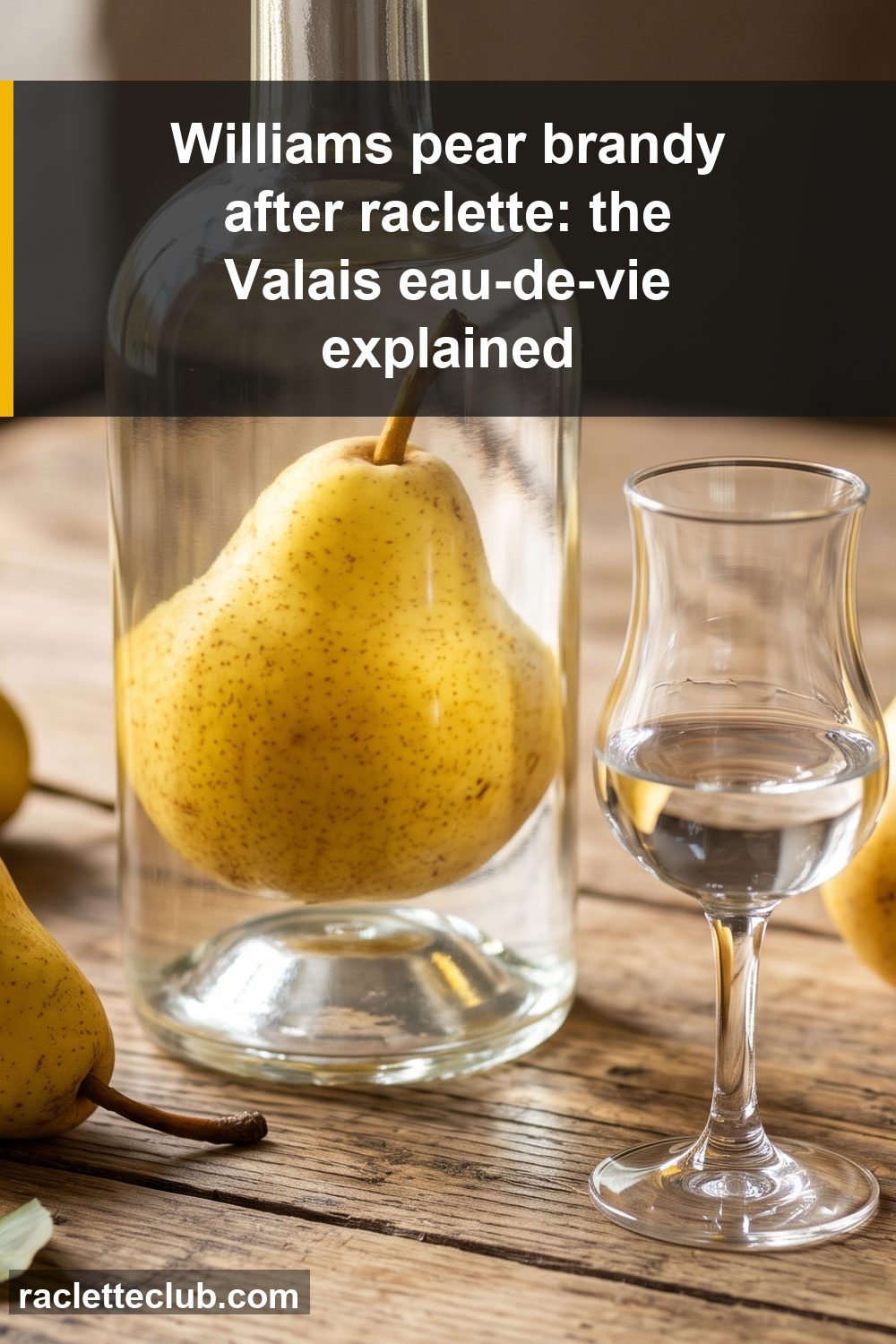
And the famous pear in the bottle? The specification explicitly allows it. No, it didn’t squeeze through the neck: in spring, the bottle is attached to the tree and the fruit grows inside it. It’s patience in glass form.
A bit of history
According to the Swiss AOP-IGP Association, the Williams variety was introduced in the Valais in the early 20th century, and a brandy made exclusively from Williams pears appeared in 1945. The original idea was to make good use of fruit that wasn’t pretty enough for the table. Today, production remains small: Valais/Wallis Promotion reports 14,440 liters of Eau-de-vie de poire AOP produced in 2024, and about 12 kg of fruit for one liter of brandy.
The taste
The specification puts it bluntly: an intense Williams pear flavor. The flaws it hunts for are notes that are too grassy, oily, rancid or oxidized. A good Williams pear brandy smells like ripe fruit eaten over the kitchen sink, with a dry palate (sweetening is limited), warmth, then a long, fragrant finish. In our opinion, it’s the fruitiest brandy in the family, the one that can win over guests who say they don’t like strong spirits.
Why after a raclette (and what science says)
Valais raclette, Fendant, Williams pear brandy: the trio has the merit of geographic consistency. After the melted cheese, the pear aroma and the dryness of the brandy refresh the palate. But let’s be frank about the “digestif” effect.
In 2008, a German team tested Williams pear brandy specifically (along with brandy, aquavit, an herbal liqueur and espresso) on ten healthy men after a hearty meal. The result: none of these digestifs sped up gastric emptying compared with water, and the feeling of heaviness didn’t change. What sped up emptying? A slow walk (4 km/h, about 2.5 mph, throughout the three hours of measurement), with no effect on that heaviness. In 2010, a Zurich study on fondue even observed slower digestion when alcohol was involved. So Williams pear brandy is a pleasure, not a medicine.
How to choose
- “Eau-de-vie de poire du Valais AOP” or “Eau-de-vie de poires Williams du Valais”: these are the label terms set out in the specification, along with the AOP logo.
- “Williams” on its own: the guarantee covers the variety (100% Williams), not the origin.
- The strength: at least 40% ABV for the AOP, 37.5% ABV for an ordinary fruit brandy.
- “Pear liqueurs”: these are different products, sweeter and less strong. Don’t mix them up if you’re after the real brandy.
Serving Williams pear brandy
The temperature: Valais/Wallis Promotion recommends serving Valais brandies between 8 and 12 °C (about 46 to 54 °F). Too cold, and it closes up; at heated-living-room temperature, the alcohol takes over. The glass: a small tulip glass, which concentrates the pear aroma, rather than a shot glass. The pour: one small glass, around 2 cl (about 2/3 oz), like the schnapps in the Zurich study. Sip it slowly; don’t knock it back.
Pairings
Valais/Wallis Promotion mentions Williams pear brandy as a digestif, with a sorbet, in a cocktail or in a cake. Our favorite trio to close a raclette: a pear sorbet with a splash of the brandy, a pear tart, or a square of dark chocolate with your coffee. It can also play the aperitif: the Morand distillery itself is nudging its brandies toward cocktails.
More raclette digestifs
Back to the complete guide to digestifs after raclette. More Valais and alpine brandies: our page on abricotine, our page on kirsch and our page on marc and grappa. For an alcohol-free option, head to our guide raclette and digestion.
Frequently asked questions
What’s the difference between poire williams and Williamine?
Poire williams is a pear brandy made only from the Williams variety. Williamine is a brand belonging to the Morand distillery in Martigny. The official Valais appellation is “Eau-de-vie de poire du Valais AOP”.
Does Williams pear brandy help digestion?
No. A 2008 study that specifically tested Williams pear brandy found no faster gastric emptying compared with water. A slow walk after the meal, on the other hand, did speed it up, without relieving the feeling of heaviness.
At what temperature should you serve Williams pear brandy?
Valais/Wallis Promotion recommends 8 to 12 °C (about 46 to 54 °F) for Valais brandies, in a small tulip glass that concentrates the aromas.
Is the pear in the bottle allowed under the AOP?
Yes. The specification for Eau-de-vie de poire du Valais AOP explicitly allows a Williams pear inside the bottle.
Sources
- Swiss Federal Office for Agriculture (FOAG): Eau-de-vie de poire du Valais AOP specification (amended in 2014 and 2020, in French)
- Swiss AOP-IGP Association: Eau-de-vie de poire du Valais AOP
- Valais/Wallis Promotion: Valais AOP brandies (in French)
- Valais/Wallis Promotion: “As an aperitif rather than a digestif” (Morand, Williamine; in French)
- Regulation (EU) 2019/787 on spirit drinks, Annex I (category 9, fruit spirit; in French)
- Franke et al., 2008, J Gastrointestin Liver Dis: digestifs, espresso and walking after a meal
- Heinrich et al., 2010, BMJ: wine, black tea or schnapps with fondue
- The Oxford Companion to Spirits and Cocktails: poire Williams and the bottle attached to the tree
- Wikipedia: Poire Williams
- PubMed Central: summary of Heinrich et al., BMJ 2010
Please drink responsibly.