In short: Fendant is the Chasselas of the Valais, and it’s the wine the Valais locals themselves pour with raclette. Light, dry, floral, sometimes with the faintest prickle of fizz, it rinses your palate between two scrapings of cheese. Drink it young: aim for the 2024 vintage (fresh, taut, aromatic) and 2025 (billed as remarkable in Switzerland), or a well-kept 2023.
This article contains Amazon affiliate links: if you buy through these links, Raclette Club earns a small commission at no extra cost to you. Learn more.
Why Fendant goes with raclette
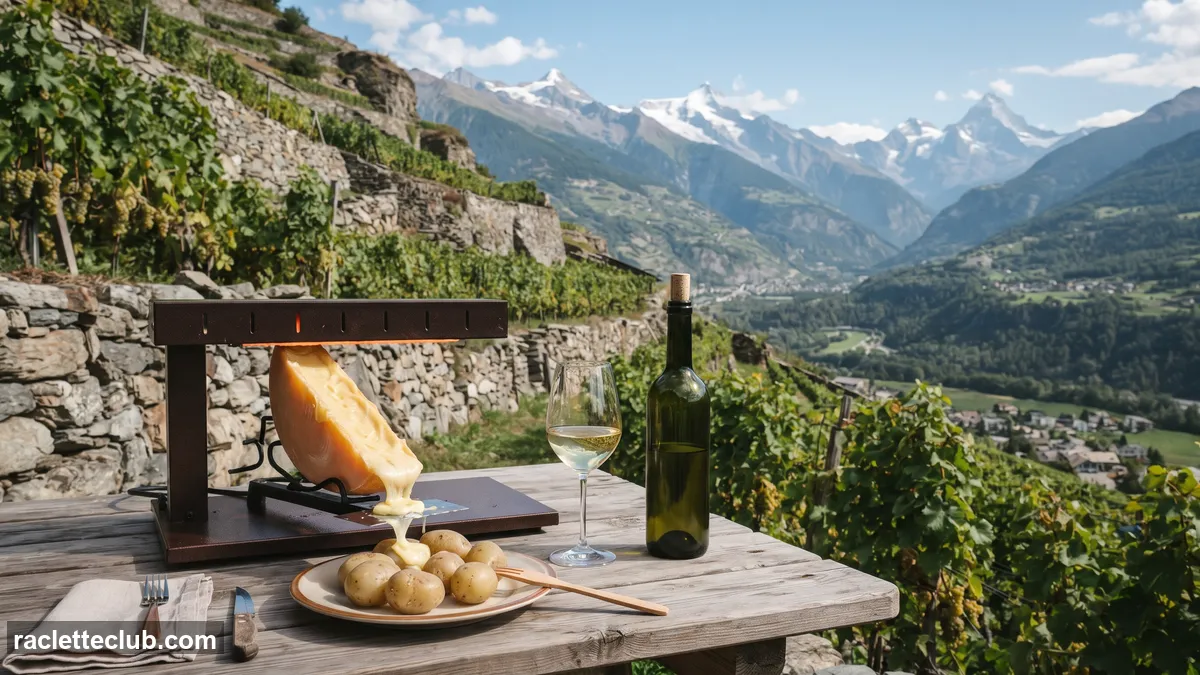
Some pairings are up for debate. This one isn’t. The official Valais tourism site puts it plainly: raclette is happily served “with a glass of Fendant du Valais.” Same terroir, same Rhône valley, same hillsides above the cheese dairies: Fendant and Raclette du Valais AOP grew up together, and you can taste it.
Fendant isn’t a different grape from Chasselas: it’s simply its Valais name. It reportedly comes from the French verb “fendre” (to split), because the skin of a ripe berry splits under your fingers instead of bursting. Swiss Wine Valais, the regional wine board, describes it as light, supple, dry, fruity and floral, often with a very slight sparkle. On the nose, flowers (linden blossom first and foremost), sometimes mineral hints of flint and hazelnut; on the palate, lemon or ripe apple.
Why does it work with melted cheese? Because Fendant isn’t trying to steal the show. Its gentle sparkle and freshness cut through the fat, its hazelnut notes echo the milky flavor of the cheese, and its lightness lets you last three hours of raclette without feeling like you’ve swallowed a wine textbook. It’s perfect with a classic raw-milk Valais raclette and very good with an herb raclette. With a smoked or peppercorn raclette it gets the job done, but a slightly fuller wine (a Chignin-Bergeron, for instance) may upstage it.
Where to look: Fendant AOC Valais, Grand Crus and Chasselas from elsewhere
Fendant AOC Valais
According to Swiss Wine Valais, Chasselas covers 768 hectares of the Valais’s 4,675 hectares of vineyards, or about 16%, making it the canton’s second grape after Pinot Noir. Nearly 300 producers grow it. In other words, you’ll find Fendant at every level, from the everyday bottle to the hillside special cuvée. On the label, look for the word Fendant and AOC Valais. The name Fendant refers to Chasselas from the Valais; in the canton of Vaud, for example, the cantonal regulation provides the names Chasselas vaudois or Dorin vaudois for the same grape.
Fendant Grand Cru
The Valais has a cantonal Grand Cru regulation, approved by the cantonal government in 2005: among other things, a Grand Cru wine must score at least 84 out of 100 at the official control tasting. Each municipality can then set its own rules, sometimes stricter ones. Conthey, for example, requires 86 points and allows Fendant in designated sectors of its hillside. For a big crowd, it’s not essential; to impress the father-in-law who “knows Switzerland really well,” it’s a formidable weapon.
What about Chasselas outside the Valais?
If you can’t find Fendant, a Chasselas from Vaud or Geneva follows the same logic: light, dry, thirst-quenching. On the French side, Savoie has its Chasselas too: the AOC Vin de Savoie specification makes Chasselas the main grape of the Crépy, Marignan, Marin and Ripaille crus, on the shores of Lake Geneva. But for a Valais raclette, the most spot-on pairing is still Fendant.
The best Fendant vintages
Rule number one: Fendant is meant to be drunk young. With raclette, you want its freshness and its sparkle, not the aromas of age. Pick the latest or second-latest vintage available. The assessments below come from the official press releases of the Valais Office of Vine and Wine and Swiss Wine Valais, the canton’s harvest reports (2018 to 2025), and the Swiss Federal Office for Agriculture for 2025. They cover Valais wines or whites in general, except where Fendant or Chasselas is named.
| Vintage | Quality / profile | When to drink |
|---|---|---|
| 2025 | In Switzerland, the Federal Office for Agriculture announces “particularly remarkable” wines, after a favorable season and a slightly early harvest. In the Valais, the canton’s harvest report counts about 6.2 million kilos of Chasselas (2015-2024 average: 8 million) at 19% Brix, but we did not find a tasting assessment specific to Fendant. | The vintage to go for as soon as it’s released |
| 2024 | A very small harvest (34 million kilos, one of the three smallest in more than 50 years), but “a vintage of know-how”: slightly lower alcohol, particularly expressive and aromatic whites, with lovely tension. Ideal for raclette. | Now |
| 2023 | “A winegrower’s vintage”: a year of contrasts, local hail, uneven ripeness. Delicate whites, interesting acidity, wines a little less rich than 2022, with lovely elegance. | Now, without waiting too long |
| 2022 | A hot, dry year with perfectly healthy grapes. Fleshy, flattering whites with surprising freshness; the cantonal enologist calls the Fendant “magnificent.” | Drink without waiting |
| 2021 | A tough year in the vineyard: the Chasselas harvest dropped to about 3.9 million kilos, versus an average of 8.5 million in 2013-2022. According to the canton, sorting made it possible to bring in good-quality grapes; whites with intense fruit, between elegance and liveliness. | Past its first youth |
| 2020 | A small Chasselas harvest (about 6.7 million kilos). According to the canton, a remarkable level of quality: indulgent, finesse-driven wines with very fine concentration. | Past its first youth |
| 2019 | A normal Chasselas harvest (about 10.2 million kilos). According to the canton, the quality is there: crunchy whites, full of liveliness, with vibrant fruit. | Past its first youth |
| 2018 | A good Chasselas harvest (about 10.1 million kilos) and ripe grapes (20.1% Brix, above average). The canton speaks of an exceptional year: whites with vibrant fruit and surprising freshness for a hot year. | Past its first youth |
A word on older Fendant: even if one of them pleasantly surprises you, in our opinion that’s a tasting pleasure, not a raclette wine. With melted cheese, a lively 2024 beats an evolved 2018 every single time.
How to serve Fendant
- Temperature: chilled, but not ice-cold. SAQ product sheets give 6 to 8 °C (about 43 to 46 °F) for Fendant du Valais; some producer sheets say 8 to 10 °C (about 46 to 50 °F). Take the bottle out of the fridge just before sitting down, then keep it in a bucket with a little cold water, because the raclette grill warms up the room.
- Glass: a classic, medium-sized white wine glass. No need for a big tasting glass.
- Decanter: no. You’d lose the slight sparkle, which is exactly what we love with raclette.
- How much: our usual rule of thumb is half a bottle per wine-drinking adult over a two-to-three-hour evening, with a pitcher of water on the table.
And if your current glasses look like old jelly jars (no judgment), a set of simple white wine glasses will do the trick nicely:
The other raclette wines
Back to the complete guide to wines for raclette. If Fendant is impossible to find where you live, check out our pages on Apremont and Savoie’s Jacquère grape, dry Alsace Riesling or, to stay in the Valais with a rosé, Œil-de-Perdrix.
Frequently asked questions
Are Fendant and Chasselas the same thing?
Yes. Fendant is the name given to Chasselas in the Valais. The name comes from the skin of the ripe grape, which splits (“se fend” in French) when you press it between your fingers.
Which Fendant vintage should I pick for a raclette?
The most recent one available. Fendant is drunk young, for its freshness. In 2026, aim for 2025 or 2024; the cantonal enologist describes the 2024 as fresh, expressive and taut.
At what temperature should Fendant be served?
Chilled, between 6 and 10 °C (about 43 to 50 °F) depending on the source. Keep the bottle cold during the meal, because the room warms up fast with the raclette grill going.
Can I swap Fendant for another wine?
Yes: a Chasselas from Vaud or Geneva, an Apremont from Savoie or a dry Alsace Riesling follow the same logic, with freshness and little sugar.
Sources
- Swiss Wine Valais (regional wine board): Fendant grape profile
- Valais Office of Vine and Wine and Swiss Wine Valais: presentation of the 2024 vintage (May 2025, in French)
- Valais Office of Vine and Wine and Swiss Wine Valais: presentation of the 2023 vintage (May 2024, in French)
- Valais Office and Interprofession of Vine and Wine: presentation of the 2022 vintage (May 2023, in French)
- Canton of Valais: 2023 harvest report (Chasselas trends 2013-2023, in French)
- Radio Lac / ATS: the 2025 Swiss vintage looks remarkable (Federal Office for Agriculture, March 2026, in French)
- Valais cantonal Grand Cru regulation (approved December 14, 2005, in French)
- Municipality of Conthey: Grand Cru regulation (in French)
- Valais.ch: raclette
- AOC Vin de Savoie specification (French Ministry of Agriculture official bulletin, July 2023)
- SAQ: product sheet for a 2024 Fendant du Valais (serving temperature)
- Canton of Vaud: regulation on the quality of Vaud wines (Chasselas and Dorin appellations)
- Canton of Valais: 2025 harvest report
- Canton of Valais: 2021 harvest report
- Canton of Valais: 2020 harvest report
- Canton of Valais: 2019 harvest report
- Canton of Valais: 2018 harvest report
- Producer sheet for a Fendant AOC Valais (serving temperature 8 to 10 °C)