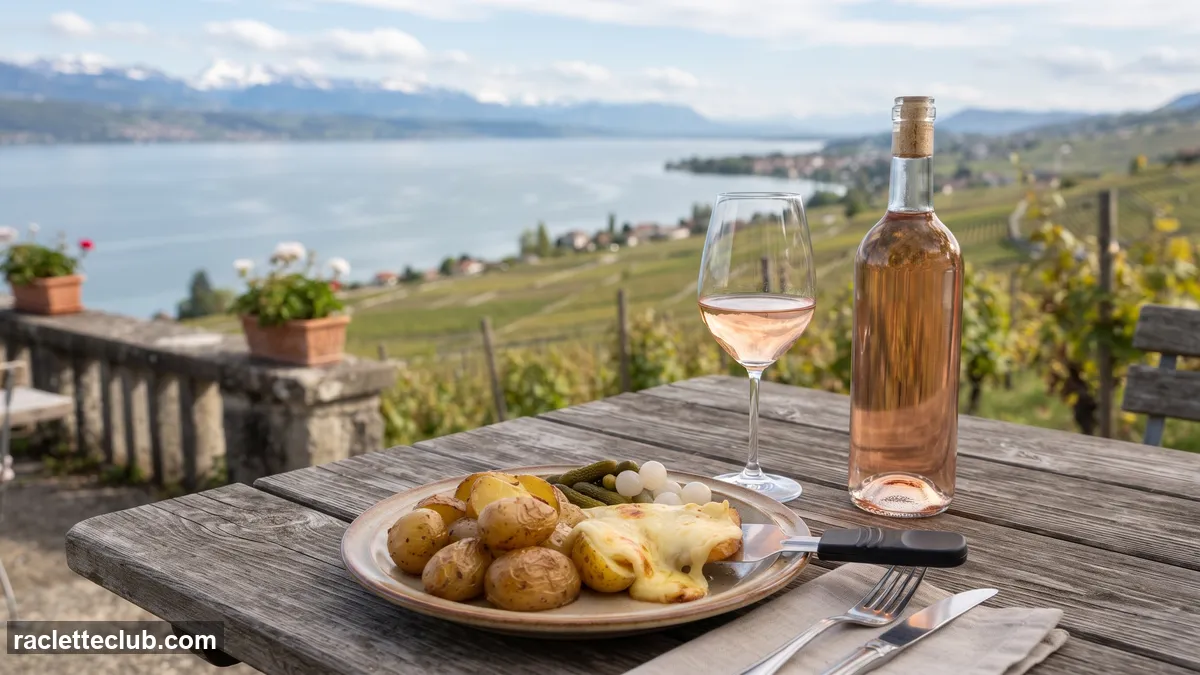
In short: Œil-de-Perdrix is a Swiss rosé made from Pinot Noir, the emblem of Neuchâtel and also produced in the Valais. Pale, fresh and light, it goes very well with raclette, especially as an aperitif and with the cured meats. It’s a wine to drink young: grab the latest vintage on the shelf, currently the 2025: the Swiss Federal Office for Agriculture rates the Swiss wines of this vintage as “particularly remarkable”.
This article contains Amazon affiliate links: if you buy through these links, Raclette Club earns a small commission at no extra cost to you. Learn more.
Naming a wine “the eye of the partridge” takes some nerve. The name, once used in France, has survived in Neuchâtel. Behind this slightly macabre poetry (the color supposedly recalls the bird’s pale eye) hides a dry, delicate rosé that has every right to a spot on a raclette table. As long as you know what you’re asking of it.
Why Œil-de-Perdrix goes with raclette
Œil-de-Perdrix is a rosé made from Pinot Noir with very short skin contact: the juice spends only a little time with the skins, hence its pale color. In the Valais, Swiss Wine Valais specifies that it’s made exclusively from Pinot Noir, with a hue ranging from lightly golden to frankly salmon pink. The trade body describes it as elegant and velvety, with a pleasant liveliness on the palate.
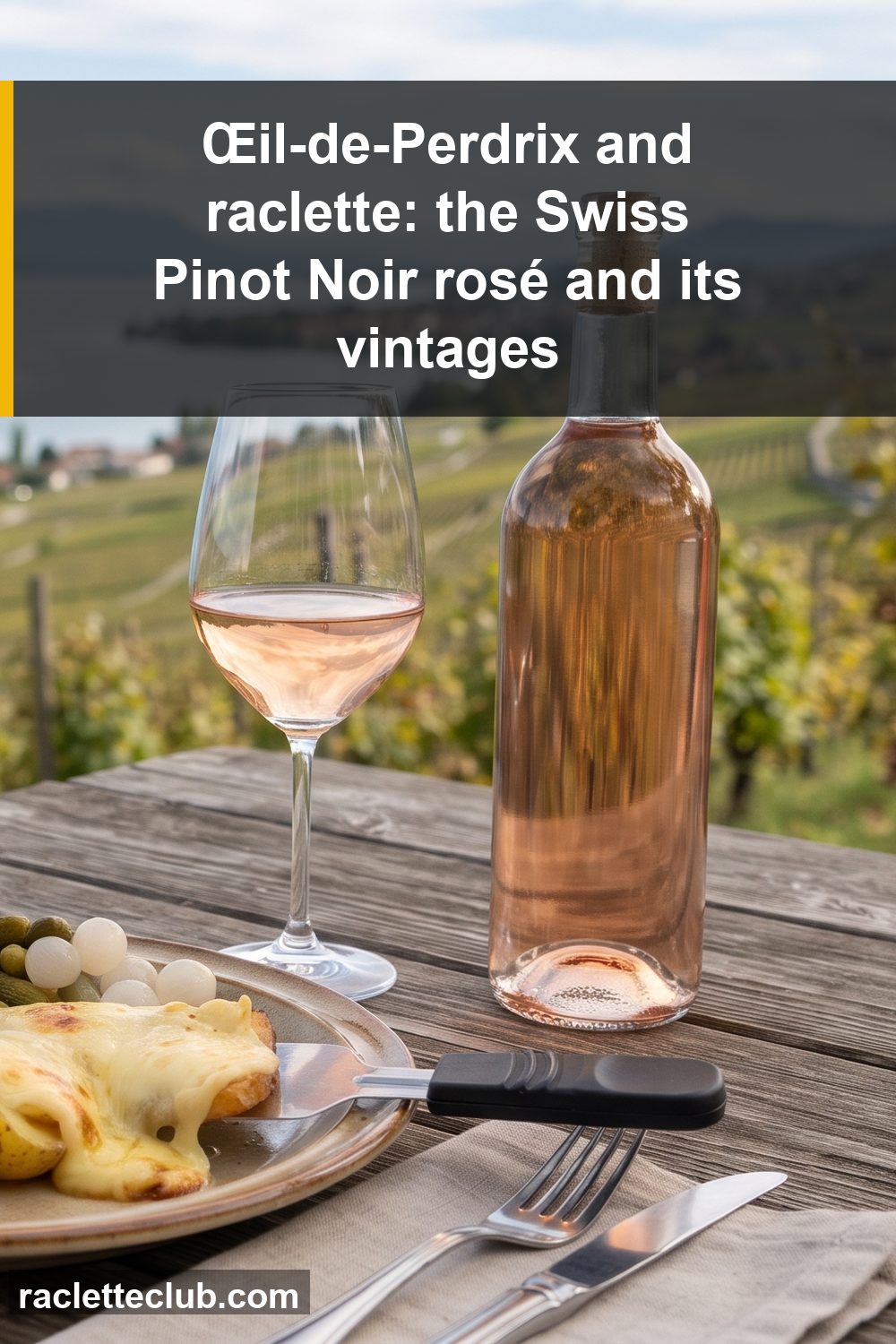
With raclette, it’s that freshness that counts. Melted cheese is rich and salty: it needs a wine that cleans the palate without overpowering it. Pinot Noir made as a rosé keeps the fruit (strawberry, small red berries) without the tannic structure of a red, which we find less comfortable with hot cheese. The result: an easygoing companion that works as well with air-dried beef, prosciutto-style ham and cornichons as it does with a raw-milk Raclette du Valais AOP.
Let’s be honest: up against a peppercorn, smoked or well-aged raclette, Œil-de-Perdrix can seem a bit shy. That’s where a tauter white like Fendant or a light red like Pinot Noir takes over. But for a classic raclette, or for guests who “don’t drink white”, it’s an excellent compromise. The rosé that brings the whole table together, in other words.
The best areas to look for
Neuchâtel, the stronghold
Œil-de-Perdrix is presented as an emblem of the Neuchâtel vineyards. Its first official mention in Neuchâtel dates back to 1861, on a label printed by Louis Bovet, a wine merchant in Areuse: the wine celebrated its 165th birthday in 2026, with an announced public tasting of 35 different Œil-de-Perdrix in Neuchâtel. For the occasion, producers adopted a clear bottle that shows off the color. Pinot Noir covers 55% of the canton’s 600 hectares (about 1,480 acres) of vineyards, and it also makes Perdrix Blanche (Pinot Noir vinified as a white) and reds.
On the label, look for Neuchâtel AOC. The cantonal regulation also recognizes municipal appellations, such as Auvernier, Cortaillod, Boudry or Cressier.
The Valais and other cantons
The Valais also produces its own Œil-de-Perdrix under the AOC Valais, 100% Pinot Noir. It’s a logical choice for a Valais raclette: same canton, same table. You’ll also find it in Geneva and in the canton of Vaud: after the Second World War, other Swiss regions adopted the method and the name, to which Neuchâtel has no exclusive rights.
The best vintages: drink the most recent
Œil-de-Perdrix is drunk young, for its freshness and lightness. No point cellaring it: the right vintage is almost always the latest release. There’s no official vintage rating specific to Œil-de-Perdrix; the table relies on Swiss (Federal Office for Agriculture) and Valais (Office of Vines and Wine, Swiss Wine Valais) reports, which cover all wines.
| Vintage | Quality / profile | When to drink |
|---|---|---|
| 2026 | A very early harvest. At the end of August 2026, La Télé reported good quality but a smaller quantity than expected, because of the drought. No official assessment yet. | From release |
| 2025 | Wines judged “particularly remarkable” by the Swiss Federal Office for Agriculture; Swiss harvest of 82 million liters, up 9.3%; dry, mild start to the season, fairly early harvest. | Now: this is the vintage to buy |
| 2024 | Small harvest (second-smallest in Switzerland in 50 years; in the Valais, among the three smallest). Wines lighter in alcohol, all about freshness and finesse according to the Valais cantonal enologist. | Now, without waiting |
| 2023 | “The quality is there,” according to the Valais harvest report; wines a little less rich than 2022, with lovely elegance. | Finish it soon if you have any |
| 2022 | An opulent vintage according to the Valais cantonal enologist. | In our opinion, too old for a rosé of this style |
| 2021 and earlier | 2021 produced the smallest Swiss harvest since 1957, but of excellent quality according to the Federal Office for Agriculture. | Skip them for an easy-drinking rosé |
Serving Œil-de-Perdrix
- Temperature: well chilled, as Swiss Wine Valais recommends (the English version of its website says 8 °C, about 46 °F). Take the bottle out of the fridge just as you sit down: it’ll warm up quickly next to the raclette grill.
- Glass: a classic white wine glass does the job. No need for a decanter: this wine doesn’t need air.
- When: as an aperitif (the Valais trade body recommends it as an aperitif and with cold dishes, mixed salads and a country-style buffet), then for the first part of the meal.
- How much: plan on about half a bottle per wine-drinking adult over the evening, as with the other raclette wines.
A sommelier’s tip: if you’re serving two wines, open the Œil-de-Perdrix first, then move on to a tauter white or a light red when the boldest cheeses arrive.
More raclette wines
Back to the complete guide to wines for raclette. If you like rosés, compare with our page on dry Loire rosés and the one on Provence rosé. And to stay in Switzerland, Fendant du Valais remains the benchmark pairing.
Frequently asked questions
What is Œil-de-Perdrix?
It’s a Swiss rosé made from Pinot Noir with very short skin contact. It’s the emblem of the Neuchâtel vineyards, where its name appears on a label as early as 1861, and it’s also produced in the Valais, under the AOC Valais, from 100% Pinot Noir.
Does Œil-de-Perdrix pair well with raclette?
Yes, especially with a classic raclette and the cured meats. Its freshness and very discreet tannins suit melted cheese, to our taste. For a smoked, peppercorn or well-aged raclette, a livelier white like Fendant or a light Pinot Noir will go the distance better.
Which Œil-de-Perdrix vintage should you buy?
The most recent. It’s a rosé to drink young. Right now, the 2025 is the right choice: the Swiss Federal Office for Agriculture describes the 2025 Swiss wines as “particularly remarkable”. The 2024, harder to find, should be drunk without waiting.
At what temperature should you serve Œil-de-Perdrix?
Well chilled, around 8 °C (about 46 °F): Swiss Wine Valais recommends serving it well chilled. A classic white wine glass is enough, no decanter needed.
Sources
- Swiss Wine Valais: Œil-de-Perdrix (grape, color, serving; in French)
- La Télé (ATS): Œil-de-Perdrix gets a new bottle for its 165th birthday (in French)
- La Télé (ATS): the 2025 vintage looks remarkable (Federal Office for Agriculture figures; in French)
- Valais Office of Vines and Wine and Swiss Wine Valais: presentation of the 2024 vintage (May 2025, in French)
- Canton of Valais: 2023 harvest report (in French)
- La Télé: the 2026 vintage looks promising despite the drought (August 2026)
- Radio Lac / ATS: the 2024 Swiss harvest, Federal Office for Agriculture figures (February 2025)
- Radio Lac / ATS: the 2021 harvest, the smallest since 1957 (March 2022)
- Beau-Lac: history and tasting of Œil-de-Perdrix from Neuchâtel
- Neuchâtel systematic collection of laws: decree on wine appellations
- Wikipedia: Œil de perdrix
- Cuisine Helvetica: Œil-de-Perdrix
- Swiss AOP-IGP Association: Raclette du Valais AOP