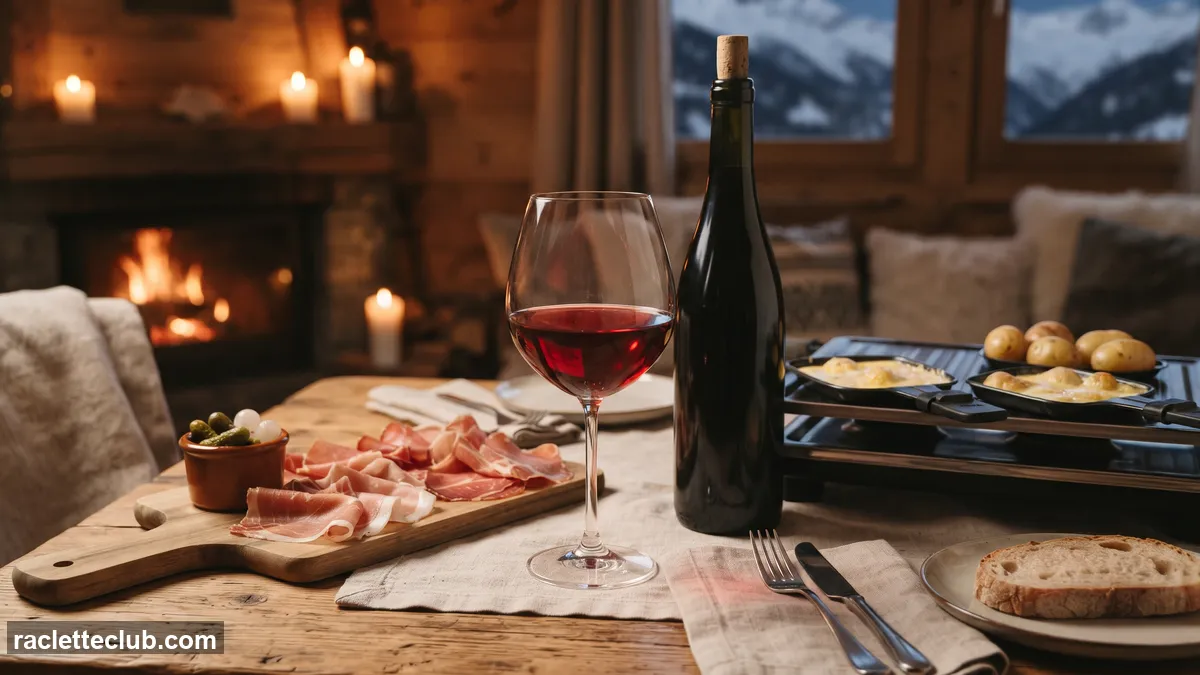
In short: Pinot Noir is, in our opinion, the best red wine for raclette, because it has few tannins and plenty of freshness. Look for it in Alsace, in Burgundy (regional or village level) and in Switzerland, where Dôle du Valais, a blend of Pinot Noir and Gamay, is even recommended “around a raclette” by the Valais wine board. As for vintages, 2024 gave fresh wines, a style that strikes us as ideal with melted cheese, while 2022 and 2023 often offer more body.
This article contains Amazon affiliate links: if you buy through these links, Raclette Club earns a small commission at no extra cost to you. Learn more.
Why Pinot Noir is the red for raclette
Red wine and melted cheese is a pairing that divides people. To our taste, a structured wine remains too massive against a raclette, even though a study conducted in Dijon showed that cheese softens the astringency of a tannic red (the Madiran tested was still the least liked). Pinot Noir sidesteps the debate. Its thin skin gives wines with low tannins, carried by lovely freshness and, when young, by aromas of cherry, raspberry and strawberry. It keeps the cheese company instead of declaring war on it.
It’s the red for guests who “don’t drink white.” It goes with a classic raclette, but also with cured meats (air-dried beef, prosciutto-style ham), and with a smoked raclette, which its red-fruit notes balance nicely. Only one rule: choose fruit-forward Pinots, not heavily extracted or heavily oaked cuvées, and not age-worthy Grand Crus. Those deserve a different meal.
The best Pinot Noir regions for raclette
Switzerland: Dôle du Valais and Valais Pinot Noir
Terroir pairing comes first, so let’s start with the Valais. According to Swiss Wine Valais, Pinot Noir is the most widely planted grape there: about 1,300 hectares, nearly 28% of the canton’s vineyards. It makes fruity, fresh, dry wines with notes of strawberry and raspberry and fine tannins. Dôle is the canton’s signature blend. Pinot Noir and Gamay must make up at least 51% of it, with a majority of Pinot Noir, and other red grapes (Gamaret, Garanoir, Syrah, Merlot…) can round it out. First made in the Valais in 1850, it’s a rather light wine with red-fruit flavors. Above all, the wine board recommends it in black and white “around a raclette with friends.” Hard to find a better endorsement.
Alsace: Pinot Noir from the Vosges
Pinot Noir is the only red grape of the AOC Alsace and covers about 10% of the vineyards, according to the Guide Hachette. It makes rosés and reds with aromas of small red fruits (blackcurrant, raspberry). Barrel-aged versions take on vanilla or toasty notes. Since the 2022 vintage, Pinot Noir has been allowed in two Grand Crus, Kirchberg de Barr and Hengst (Réussir Vigne). For raclette, go for a “classic,” unoaked Alsace Pinot Noir rather than those prestige cuvées.
Burgundy: regional and village rather than Grand Cru
The Guide Hachette calls Pinot Noir the Burgundian grape “par excellence.” For raclette, no need to break the bank: a regional Bourgogne Rouge or a village wine from the Côte de Nuits or Côte de Beaune, from a fresh vintage, will do better than a powerful Premier Cru. Melted cheese flattens the nuances of a great wine, and that would be a shame for the wine and for your wallet.
The best Pinot Noir vintages
For raclette, the best vintage isn’t necessarily the greatest one. You want fruit and freshness rather than concentration. Sunny, structured years (2015, 2018, 2020) produce superb wines, but often richer than what the cheese calls for. The table combines Burgundy (Côte d’Or reds, according to the Wine Scholar Guild), Alsace (Wine Scholar Guild) and the Valais (official vintage press releases).
| Vintage | Quality / profile | When to drink |
|---|---|---|
| 2025 | Burgundy: grape quality “considered excellent,” a vintage billed as “balanced, concentrated and promising,” with volumes sometimes reduced by the heat (Burgundy wine press office). Switzerland: wines still aging, but announced as “particularly remarkable” (Federal Office for Agriculture). Alsace: for lack of a reliable assessment of the 2025 Pinot Noir, we give no opinion. | First regional bottles worth tasting. Patience for the rest. |
| 2024 | Burgundy: a mildew year. The best wines are fresh and graceful, with light, clear fruit, and few are built to age. Alsace: fresher, livelier wines than in recent years. Valais: slightly lower alcohol, balanced reds with silky tannins (cantonal enologist). | Now: the ideal style for raclette |
| 2023 | Burgundy: the best reds have charm and fruit along with structure, but some lack density or have hard tannins. Alsace: reds with intense fruit. Valais: dense yet elegant reds, with fine aging potential. | Now (regional wines, Alsace, Dôle) |
| 2022 | Burgundy: fragrant wines with refined tannins, remarkable quality across the Côte d’Or. Alsace: another good year for Pinot Noir. Valais: a sunny vintage, full-bodied reds with dense, silky tannins. | Now (regional and village wines) |
| 2021 | Burgundy: rare freshness and classicism for the Premier and Grand Crus. Alsace: taut dry wines with remarkable fruit. Valais: a difficult year for winegrowers, according to the cantonal enologist. | Now: a fresh vintage, well suited |
| 2020 | Burgundy: concentrated, spectacular reds, with surprising freshness given the heat. Alsace: a Pinot Noir harvest that some consider the best ever. | Now (Alsace). Burgundy: save the crus for another meal. |
| 2019 | Burgundy: quality still remarkable. Alsace: an exceptional vintage, combining freshness, structure and richness. | Now for regional wines |
| 2018 | Burgundy: dark, rich reds, yet fresh and built to age well. Alsace: Pinot Noir particularly successful in a generous vintage. | Now for regional wines. The crus can wait. |
| 2017 | Burgundy: supple, approachable wines. Alsace: high quality, reds included. | Now |
| 2016 | Burgundy: from the best growers, deeply colored, lively, fleshy wines with generous fruit and supple tannins. | Now |
| 2015 | Burgundy: ripe, lively, structured wines with fine aging potential. Alsace: an exceptional vintage, Pinot Noir included. | Crus ready to drink, but often too rich for raclette |
The “When to drink” column gives our advice for a raclette, for entry-level and mid-range bottles. It’s not an official aging window. For aging, the Guide Hachette gives 2 to 10 years for Alsace reds and 2 to 5 years for Burgundies in general, and Swiss Wine Valais 5 to 8 years for a well-made Valais Pinot Noir. For raclette, however, we prefer young, fruitier bottles: that’s an opinion, not a rule.
Serving Pinot Noir with raclette
- Temperature: cool, never at the temperature of a heated living room. The Guide Hachette recommends 10 to 14 °C (about 50 to 57 °F) for a red Alsace Pinot Noir. For a red Burgundy, it gives 12 to 14 °C (about 54 to 57 °F). Twenty minutes or so in the fridge before the meal is enough.
- Glass: a wide-bowled red wine glass, “Burgundy” style, if you have one. Otherwise, a classic stemmed glass does the job just fine.
- Decanter: no need for a Dôle, an Alsace Pinot or a young regional Burgundy. A decanter can help a village wine that’s a bit closed.
- How much: about half a bottle per wine-drinking adult over the evening. If you’re also serving a white, open the white first and the Pinot afterward.
The other raclette wines
Back to the complete guide to wines for raclette. If you like light reds, keep going with our light Beaujolais page or with Savoie Gamay. And to stay in the Valais with Pinot Noir, try Œil-de-Perdrix, its rosé.
Frequently asked questions
Can you drink red wine with raclette?
Yes. We recommend a light red with low tannins. Pinot Noir is, in our opinion, the best candidate, because its fine tannins leave plenty of room for the melted cheese.
What is Dôle du Valais?
It’s the Valais’s signature red blend. Pinot Noir and Gamay make up at least 51% of it, with a majority of Pinot Noir. It’s a rather light, red-fruited wine that Swiss Wine Valais recommends with raclette.
Which Pinot Noir vintage should I choose for a raclette?
A fresh, fruit-forward vintage. 2024 gave fresh wines in Burgundy (from the best growers), Alsace and the Valais. 2022 and 2023 offer more body. Sunny years like 2015, 2018 or 2020 are richer.
At what temperature should Pinot Noir be served with raclette?
Cool: according to the Guide Hachette, 10 to 14 °C (about 50 to 57 °F) for a red Alsace Pinot Noir and 12 to 14 °C (about 54 to 57 °F) for a red Burgundy. Never at the temperature of a heated room.
Sources
- Swiss Wine Valais: “La Dôle, a no-fuss ally” (Terre&Nature, September 2025, in French)
- Swiss Wine Valais: Dôle profile
- Swiss Wine Valais: Pinot Noir profile
- Valais Office of Vine and Wine: presentation of the 2024 vintage (May 2025, in French)
- Valais Office of Vine and Wine: presentation of the 2023 vintage (May 2024, in French)
- Valais Office and Interprofession of Vine and Wine: presentation of the 2022 vintage (May 2023, in French)
- Radio Lac / ATS: the 2025 Swiss vintage according to the Federal Office for Agriculture (March 2026, in French)
- Wine Scholar Guild: Burgundy vintage chart
- Wine Scholar Guild: Alsace vintage chart
- Burgundy wine press office via Presseagence: 2025 vintage (in French)
- iDealwine: the 2024 harvest in France (Agreste estimates, in French)
- Guide Hachette des Vins: AOC Alsace Pinot Noir (in French)
- Réussir Vigne: Pinot Noir enters two Alsace Grand Crus (June 2022, in French)
- Guide Hachette des Vins: AOC Bourgogne
- NPR / NHPR: the Dijon study on wine and cheese (November 2016)
- Wikipedia: Pinot noir