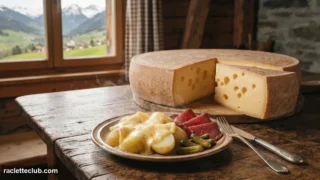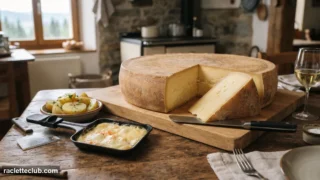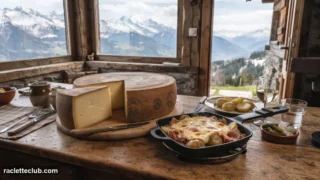
In short: Raclette du Valais PDO is a raw cow’s milk cheese, made and aged only in Valais, for at least three months in a cellar. On every heel, the name of the dairy or alpine pasture is printed, like an artist’s signature at the bottom of a painting.
Fact sheet checked on 11/02/2026 against the official websites of producers and trade associations. Do you make this cheese? Write to us to be listed in the directory.
Fact sheet: Raclette du Valais PDO
| Country | Switzerland |
|---|---|
| Region | Valais (one exception: the Spittelmatten alpine pasture, in Kandersteg, in the canton of Bern) |
| Designation | PDO, entered in the Swiss register on December 21, 2007, after the Federal Supreme Court ruling of October 15, 2007 (FOAG); also protected in the European Union |
| Milk | cow, raw |
| Paste | uncooked pressed, semi-hard |
| Aging | at least 3 months in a cellar on spruce boards (2 months for the “à la coupe” version); at least 12 months for the “à rebibes” version, for slicing |
| Size | round wheel of 4.6 to 5.8 kg, 29 to 32 cm in diameter, 6 to 8 cm high (specifications) |
| Taste | fruity (mild for young wheels, more full-bodied for alpine cheeses) |
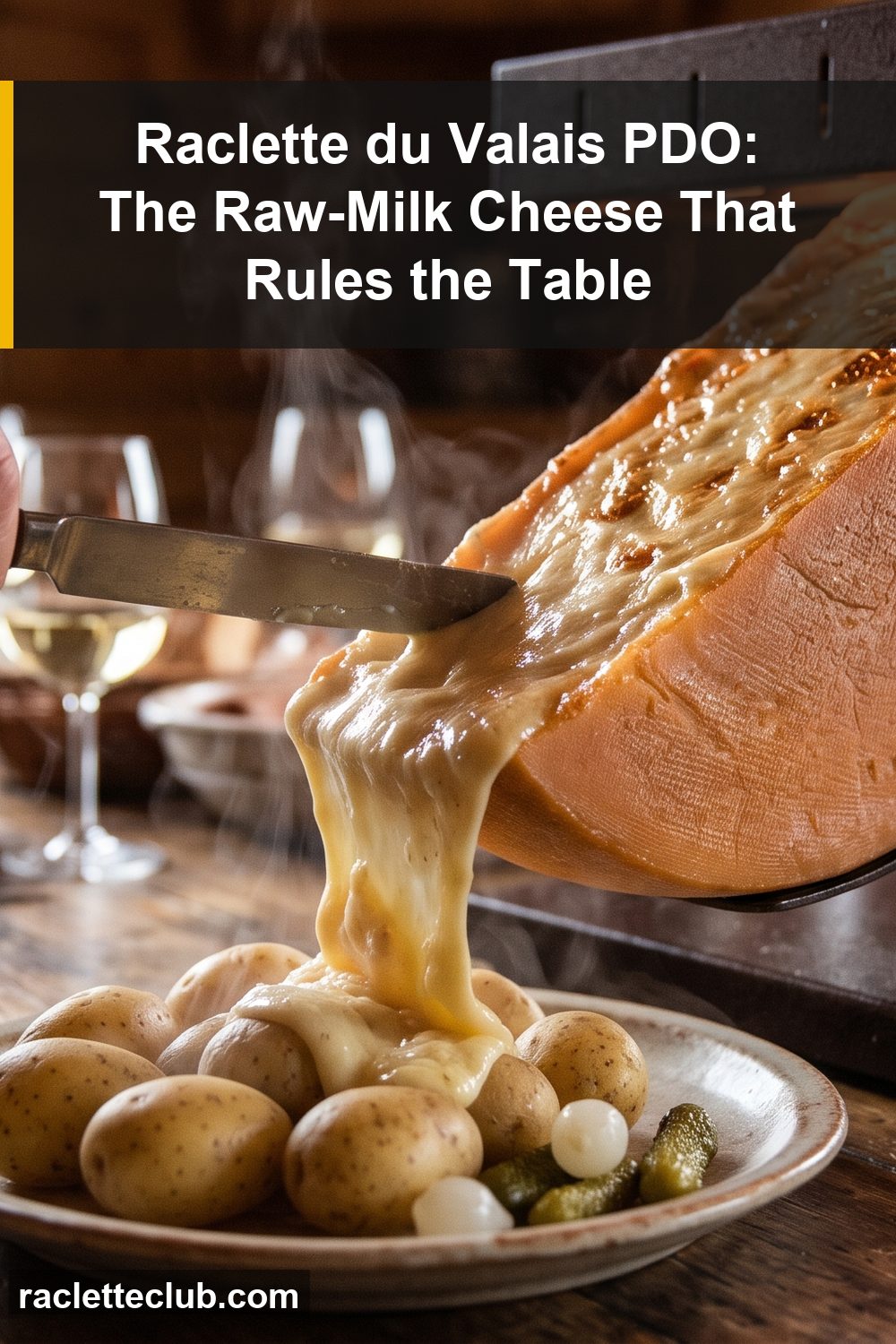
| Melt | 5/5: it melts into a creamy sheet without releasing oil, and the toasted rind is a joy to scrape |
Its history
Valais has been melting cheese long before electric grills made themselves at home on our tables. The trade association cites a mention of melted cheese in 1574, and points out that Valais cheese sometimes served as currency between the 14th and 19th centuries: wages were paid in wheels, which may explain why some of us still dream of being paid in raclette. The word itself, taken from the verb “to scrape” (racler), became official in 1874. Legend prefers a more romantic version: a winegrower named Léon, shivering with cold, set a piece of cheese near his fire and invented the dish by accident. In 2007, the name Raclette du Valais became a PDO in Switzerland, and it was then recognized in the European Union thanks to a bilateral agreement. Since 2008, it has also been on the inventory of Swiss culinary heritage. Today, dozens of village dairies and alpine pastures, from Upper Valais to the Chablais, keep the recipe alive.
Video: © Switzerland Cheese Marketing (official SwitzerlandCheese channel): Swiss Cheese Awards on Tour, Raclette du Valais PDO, German version, linked from the Sennerei Simplon website, watch on YouTube
Taste and melt: what happens in the raclette pan
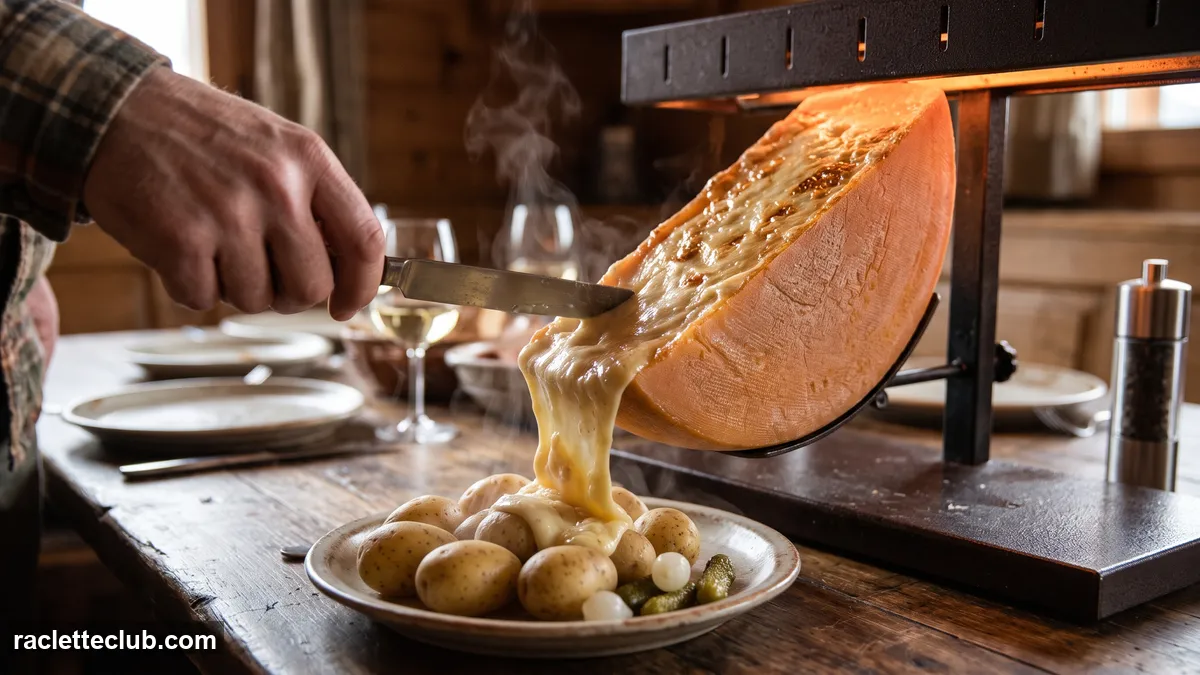
What you remember first is the melt. Set in front of the embers or under the heating element of a half-wheel grill, the cheese starts to bubble, turns golden on the surface and scrapes off in a supple sheet that doesn’t separate into a puddle of grease. The raw milk and the ban on silage in the cows’ diet give it a wide aromatic palette: fresh milk and a light tang on a three-month wheel, notes of butter, hay and flowers on an older alpine cheese. The rind, regularly rubbed in the cellar, toasts beautifully and adds a little hazelnut flavor that connoisseurs fight over at the edge of the grill. Every heel carries an origin, Bagnes, Gomser, Anniviers or the name of an alpine pasture, and regulars end up with a favorite, the way you have your football club. According to the producers, alpine versions have more character, and valley wheels are milder.
On the nose and palate: lactic and fresh when young, then notes of hay, alpine flowers and hazelnut butter; every dairy has its own signature
How to serve it
Plan on 200 to 250 g of cheese per person for a meal, a little more if your guests have been hiking all day or claim they have. Take the wheel out of the fridge an hour ahead so it melts evenly. The queen version remains the half wheel: you cut the wheel in two, present the cut face to a wood fire or a raclette oven, then scrape the melted part straight onto the plate, toasted rind included. With a raclette-pan grill, cut slices of 3 to 4 mm and let them melt without frying. Serve hot potatoes in their skins, gherkins, pearl onions and a little dried meat. Pepper and paprika stay on the table, everyone does what they like with them, even if purists raise an eyebrow.
Pairings
- Wines: Fendant (Valais Chasselas), Petite Arvine, Johannisberg, light Valais Pinot Noir, hot black tea for the teetotalers
- On the table: potatoes in their skins, pickled gherkins and pearl onions, Valais dried meat, sliced pear or apple, Valais PDO rye bread
Our recipes with this cheese
- Half-wheel raclette at home
- Traditional raclette, the basic recipe
- The oven-baked raclette potato
How much should you plan? Our guide to raclette cheese quantities per person does the math, and our comparison of the best raclette cheeses sets it against the others.
Raclette du Valais PDO producers: the directory
Four families of producers, from the giants to the small alpine dairies. Contact details taken from their official websites; logos are shown from those sites, with credit.
The biggest producers
The biggest volumes: industrial producers and large cooperatives.

Cremo SA (marque Valdor)
Villars-sur-Glâne (aging cellars in Sierre), Switzerland
Ages and sells under the Valdor brand Raclette du Valais PDO from small Valais dairies and alpine pastures, matured in its cellars in Sierre.
- Address: Route de Moncor 6, 1752 Villars-sur-Glâne, Switzerland (mailing address: Case postale, CH-1701 Fribourg)
- Phone: +41 26 407 21 11
- Email: info@cremo.ch
- Website: cremo.ch/fr
- Contact: form
- Social media: LinkedIn
- Award: Silver medal at the World Cheese Awards 2024 for the Raclette du Valais PDO Valdor Gomser 55, made in Grengiols (source: https://cremo.ch/en/2025/07/01/du-cote-marche/)
Logo: © Cremo SA (marque Valdor), shown from its official website.
A. Walker AG
Bitsch, Switzerland
Family-run Upper Valais business founded in 1956, listed by the trade association among the dairies and affineurs of Raclette du Valais PDO, based in Bitsch.
- Address: Furkastrasse 164, 3982 Bitsch, Switzerland
- Phone: +41 27 928 62 62
- Email: info@walker.swiss
- Website: walker.swiss
- Contact: form
- Social media: Facebook · Instagram · YouTube
The best known
The brands you come across in stores.

Bio-Bergkäserei Goms (Bio Gomser)
Gluringen, Switzerland
Organic dairy in the Conches valley that makes the Bio Gomser 11 Valdor raclette.
- Address: Furkastrasse 402, 3998 Gluringen, Switzerland
- Phone: +41 27 973 20 80
- Email: info@biogomser.ch
- Website: biogomser.ch
- Social media: Facebook
- Award: Gold at the Swiss regional products competition in 2021 for its raclette, according to the producer (source: https://www.biogomser.ch/)
Logo: © Bio-Bergkäserei Goms (Bio Gomser), shown from its official website.
Centrale laitière de Liddes (Bagnes 4)
Liddes, Switzerland
Makes Bagnes 4, a raw-milk raclette also sold from a vending machine open day and night in front of the dairy, on the Grand-Saint-Bernard road.
- Address: Route du Grand-St-Bernard 29, 1945 Liddes, Switzerland
- Phone: +41 79 550 03 95
- Email: laiteriedeliddes@bagnes4.ch
- Website: bagnes4.ch
- Social media: Facebook
- Award: Diploma at the Swiss Cheese Awards 2026, Raclette du Valais PDO category (Sylvie Dussailler, Fromagerie de Liddes) (source: https://www.cheese-awards.ch/fileadmin/Switzerland/SCA_2026/Gewinner_SCA_2026_def_261013.pdf)
The most renowned
Medal winners, prize winners or renowned affineurs, with a sourced award.
La Ferme à Gaby (Alpage de Champoussin)
Champoussin (Val-d'Illiez), Switzerland
Alpine pasture with a mountain restaurant where you can watch cheese being made and eat a Raclette du Valais PDO made on site.
- Address: Blaise Perrin, CH-1873 Champoussin, Switzerland
- Phone: +41 24 477 30 88
- Email: contact@lafermeagaby.ch
- Website: lafermeagaby.ch
- Contact: form
- Award: Diploma at the Swiss Cheese Awards 2026, Raclette du Valais PDO category (Blaise Perrin, Alpage de Champoussin) (source: https://www.cheese-awards.ch/fileadmin/Switzerland/SCA_2026/Gewinner_SCA_2026_def_261013.pdf); 1st category prize in 2024 according to Cremo (source: https://cremo.ch/en/2025/07/01/du-cote-marche/)
Laiterie des Haudères (Laiterie Centrale de la Commune d'Evolène)
Les Haudères (Evolène), Switzerland
Cooperative dairy in the Val d’Hérens that makes the Haudères PDO raclette and local tommes, with a shop open every day.
- Address: Route Principale 15, 1984 Les Haudères, Switzerland
- Phone: +41 27 283 12 75
- Website: fromagerie-hauderes.ch
- Award: Prize for the best Raclette du Valais PDO at the Swiss Cheese Awards 2022, according to the Val d’Hérens tourist office (source: https://www.valdherens.ch/en/creamery-les-hauderes-fp40490)
Small local producers
Farms, alpine pastures and village dairies.

Fromagerie d'Anniviers
Vissoie, Switzerland
Makes from October to June the PDO raclette marked “Anniviers”, from raw milk collected between 900 and 1,900 m, worked in copper vats.
- Address: Route des Sampelets 6, Case postale 45, 3961 Vissoie, Switzerland
- Phone: +41 27 475 14 75
- Email: info@fromagerie-anniviers.ch
- Website: fromagerie-anniviers.ch
- Contact: form
Logo: © Fromagerie d'Anniviers, shown from its official website.

Sennerei Simplon
Simplon, Switzerland
Cheese cooperative in the village of Simplon, on the pass road, listed by the trade association among the Raclette du Valais PDO dairies.
- Address: Biel 5, 3907 Simplon, Switzerland
- Phone: +41 27 979 13 66
- Email: info@sennerei-simplon.ch
- Website: sennerei-simplon.ch
- Contact: form
- Social media: Facebook
Logo: © Sennerei Simplon, shown from its official website.
Where to buy it
You can find Raclette du Valais PDO at cheese shops, in Valais village dairies, at markets and in Swiss supermarkets, as a whole wheel, half wheel or slices. To recognize the real one, look at the heel: the name of the dairy or alpine pasture is printed there. A casein mark placed on each wheel shows the dairy number, the designation and the production date. The trade association specifies that a jury of experts checks the appearance, the paste, the holes, the taste and the melt before granting the name. A wheel with no origin on the heel or a vague mention like “Valais-style raclette” is not a PDO.
More addresses in our guide where to buy good raclette cheese.
Follow on social media
- Raclette du Valais PDO (trade association), channel linked from raclette-du-valais.ch (youtube)
- Raclette du Valais PDO (trade association) (instagram)
- Raclette du Valais PDO (trade association) (facebook)
Vote for the best raclette cheese
One vote per person, no sign-up. The ranking is visible with “View ranking”.
Frequently asked questions
Is Raclette du Valais PDO always made from raw milk?
Yes. The specifications require raw cow’s milk, delivered to the dairy and processed without pasteurization, which gives the cheese its aromatic palette.
Can you eat the rind?
Yes, and it’s even one of the highlights of the half wheel: the rind toasted in front of the fire tastes of hazelnut. Just scrape it if it is very thick.
What do the names on the heel, like Bagnes or Gomser, mean?
They indicate the origin of the cheese, the dairy or alpine pasture where it was made. Bagnes 4, for example, designates the raclette from the Liddes dairy.
How long is it aged?
At least three months in a cellar (two months for the “à la coupe” version). The “à rebibes” version, for slicing into thin shavings, is aged at least twelve months.
Read also: all raclette cheeses, the secrets of a successful raclette and what is raclette?
Sources
- Trade association contact details, list of dairies and affineurs, social media : raclette-du-valais.ch
- Trade association email and form : raclette-du-valais.ch/fr-ch/contact
- Raw milk, no silage, Swiss culinary heritage since 2008 : raclette-du-valais.ch/fr-ch/raclette-du-valais
- Aging of 3 months minimum, casein plate, origin on the heel, jury check : raclette-du-valais.ch/fr-ch/raclette-du-valais/fabrication
- 1574, official name in 1874, legend of Léon, PDO since 2007 and protection in the EU : raclette-du-valais.ch/fr-ch/raclette-du-valais/histoire-orig
- Spruce boards, registration on 12/21/2007 : aop-igp.ch/en/walliser-raclette-aop
- Specifications (raw milk, no silage, 4.6 to 5.8 kg, 29 to 32 cm, 6 to 8 cm, aging 3 months / 2 months à la coupe / 12 months à rebibes, casein mark, taxation, Spittelmatten alpine pasture) : aop-igp.ch (Raclette du Valais PDO specifications)
- File history (Federal Supreme Court ruling of 10/15/2007, registration published on 12/21/2007) : blw.admin.ch (Raclette du Valais history)
- Unpasteurized milk : cheesesfromswitzerland.com/en/cheeses-from-switzerland/chees
- Swiss Cheese Awards 2026 results (Raclette du Valais PDO: winner Gaëtan Cardinaux, Alpage de Tanay) : cheese-awards.ch/fileadmin/Switzerland/SCA_2026/Gewinner_SCA
- World Cheese Awards 2024 awards (Valdor Gomser 55, Champoussin) : cremo.ch/en/2025/07/01/du-cote-marche
- Valdor aged in the Sierre cellars : cremo.ch/en/groupe/nos-produits/fromage
- Anniviers raclette: season, milk, marking : fromagerie-anniviers.ch/raclette-aop-valais
- Liddes dairy, Bagnes 4, 24/7 vending machine : saint-bernard.ch/en/practical/useful-contacts/dairy-10710
- La Ferme à Gaby website : valais.ch/fr/savourer/activites/gastronomie/alpages-avec-buv
- La Ferme à Gaby contact : lafermeagaby.ch/contact-et-horaires
- Liddes dairy contacts : bagnes4.ch/contacts-2
- Fromagerie d’Anniviers contact : fromagerie-anniviers.ch/2-uncategorised/19-contact
- Laiterie Centrale d’Evolène (website linked by the trade association) : fromagerie-hauderes.ch; address and shop : valdherens.ch
- Swiss Cheese Awards on Tour video, SwitzerlandCheese channel linked from the Swiss Cheese Awards website : cheese-awards.ch