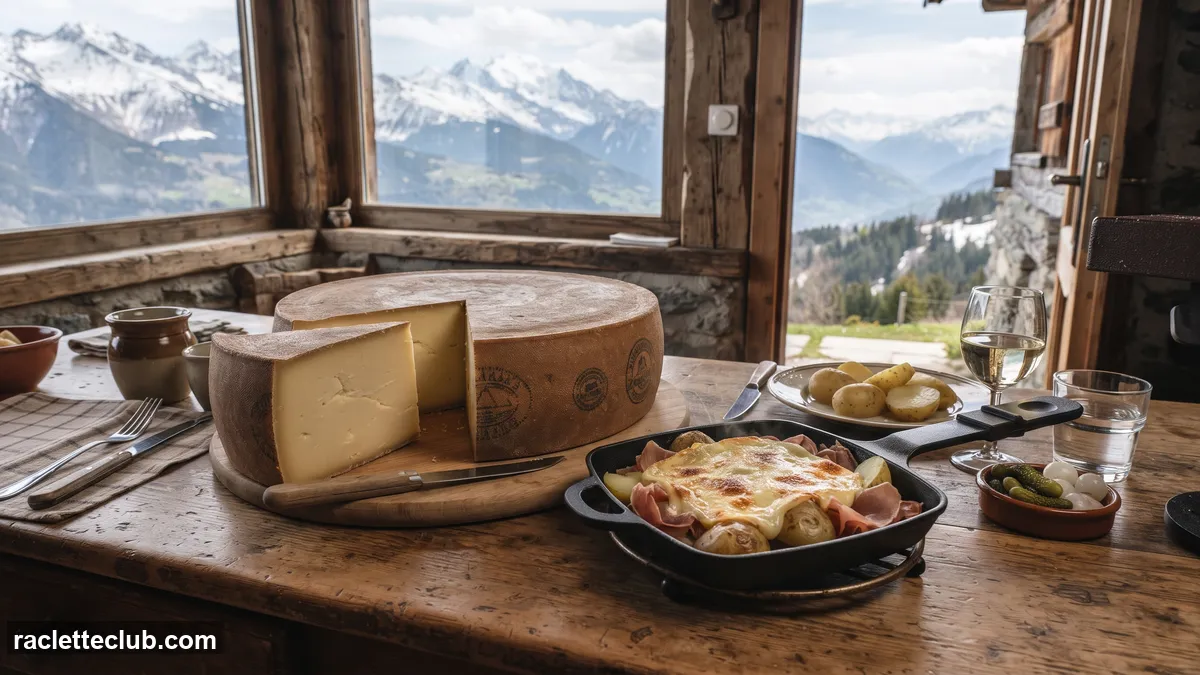
In short: Beaufort AOP, nicknamed “the prince of gruyères”, is the great high-mountain cheese of Savoie, made from the raw whole milk of Tarine and Abondance cows and aged for at least 5 months. Its producers call it “wonderfully melting”, and it’s the soul of Savoyard fondue. At a raclette, it melts well but remains a cooked pressed cheese: our honest advice is to pair it with a raclette cheese rather than serve it alone, and to save old Beauforts and Chalet d’Alpage for the cheese board.
This article contains Amazon affiliate links: if you buy through these links, Raclette Club earns a small commission at no extra cost to you. Learn more.
Beaufort: ID card
| Criterion | Beaufort AOP |
|---|---|
| Country | France |
| Region | Savoie: the Beaufortain, Tarentaise and Maurienne valleys and part of the Val d’Arly, between 500 and 2,500 m (Syndicat de défense du Beaufort) |
| Designation | AOC in 1968, European PDO in 2006 (Syndicat de défense du Beaufort) |
| Milk | Cow’s milk, raw and whole, exclusively from Tarine and Abondance breeds; base diet of hay and pasture grass |
| Paste | Cooked pressed: curd grains heated to 53-54 °C, molded in linen cloth and a beechwood hoop that gives the concave side |
| Aging | 5 months minimum, in a cellar below 10 °C; peak flavor between 7 and 12 months according to the producers |
| Format | Wheel 35 to 75 cm in diameter, 11 to 16 cm high, about 40 kg (producers); 20 to 70 kg according to the white paper on mountain pressed cheeses |
| Flavor | Fruity, ivory to pale yellow paste; milkier in winter, more floral and fruity in summer |
| Meltability | Very good, a pillar of Savoyard fondue; old Beauforts melt less evenly |
The cheese that almost disappeared
According to the Syndicat de défense du Beaufort (the Beaufort trade body), its history goes back to the 12th century, when Cistercian monks set up farms and pastures in the Alps. The cheese was then made in summer mountain chalets, and the name “Beaufort” only appeared for the first time in 1865. Brillat-Savarin supposedly nicknamed it “the prince of gruyères”, the white paper on mountain pressed cheeses recalls.
In the 1960s, it came close to disappearing: workers left for the construction sites of ski resorts and dams, and production fell below 500 tonnes. A few farmers then bet on quality and a price that could cover the extra costs of high-mountain farming. The first dairy cooperative was founded in 1961, and the AOC followed in 1968. The bet paid off: in 2023, producers made 136,239 wheels, or 5,300 tonnes, with 17,000 Tarine and Abondance cows.
There are three Beauforts. Plain Beaufort, made from November to May with hay-fed milk, has an ivory paste and rather milky aromas. Beaufort été (summer Beaufort), made from June to October, is yellower, floral and fruity. Beaufort Chalet d’Alpage, the rarest (about 400 tonnes a year), is made in summer above 1,500 m, twice a day, with the warm milk of a single herd.
Flavor and melt: a good raclette cheese?
Beaufort melts beautifully. Its own producers describe it as “wonderfully melting”, perfect for binding sauces and essential to Savoyard fondue. In Savoie, fondue is in fact often made “50-50 Beaufort and Emmental”, notes the French food guide Le Fooding. But it isn’t a raclette cheese: raclette cheeses are uncooked pressed cheeses, like Raclette de Savoie, while Beaufort is a cooked pressed cheese, made to age.
Under the machine, a Beaufort a few months old gives a silky layer and a superb fruity flavor. A very old Beaufort, on the other hand, melts less well: Cook’s Illustrated’s tests show that a longer-aged cheese, which has lost water, releases more separated fat and more clumps when melted. And melting a long-aged Chalet d’Alpage is a bit like using a grand cru to deglaze a pan.
Our verdict: on its own, a young Beaufort makes a luxury raclette, a little less runny than a classic raclette. Blended with a Raclette de Savoie or an Abondance, it’s terrific.
How to serve it at a raclette
- Quantity: our team’s benchmark is 200 g of cheese per person in total. One third Beaufort is enough to flavor the whole thing, and your budget will thank you.
- Which one? A winter Beaufort or a still-young Beaufort été for the pan; long-aged ones and Chalet d’Alpage for the board.
- In slivers on top of the raclette slice, so they melt together.
- Storage: several weeks in the bottom of the fridge, well wrapped in parchment paper. Take it out 30 minutes before serving, and if it’s vacuum-packed, unwrap it at least two days ahead, the producers advise.
Which wines go with Beaufort
What grows together goes together, in our opinion. A full, fragrant Chignin-Bergeron stands up to Beaufort’s fruitiness. A Roussette de Savoie (Altesse) plays the finesse card. And for red lovers, a peppery, fresh Mondeuse stays in the Savoyard mountains.
In the pantry
All the other ingredients for the evening are kept here: head back to the raclette pantry. For the great cooked pressed cheeses, see also Comté, Le Gruyère AOP and Emmentaler, its fondue partner.
Frequently asked questions
Can you make raclette with Beaufort?
Yes, it melts very well. But it’s a cooked pressed cheese: it’s at its best young and blended, about one third Beaufort to two thirds raclette cheese.
What’s the difference between Beaufort, Beaufort été and Chalet d’Alpage?
Beaufort is made from November to May, Beaufort été and Chalet d’Alpage from June to October. Chalet d’Alpage is made above 1,500 m, twice a day, with the milk of a single herd.
Why does Beaufort have a concave side?
The cheese is molded in linen cloth and then in a beechwood hoop, which gives it its characteristic concave side.
How do you store Beaufort?
In the bottom of the fridge, wrapped in parchment paper, for up to several weeks. Take it out 30 minutes before eating.