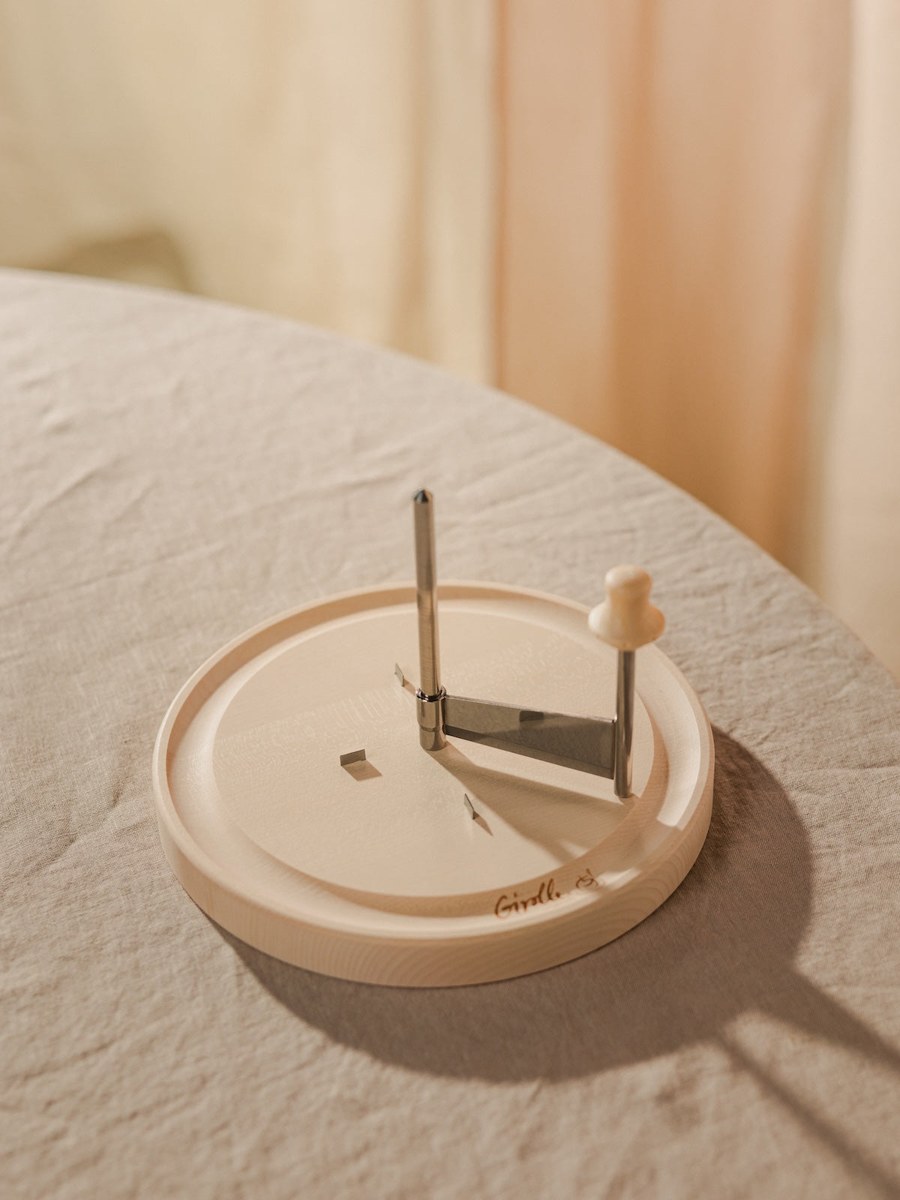
In short: the original Girolle is for Tête de Moine fans who want the original tool rather than a copy. What we take away: solid maple and stainless steel, Swiss design and manufacture according to the maker, and cheese rosettes in a few turns of the crank.
This article contains Amazon affiliate links: if you buy through these links, Raclette Club earns a small commission at no extra cost to you. Learn more.

At a glance
| Feature | Original Girolle |
|---|---|
| Type | Girolle (rotating cheese shaver for making rosettes) |
| Brand | Girolle Schweiz on Amazon.fr; product presented by girolle.ch as “The original Girolle” |
| Material | Solid maple and food-grade stainless steel, no plastic according to the maker |
| Dimensions and weight | Not stated by Girolle |
| Cheeses | Tête de Moine AOP, and cylindrical semi-hard cheeses (Appenzeller, some farmhouse raclettes) of about 800 g to 1 kg |
| Use | Central rod pushed into the center of the cheese, blade laid flat, crank turned clockwise |
| Care | Not stated by Girolle |
| Warranty | Lifetime warranty on the knife, handle and base, spare parts available, according to girolle.ch |
| Made in | Made in Switzerland (Jura); Swiss maple certified Swiss Wood according to the product page, “of European origin” according to the girolle.ch FAQ |
| History | Invented in 1982 in Lajoux (Swiss Jura), patent EP0081466A1 |
Our take
The girolle is one of those objects that turn a cheese into a show. On paper, the principle is simple: you stand the wheel on the central rod, lay the blade flat on top, turn the crank, and the cheese unrolls into thin, frilly rosettes. The original version, invented in 1982 in Lajoux in the Swiss Jura, is still made in the region according to its maker, in solid maple and food-grade stainless steel, with no plastic. The maker advises taking the cheese out of the fridge 10 to 15 minutes beforehand, for softer rosettes.
It is designed for Tête de Moine AOP, but the maker says it works with other semi-hard, cylindrical cheeses, such as Appenzeller or some farmhouse raclettes, for wheels of about 800 g to 1 kg. A great way to kick off an aperitif before the raclette that will raise your guests’ eyebrows, right before you watch them fight over who turns the crank. As for lifespan, girolle.ch advertises a lifetime warranty on the knife and crank, and sells spare parts. Girolle does not, however, state its dimensions or washing instructions.
On video
Video: Tête de Moine AOP, Fromage de Bellelay on YouTube. Tips from the cheese trade association on getting the rosettes right; the girolle shown is not necessarily this model.
Video: Lakeview Cheese Galore on YouTube. A demonstration of the same type of tool by a cheese shop.
Strengths
- The original tool, designed and made in Switzerland according to the maker
- Solid maple and stainless steel, no plastic
- Lifetime warranty on the knife and crank, spare parts available
- Also works with other cylindrical semi-hard cheeses
- A real entertainment moment at the aperitif
Things to consider
- Dimensions and weight not stated by Girolle
- Washing instructions not stated (wooden base)
- Only for cylindrical cheeses of about 800 g to 1 kg
- No protective cover mentioned in the description
Original Girolle: who is it for?
For Swiss cheese fans, for people who entertain often and like to put a conversation piece on the table, and for anyone looking for a lasting gift for a raclette lover. On the other hand, if you buy a Tête de Moine once a year, a supermarket girolle will do. And if your favorite cheeses are soft ones, the girolle isn’t made for them.
Alternatives
- kela Luxus 77085 : a beech girolle, 16 x Ø 22 cm (Kela), sold without a bell.
- Boska Monaco 850520 : a girolle with a black marble base.
- Kesper 68621 : a natural wood girolle supplied with a cover.
For other cheese tools, read our selection of essential raclette accessories.
Our recipes to make with it
- Traditional raclette, preceded by a rosette aperitif.
- Our boards and platters for raclette, to serve the rosettes with cured meats.
- Our essential raclette accessories, to round out the table.
Frequently asked questions
Which cheeses can you use the original Girolle with?
It is designed for Tête de Moine AOP. The maker says it also works with other semi-hard, cylindrical cheeses, such as Appenzeller or some farmhouse raclettes, of about 800 g to 1 kg.
What is the original Girolle made of?
According to girolle.ch, it is made of solid European-origin maple and food-grade stainless steel, with no plastic, and made in the Swiss Jura.
How do you make beautiful rosettes with a girolle?
The maker advises taking the cheese out of the fridge 10 to 15 minutes beforehand, pushing the rod into the center, laying the blade flat and turning the crank clockwise.