In short: kirsch is a cherry brandy, dry and crystal clear, with an almond note that comes from the pits. Two appellations set the standard: Zuger Kirsch / Rigi Kirsch AOP in central Switzerland and Kirsch de Fougerolles AOC in France’s Haute-Saône. After a raclette, it cleans the palate like nothing else. The “coup du milieu” and the digestif effect, on the other hand, owe more to tradition than to medicine.
This article contains Amazon affiliate links: if you buy through these links, Raclette Club earns a small commission at no extra cost to you. Learn more.
What exactly is kirsch?
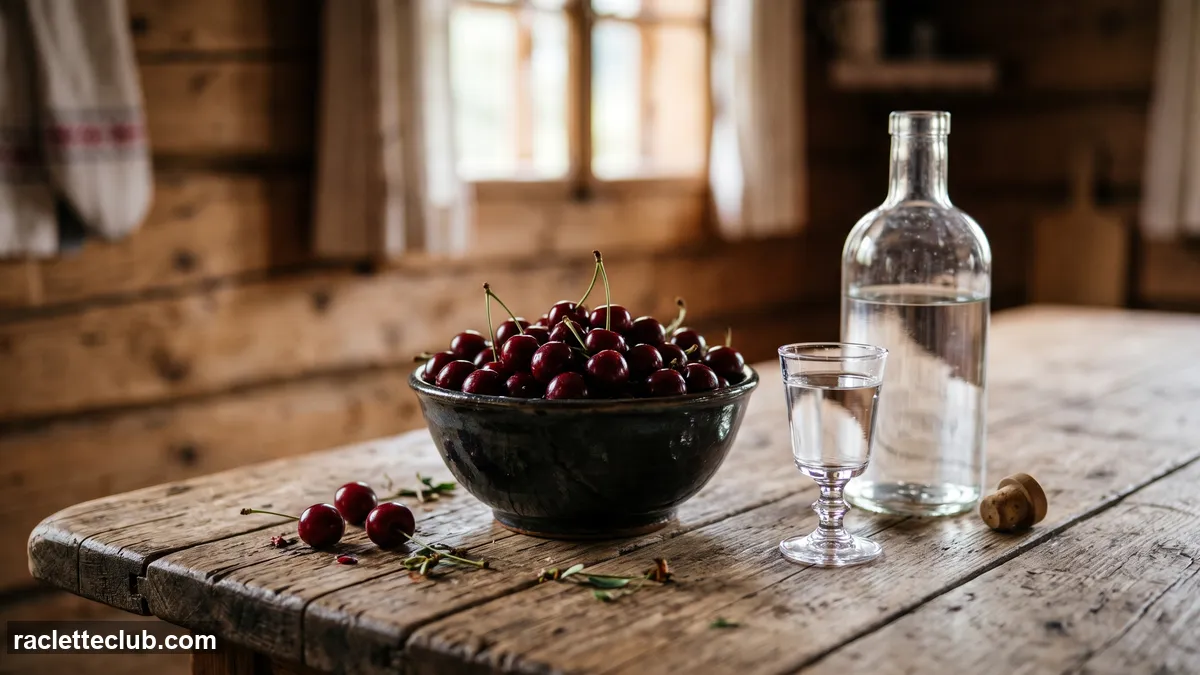
Kirsch is short for the German Kirschwasser, “cherry water.” The EU regulation on spirit drinks puts it simply: “kirsch” is the accepted name for cherry brandy, a fruit brandy that must be at least 37.5% ABV. The cherries are fermented with their pits, then distilled. The pits give it that famous bitter almond note, more or less pronounced depending on the varieties and the distiller’s skill.
The two great appellations
Zuger Kirsch and Rigi Kirsch AOP (Switzerland)
Registered by the Swiss Federal Office for Agriculture in 2013 and amended at the end of 2024, this AOP covers the whole canton of Zug and a series of municipalities in the cantons of Schwyz and Lucerne around Mount Rigi. Distilleries choose one of the two names, never both on the same bottle. The key points of the specification:
- Local cherries: a list of 63 distilling cherry varieties (Lauerzer, Zuger Rotstieler, Weggiser, sour cherries…), from standard tall-trunk cherry trees, with no more than 10% of other varieties from the area.
- The almond note: the document attributes it to the use of small regional cherries, which have a high proportion of pit.
- Production: crushing no later than 48 hours after harvest, fermentation at 23 °C (73 °F) maximum, distillation by May 31 of the following year at the latest, and a distillation heart averaging at least 68% ABV.
- In the bottle: at least 40% ABV, at least 6 months of resting, sweetening of no more than 5 g/l.
- A blind tasting every year: a score of at least 16 out of 20 is needed to carry the appellation.
Kirsch de Fougerolles AOC (France)
Recognized as an appellation of origin in 2010, Kirsch de Fougerolles comes from a small sandstone region, the Vôge, on the border between the Haute-Saône and the Vosges. The specification approved in 2015 leaves very little to chance:
- A precise area: Fougerolles and a handful of neighboring municipalities in the Haute-Saône and the Vosges, on identified orchards.
- Guignes and merises only (sweet cherry types, including wild cherries): bigarreau cherries and sour cherries are excluded. Local varieties (Béchat, Marsot, Noire de Fontaine…) must make up at least 80% of the trees.
- Natural fermentation: no heating, no added yeast, no added sugar.
- Regulated distillation: between August 15 and the following April 30, in a copper pot still.
- In the bottle: at least 45% ABV, at least six months of maturation in a neutral container, and sweetening is prohibited.
A local tradition noted in the specification: kirsch is often aged in glass demijohns, and the product sold frequently blends brandies of different ages.
The taste
A good kirsch is dry, clean and clear. The nose suggests black cherry, pit and almond, sometimes floral or spicy notes: the Swiss specification lists “floral”, “spicy”, “herbal”, “bitter almond” and “fruity ester”. The Fougerolles one talks about “clean, frank fruity and pit” character. On the palate, it’s the sharpest brandy in the family.
Kirsch in fondue… and after raclette
Kirsch is the quiet ingredient in many Swiss fondues: the moitié-moitié recipe published by the Fribourg region adds it “to taste”. Another tradition has you pause halfway through the fondue to drink a small glass of kirsch or another brandy: the famous “coup du milieu”, credited with digestive virtues.
Except science got there first. In 2010, researchers at University Hospital Zurich served fondue to 20 volunteers, with white wine or black tea, followed by a small cherry schnapps or water. The verdict, published in the BMJ: with alcohol, the stomach empties more slowly, and the schnapps tends to slow things down a little more. The good news, though: symptoms (heaviness, heartburn) weren’t any more frequent. Another study, in 2008, found no speeding-up effect from digestifs after a meal, whereas a slow walk (4 km/h, about 2.5 mph, throughout the three hours of measurement) did speed up stomach emptying, without relieving symptoms.
Same goes for raclette: kirsch doesn’t “dissolve” the cheese. It rinses the richness off your palate, and that’s already pretty great.
How to choose your kirsch
- For sipping: aim for an appellation. “Kirsch de Fougerolles” with the words “Appellation contrôlée”, or “Zuger Kirsch” / “Rigi Kirsch” AOP.
- The word “fermier” (farm-made) on a Kirsch de Fougerolles: it’s reserved for a brandy made from cherries harvested, fermented, distilled, matured and bottled on the farm.
- For baking and fondue: read the label. The EU regulation accepts the name “kirsch” for cherry brandy: check that this is what the bottle says.
Serving kirsch
The temperature: cool but not ice-cold. For Valais fruit brandies, Valais/Wallis Promotion recommends 8 to 12 °C (about 46 to 54 °F), a good starting point for kirsch too. The glass: a small tulip glass, which lets the cherry breathe. The pour: a small glass of about 2 cl (about 2/3 oz), as in the Zurich study. At 40 or 45% ABV, there’s no need for more.
Pairings
Kirsch was born for cherries: a warm clafoutis, a Black Forest cake, a sour cherry sorbet. It also loves dark chocolate, fresh pineapple and coffee. And the Zuger Kirschtorte IGP, Zug’s kirsch cake, proves you can eat it too.
More raclette digestifs
Back to the complete guide to digestifs after raclette. More fruit brandies: our page on Williams pear brandy and our page on abricotine. For an herbal liqueur, check out génépi. And if you’d rather finish without alcohol, it’s all in our guide raclette and digestion.
Frequently asked questions
Does kirsch help you digest raclette or fondue?
No. A Zurich study published in the BMJ in 2010 showed that with alcohol, the stomach empties more slowly after a fondue, though without increasing symptoms. A slow walk after the meal sped up gastric emptying in a 2008 study, where digestifs changed nothing.
What’s the difference between Kirsch de Fougerolles and Zuger Kirsch?
Kirsch de Fougerolles AOC comes from the Haute-Saône and the Vosges in France, is at least 45% ABV and can’t be sweetened. Zuger Kirsch or Rigi Kirsch AOP comes from central Switzerland, is at least 40% ABV and allows up to 5 g/l of sugar. Both require at least six months of resting.
What is the “coup du milieu”?
It’s the tradition of pausing halfway through a fondue to drink a small glass of kirsch or another brandy. As far as digestion goes, science doesn’t back it up: alcohol actually tends to slow stomach emptying.
How should you serve kirsch?
Cool but not ice-cold, in a small tulip glass, in a small pour of about 2 cl (about 2/3 oz). It pairs with cherry desserts, dark chocolate and coffee.
Sources
- Swiss Federal Office for Agriculture (FOAG): Zuger Kirsch / Rigi Kirsch AOP specification (amended December 19, 2024, in French)
- Specification for the Kirsch de Fougerolles AOC (BO Agri, January 15, 2015, in French)
- INAO: Kirsch de Fougerolles product page (in French)
- Regulation (EU) 2019/787 on spirit drinks, Annex I (category 9, fruit spirit; in French)
- Fribourg Region: moitié-moitié fondue recipe
- Heinrich et al., 2010, BMJ: wine, black tea or schnapps with fondue
- ScienceDaily: summary of the Zurich fondue study (2010)
- Franke et al., 2008, J Gastrointestin Liver Dis: digestifs, espresso and walking after a meal
- Valais/Wallis Promotion: Valais brandies (serving temperature; in French)
- Wikipedia: Kirsch, etymology and fermentation with the pits
- Fromage Suisse: “Vous avez dit fondue ?” (coup du milieu)
- Fondues.net: the coup du milieu
- Swiss Federal Office for Agriculture (FOAG): Zuger Kirschtorte IGP specification
- PubMed Central: summary of Heinrich et al., BMJ 2010
Please drink responsibly.