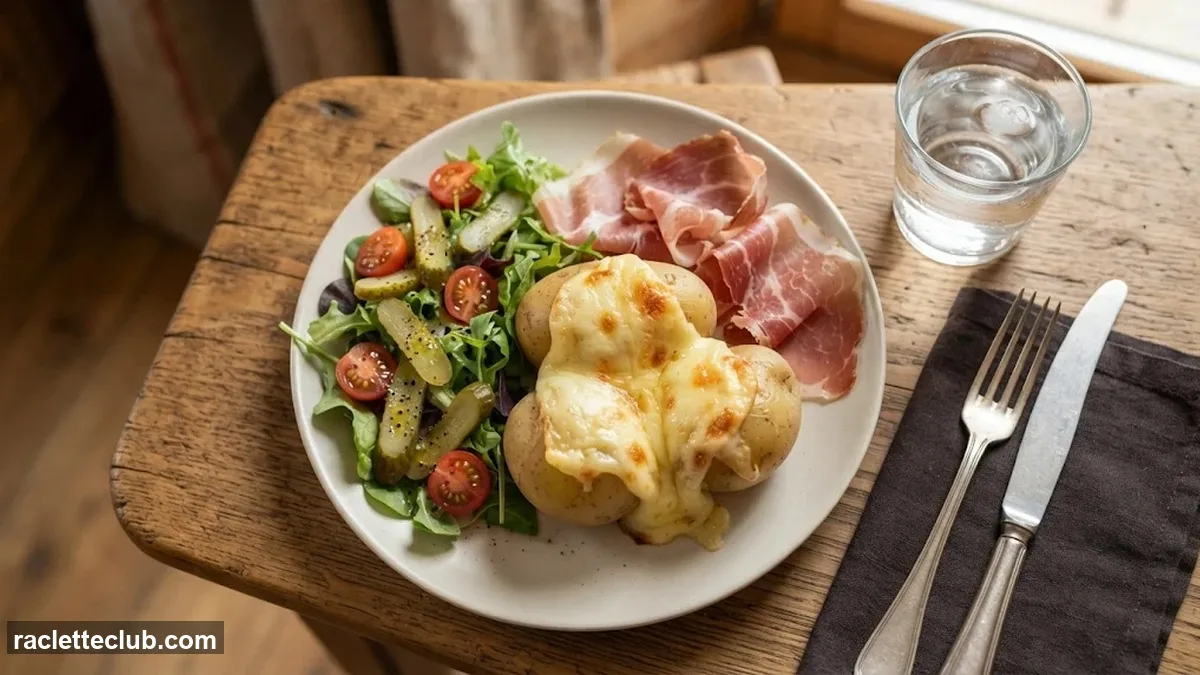
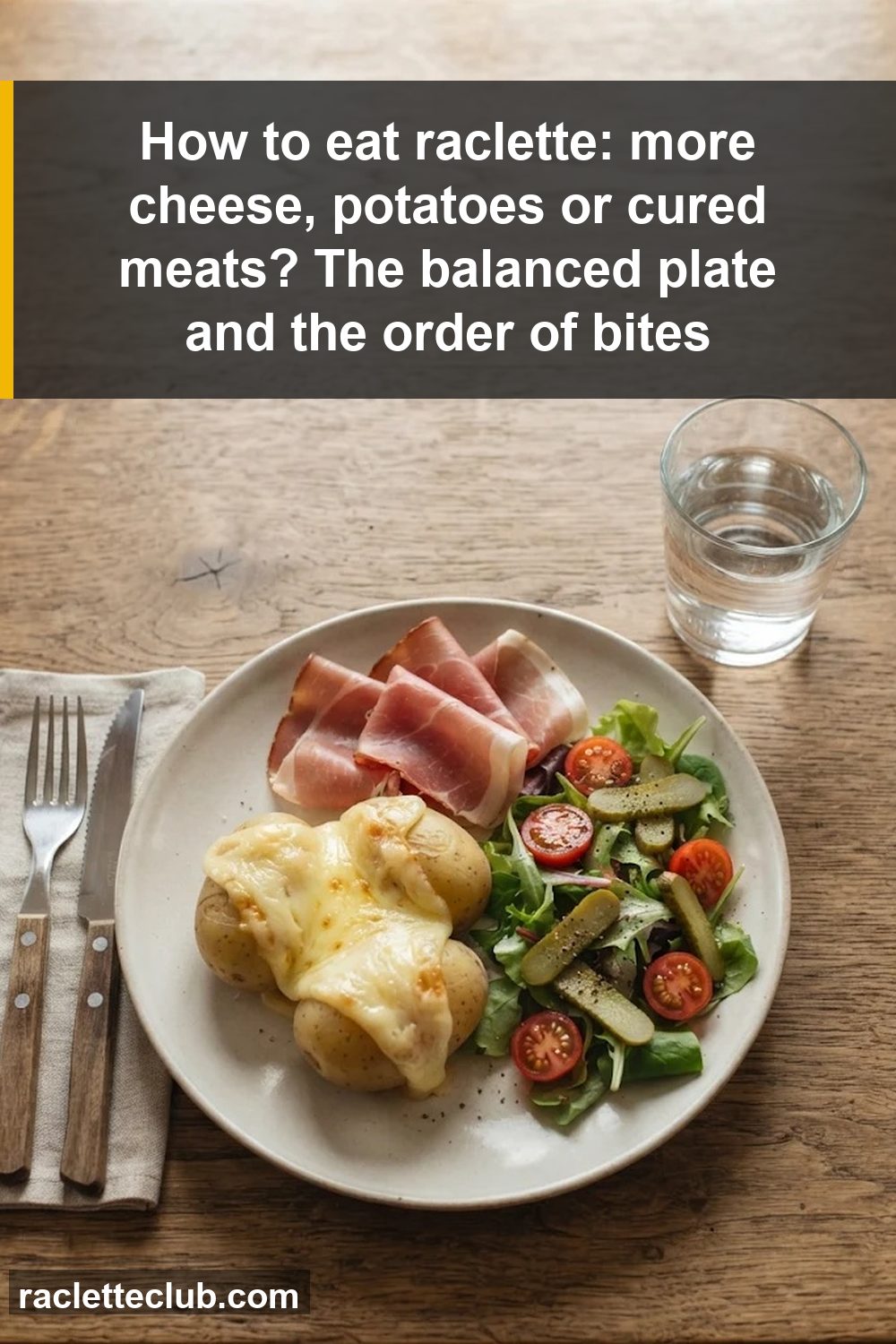
In short: for a balanced raclette plate, go for more potatoes and vegetables, a reasonable amount of cheese (around 200 g (7 oz)) and cured meats as a simple accent (about 50 g (1.8 oz)). Start with a salad or raw vegetables, eat slowly, and alternate bites rather than chaining little pans of cheese on its own.
It is the great debate at every table: there is the “cheese first, the rest is decoration” team, the “unlimited potatoes” team and the uncle who builds a mountain of cured ham. Who is right? We dug out the food composition table of ANSES, the French food safety agency, and the guidelines of Manger Bouger, the French public health agency’s nutrition site, to settle it without spoiling the party.
What each element really contains
Here are the figures from the ANSES Ciqual table, per 100 g. They speak for themselves.
| Per 100 g | Energy | Fat | Salt |
|---|---|---|---|
| Raclette cheese | 342 kcal | 27.5 g | 1.7 g |
| Cured ham | 225 kcal | 13.2 g | 5.7 g |
| Boiled potato | 80 kcal | 0.3 g | depends on the cooking salt |
Cheese is the fattiest, and fat slows down stomach emptying: it is the main culprit behind that heavy feeling. Cured meat, for its part, is the salt champion. The potato, long blamed for everything, is actually the lightest item on the plate, as long as you do not drown it in cheese.
So: more cheese, potatoes or cured meats?
Cheese remains the star: this is a raclette, not a mixed salad. Our quantity guide recommends 200 to 250 g (7 to 9 oz) per person for a dinner. For a lighter evening, stay around 200 g (7 oz). As a benchmark, Manger Bouger counts 30 g (1 oz) of cheese as one serving of dairy and recommends two a day: a raclette is a festive meal, not an everyday menu.
Potatoes can take up more room: 200 to 250 g (7 to 9 oz) per person, or a little more if you cut back on cheese. They fill you up without weighing you down. Manger Bouger points out that starchy foods, potatoes included, have their place every day.
Cured meats are best kept as an accent. Manger Bouger recommends limiting them to 150 g (5.3 oz) a week. The usual 50 to 80 g (1.8 to 2.8 oz) at a raclette therefore already represent a third to half of the week, and a lot of salt: the site notes that 5 to 6 slices of dry sausage already provide 5 g of salt, which is the limit for a whole day.
Our balanced raclette plate
| Per adult | Indulgent evening | Lighter evening |
|---|---|---|
| Raclette cheese | 250 g (9 oz) | 180 to 200 g (6.3 to 7 oz) |
| Potatoes | 200 g (7 oz) | 250 to 300 g (9 to 10.5 oz) |
| Cured meats | 80 g (2.8 oz) | 40 to 50 g (1.4 to 1.8 oz) |
| Vegetables and salad | a small salad | 200 g (7 oz) or more |
This table is our opinion as food lovers, not a medical prescription. Vegetables make all the difference: mushrooms, onions, peppers or courgettes work very well under the cheese, and a big green salad as a starter fills the plate without weighing it down. Our list of the best vegetables for raclette will give you ideas.
To get it right without thinking about it, weigh the cheese once before the meal and pre-cut the slices: we eat what is on the table, not what was planned.
Amazon Basics Digital Kitchen Scale
A simple digital kitchen scale, to weigh the cheese and potatoes once and for all. It will come in handy for desserts too.
The order of bites: start with the greens
Several studies have tested the order of foods within a meal. In people with type 2 diabetes, eating vegetables and protein fifteen minutes before starchy foods clearly reduced the blood sugar spike (Shukla, Diabetes Care, 2015). In people with prediabetes, the effect was of the same order. In Japan, the “vegetables first” instruction also improved diabetes control over two years.
Let us be honest: these studies concern people with diabetes or prediabetes, and they measure blood sugar, not digestion. But starting with a salad or raw vegetables has another obvious advantage: you reach the cheese a little less hungry. In practice:
- As a starter: green salad, raw vegetables or a small cold potato salad with vinaigrette.
- During the meal: alternate a bite of cheese with potato and vegetables, rather than three little pans of cheese on its own.
- Cured meats: with the cheese, in small amounts, not on a separate plate.
- The pace: put your fork down between two little pans, the raclette grill is not a stopwatch.
For the potato salad, a fun detail: potatoes that are cooked and then cooled contain more resistant starch. In a 2005 Swedish study on 13 healthy volunteers, boiled potatoes kept in the fridge for 24 hours, then served with vinaigrette, lowered the glycaemic index of the meal by 43% compared with freshly cooked potatoes.
Eating slowly: the real Swiss secret?
Traditional raclette is eaten pan by pan, one scraping after another: it is almost a slow meal by nature. And that is a good thing. A meta-analysis of 22 studies showed that people eat less when they eat slowly. In a study of 30 women, eating slowly reduced the meal by about 70 kcal and increased the feeling of fullness at the end.
For wine, herbal tea, an after-dinner walk and the signs that should prompt a visit to the doctor, everything is in our guide Raclette and digestion. And to go with your plate, discover the condiments that help digestion and the after-dinner herbs.
Read also
- Raclette and digestion: how to finish a rich meal well
- Condiments that help digestion
- Herbs that help digestion
- Supplements and digestion: what is worth it
- How much raclette cheese per person?
Frequently asked questions
Should you eat more cheese or more potatoes at a raclette?
For an easier-to-digest raclette, more potatoes and vegetables, and a reasonable amount of cheese, around 200 g (7 oz) per adult. Cheese is the fattiest item on the plate (27.5 g of fat per 100 g according to ANSES, the French food safety agency), potato the lightest.
How much cured meat per person for a raclette?
Allow 40 to 80 g (1.4 to 2.8 oz) per person. Manger Bouger, the French public health nutrition site, advises limiting cured meats to 150 g (5.3 oz) a week: one raclette already accounts for a good share of that, and a lot of salt.
In what order should you eat a raclette?
Start with a salad or raw vegetables, then alternate cheese, potatoes and vegetables, taking your time. Studies on food order mainly concern people with diabetes, but starting with the greens also helps you reach the cheese less hungry.
This article gives general guidelines and does not replace the advice of a doctor or dietitian. If you follow a specific diet (diabetes, high blood pressure, low-salt diet), ask a healthcare professional for advice.
The Amazon links on this page are affiliate links: if you buy through them, Raclette Club earns a small commission at no extra cost to you. We do not track prices: check them on Amazon.
Sources
- ANSES, the French food safety agency, Ciqual food composition table (raclette 12749, cured ham 28800, boiled potato 4003) (in French)
- Manger Bouger, the French public health nutrition site: cured meats (in French)
- Manger Bouger: dairy products (in French)
- Manger Bouger: fruit and vegetables (in French)
- Manger Bouger: starchy foods (in French)
- Levine et al., Gut and Liver 2015: fatty meals and stomach emptying
- Shukla et al., Diabetes Care 2015: food order and blood sugar
- Shukla et al., 2019: food order in people with prediabetes
- Imai et al., 2011: vegetables first, a two-year trial
- Leeman et al., 2005: cooled potatoes, vinegar and blood sugar
- 2020 review: resistant starch
- Robinson et al., 2014: meta-analysis on eating rate
- Andrade et al., 2008: eating slowly and satiety