
In short: there are no digestive condiments that “melt” the cheese in your stomach. Cornichons and mustard mostly balance the fat on your palate. Caraway has a recognised traditional use against bloating, and ginger speeds up stomach emptying without actually relieving sensitive stomachs. The rest is a matter of taste, and that is already a lot.
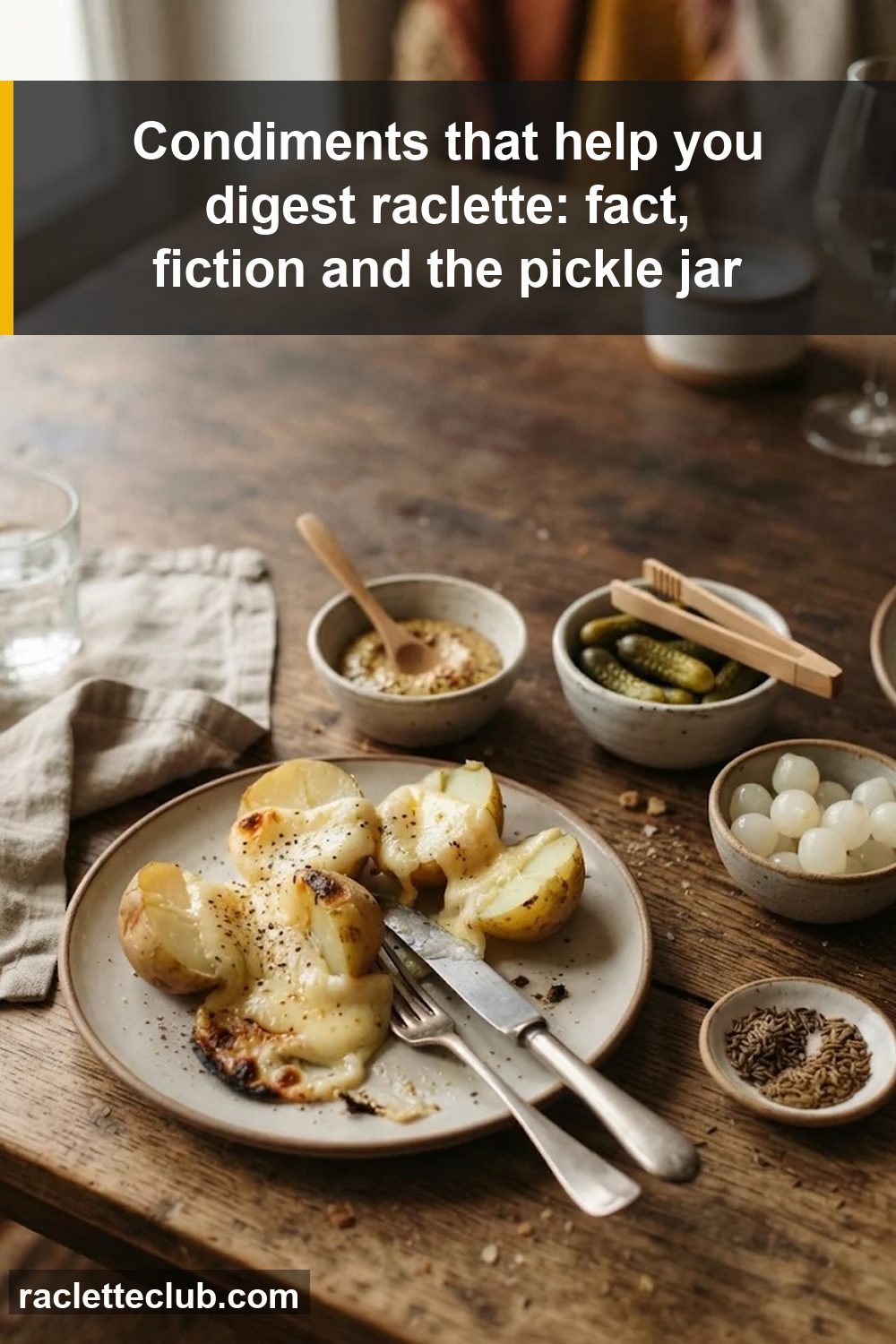
On every raclette table there is that little jar of cornichons everyone dips into “to help it go down”. Good news: you are right to love them. Less good news: science does not say quite what tradition claims. We went through the classic condiments, using official sources and published studies, to find out which ones deserve their reputation as digestion helpers.
Why you feel heavy after a raclette
Raclette cheese contains about 27 g of fat per 100 g, according to the Ciqual table of ANSES, the French food safety agency. And fat slows down stomach emptying: that is what stretches out the over-full feeling after a rich meal, as a review published in Gut and Liver in 2015 points out. Add cured meats, potatoes and white wine, and you get the famous 11 pm nap on the sofa.
A condiment does not change these mechanics. It can, however, make the meal more pleasant, make you want more vegetables, and sometimes limit bloating. For the full picture (portions, walking, herbal teas, when to see a doctor), read our guide Raclette and digestion: how to finish a rich meal well.
Cornichons and pickled onions: the cult duo
Their acidity cuts through the fat of the cheese, which is why they have been on every table forever. But beware of the popular belief: vinegar does not speed up digestion, it rather does the opposite. In a 1998 Swedish study on ten volunteers, adding vinegar to white bread lowered blood sugar after the meal, most likely because the stomach emptied more slowly. Another study, in 2005, found more satiety with more vinegar.
In other words, cornichons may help you feel full a little sooner, which is no bad thing when facing your fifth little pan. Another useful detail: shop-bought cornichons in vinegar are not fermented foods. According to the ISAPP scientific consensus published in 2021, vegetables pickled in vinegar contain no live cultures. Finally, if you are prone to acid reflux, go easy: Ameli, the French national health insurance, lists vinegar among the foods that can trigger it.
Maille Cornichons Original
The original cornichons from the Dijon house of Maille, crunchy and nicely tangy: the classic you find on most raclette tables. Check availability on Amazon.
Raw sauerkraut and lacto-fermented vegetables
If you are looking for live cultures, head for raw sauerkraut or lacto-fermented vegetables sold in the chilled section, labelled “raw” or “unpasteurized”. Once pasteurized, they no longer contain live microorganisms, according to the same 2021 consensus.
What do we know about their effects? Not much, honestly. A Stanford University trial published in Cell in 2021 showed that a diet rich in fermented foods gradually increased microbiota diversity in healthy adults. But it did not measure the digestion of a meal. And in a small trial on irritable bowel syndrome, pasteurized sauerkraut did as well as raw. We found no study on sauerkraut for digesting a raclette. Our take: a few forkfuls of raw sauerkraut on the side are tangy, crunchy and original. Just not a remedy.
Caraway and cumin: the seeds of tradition
Caraway, often confused with cumin, is the best-documented condiment on this list. The European Medicines Agency (EMA) recognises its traditional use for relieving bloating and flatulence. Traditional use means the plant has been used for a long time with no known problems, not that its effectiveness has been proven in clinical trials. The monograph advises against it under 12, during pregnancy and breastfeeding, in case of liver disease or gallstones, and in case of allergy to celery, fennel or anise.
Cumin, on the other hand, has neither an EMA monograph nor a controlled trial: all we found was an Iranian case series with no comparison group. We love it for the taste, full stop. A pinch of caraway or cumin on jacket potatoes changes everything, and it is a genuine tradition in Alpine and Alsatian cooking.
McCormick Gourmet Organic Caraway Seed 1.62 oz
Whole organic caraway seeds in a small 1.62 oz jar, to sprinkle on potatoes or steep after the meal. A little goes a long way.
McCormick Cumin Seed 0.95 oz
Whole cumin seeds in a 0.95 oz jar, for those who prefer its warmer aroma. For the taste, not for your health: no serious study credits it with a digestive effect.
Ginger: it speeds up the stomach, no miracle
It is the only condiment on this list that does the opposite of vinegar. In a trial published in 2008 on 24 healthy volunteers, 1.2 g of ginger in capsules halved stomach emptying time. But in people with digestive complaints (dyspepsia), a 2011 study found that the stomach emptied faster without the symptoms improving.
The EMA recognises a traditional use of ginger against bloating and mild digestive complaints. Pickled ginger, or ginger grated into a vinaigrette, brings freshness next to the cheese. In large amounts it can cause heartburn, according to the US NCCIH: if you take any medication, talk to your doctor or pharmacist before taking it in capsules.
Mustard, pepper and paprika: flavour, not proof
Dijon mustard on a slice of cured ham is divine. But we found no human study showing that it helps digestion. For pepper, the only lead is a rodent study, in which piperine actually slowed stomach emptying. As for reflux, the UK National Health Service (NHS) lists spicy food among the triggers of heartburn: if that is your weak spot, go easy.
Maille Dijon Originale mustard 13.4 oz (pack of 2)
Maille’s original Dijon mustard, in a pack of two 13.4 oz jars, to wake up the cured meats. Not digestive, but so good we forgive it.
The summary
| Condiment | What we know | Our advice |
|---|---|---|
| Cornichons, pickled onions | Vinegar slows stomach emptying and increases satiety | Yes for the taste, go easy if you have reflux |
| Raw sauerkraut | Live cultures, effect on digestion not demonstrated | On the side, for variety |
| Caraway | Traditional use recognised by the EMA against bloating | On potatoes or as an infusion |
| Cumin | No serious evidence | For the aroma |
| Ginger | Speeds up stomach emptying, symptoms unchanged | In small amounts, medical advice if on medication |
| Mustard, pepper | No human study on digestion | For pleasure |
The real secret of an easy-to-digest raclette is not in the jar, it is on the plate: the share of cheese, potatoes, cured meats and vegetables. We explain everything in How to eat raclette: the balanced plate and the order of bites.
Read also
- Raclette and digestion: how to finish a rich meal well
- Fennel, aniseed, caraway, ginger: grandma’s seeds and spices
- Herbs that help digestion
- Cheese, potatoes or cured meats: the balanced raclette plate
- Supplements and digestion: what is worth it
- The best vegetables for raclette
Frequently asked questions
Do cornichons help you digest raclette?
Not strictly speaking. Their acidity balances the fat on your palate and vinegar slightly increases satiety, but it rather slows stomach emptying. They are excellent companions, not a remedy.
Which condiment should I choose for bloating?
Caraway is the only condiment on this list with a traditional use recognised by the European Medicines Agency against bloating and flatulence. It is not recommended under 12, during pregnancy, or in case of liver disease or gallstones.
Is raw sauerkraut better than cooked?
Raw sauerkraut keeps its live cultures, pasteurized sauerkraut does not. But no study shows that it helps you digest a rich meal: it is mostly a tangy, original side dish.
This article is for information only and does not replace the advice of a doctor or pharmacist. If you are pregnant, breastfeeding, on medication, or if your digestive problems keep coming back, ask a healthcare professional for advice.
The Amazon links on this page are affiliate links: if you buy through them, Raclette Club earns a small commission at no extra cost to you. We do not track prices: check them on Amazon.
Sources
- ANSES, the French food safety agency, Ciqual food composition table (raclette, code 12749) (in French)
- Levine et al., Gut and Liver 2015: fatty meals and stomach emptying
- Liljeberg and Björck, 1998: vinegar, blood sugar and stomach emptying
- Östman et al., 2005: vinegar, blood sugar and satiety
- Marco et al., 2021: ISAPP consensus on fermented foods
- Wastyk et al., Cell 2021: fermented foods and the microbiota
- Pilot trial: sauerkraut and irritable bowel syndrome
- European Medicines Agency: caraway fruit
- Agah et al., 2013: cumin and irritable bowel syndrome, case series
- Wu et al., 2008: ginger and stomach emptying
- Hu et al., 2011: ginger and functional dyspepsia
- European Medicines Agency: ginger
- NCCIH: ginger
- Ameli, the French national health insurance: acid reflux, what to do and when to see a doctor (in French)
- NHS: heartburn and acid reflux