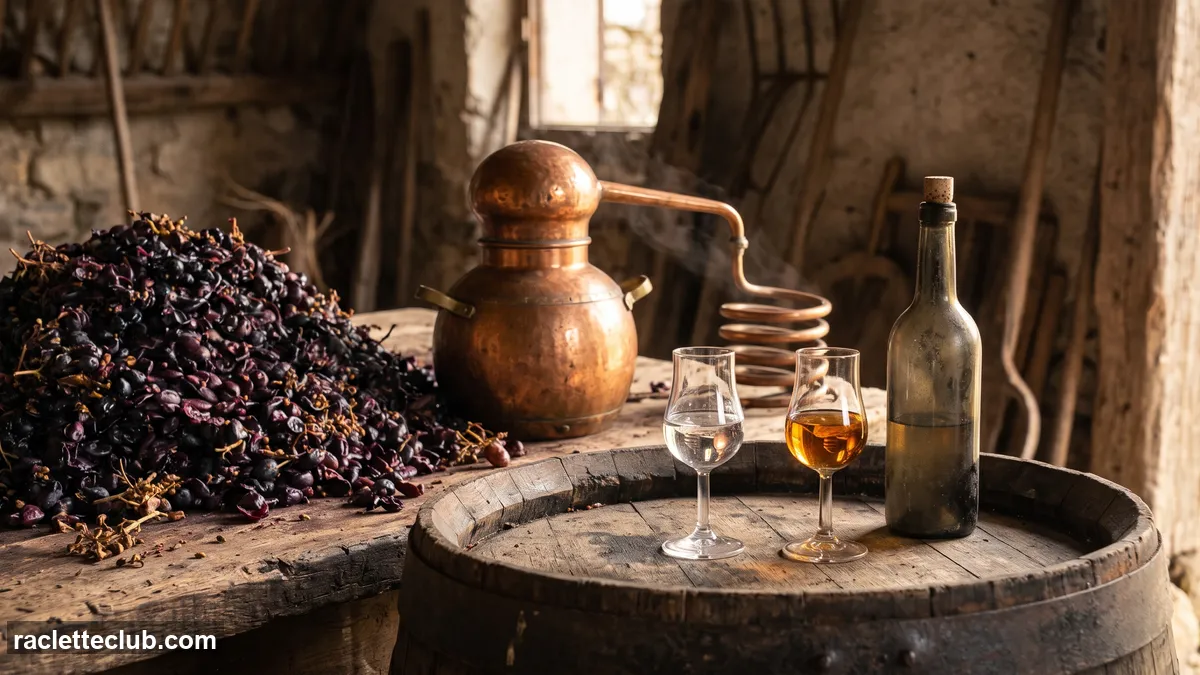
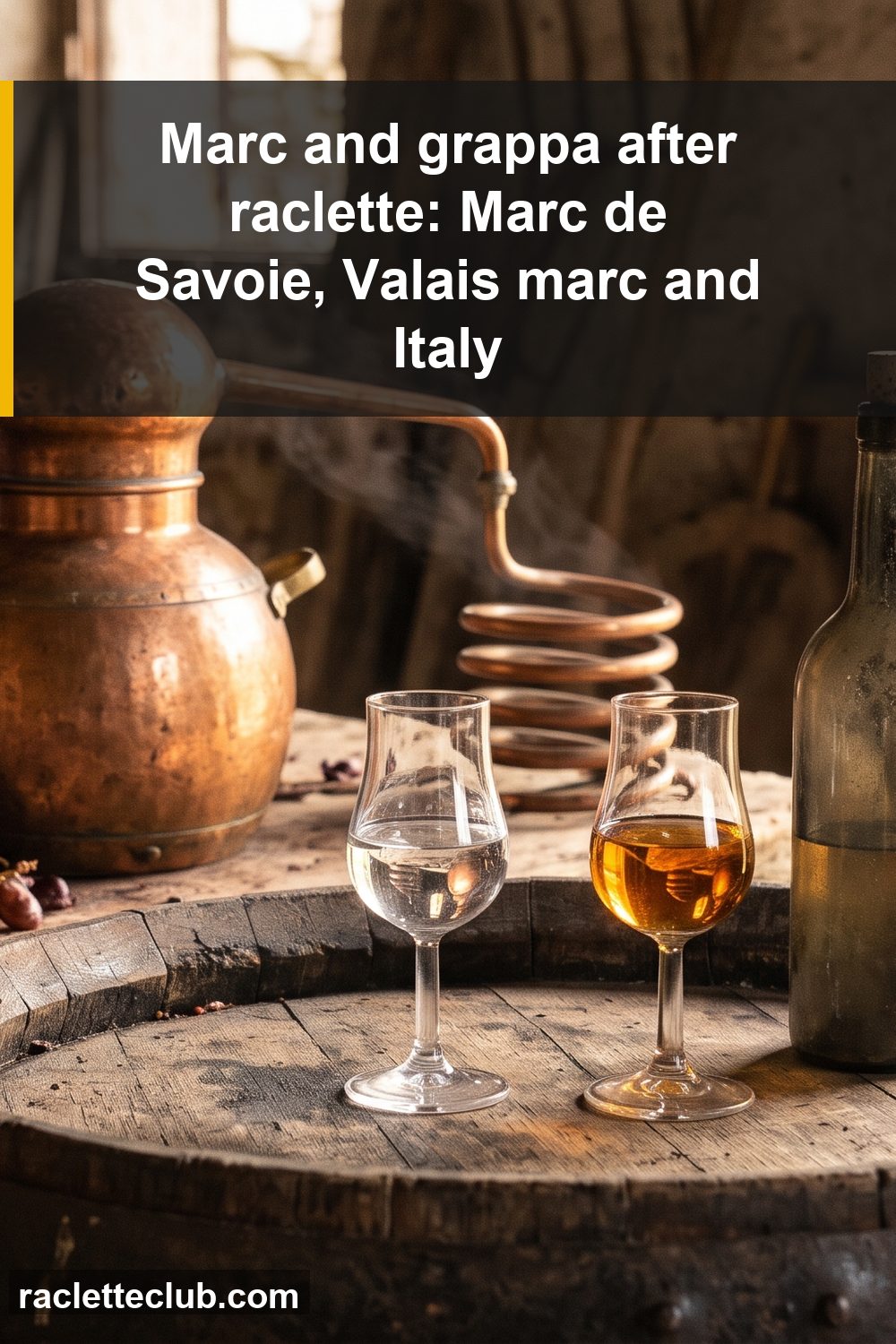
In short: marc and grappa are brandies distilled from grape pomace, what’s left of the skins, seeds and stems after pressing. On the Alpine side, Marc de Savoie is a geographical indication governed by a specification (40% ABV minimum at sale). On the Italian side, Grappa is protected too, with precise aging terms. After a raclette, it’s the winemaker’s digestif: straightforward, aromatic, in a small pour.
This article contains Amazon affiliate links: if you buy through these links, Raclette Club earns a small commission at no extra cost to you. Learn more.
Marc, grappa: the same idea, several terroirs
The principle comes from good old farmhouse wisdom: waste nothing. The pomace, that cake of skins and seeds left behind by the press, is still packed with aromas, so it gets distilled. The EU regulation on spirit drinks (EU 2019/787) defines “grape marc spirit or grape marc”: it’s produced exclusively from fermented pomace, distilled at less than 86% ABV, with the first distillation carried out in the presence of the pomace itself. A little wine lees may be added, up to 25 kg per 100 kg of pomace. The minimum strength is 37.5% ABV, flavoring is prohibited, and sweetening, to round out the taste, is capped at 20 g per liter.
Marc de Savoie (geographical indication)
Its specification, approved by the decree of July 15, 2024, is precise. The pomace comes from grapes harvested within the area of the Vin de Savoie or Savoie, Roussette de Savoie and Seyssel appellations: Jacquère, Altesse, Mondeuse, Gamay, Roussanne and, in Haute-Savoie, Chasselas, among others. Distillation takes place before March 31 following the harvest, in copper stills, at 72% ABV maximum. It’s sold at 40% ABV minimum, either clear after at least one month of resting in tank, or aged at least two years in oak. The document describes it as floral, slightly fruity and round, with a finish that doesn’t burn; aged, it turns amber.
Marc in the Valais
The Valais knows pomace brandy too: the historical brochure of the Morand distillery, in Martigny, recounts that it distilled it from its earliest days. Be aware, though: unlike Abricotine and Williams pear brandy, Valais marc is not an AOP on the Swiss register, according to the list of Valais AOP brandies published by the canton’s promotion agency. So quality depends entirely on the distiller.
Italian Grappa
Grappa is an Italian geographical indication, governed by a technical file amended by Ministerial Decree No. 747 of January 28, 2016. This text reserves the terms “vecchia” or “invecchiata” for grappas aged at least 12 months in unvarnished wooden casks or containers, in cellars under tax control, and “riserva” or “stravecchia” for those aged at least 18 months. There are also regional indications, such as Grappa del Friuli, whose technical file sets a minimum of 40% ABV.
The taste: from young and lively to old and amber
A clear marc or grappa is grape in its most direct form: flowers, fruit, a hint of rusticity, sometimes a green touch reminiscent of the stems. It’s lively, it “wakes you up”. The wood-aged versions round out, pick up notes of vanilla, dried fruit and wood, and go easy on palates that dread the burn.
Why after a raclette (and why it won’t help you digest)
Marc is the ultimate terroir pairing: it comes from the same vines as the white wines served with the cheese. A Marc de Savoie after a raclette washed down with Apremont is the grape’s story told all the way to the end.
But let’s be honest: the “digestif” effect is a stubborn legend. In 2010, Zurich researchers published a trial in the BMJ in which 20 volunteers ate cheese fondue with white wine or black tea, followed by a small glass of kirsch or water. The result: the stomach emptied more slowly with alcohol, with no clear difference in symptoms. A 2008 German study on several digestifs found no faster gastric emptying; a slow walk (4 km/h, about 2.5 mph, throughout the three hours of measurement), however, did, without relieving symptoms. Marc is a pleasure, not a medicine.
To finish the meal without alcohol, check out our guide raclette and digestion instead, with its herbal teas and alcohol-free tips.
How to choose
- The protected name: “Marc de Savoie” or “Grappa” on the label guarantees a specification has been followed; a plain “eau-de-vie de marc” (pomace brandy) only follows the general EU definition.
- Clear or aged: clear for freshness and fruit, aged (two years minimum for an aged Marc de Savoie, “invecchiata” or “riserva” for a grappa) for roundness.
- The grape variety: when it’s listed, it’s a good clue to the aromatic profile.
Serving
Small glass, small pour: 2 to 3 cl (about 2/3 to 1 oz) is enough. A tulip glass (the famous grappa glass) concentrates the aromas and keeps your nose from getting singed. To our taste, clear ones are served cool rather than ice-cold, aged ones closer to room temperature.
Pairings
- Coffee: to our taste, grappa and espresso make a fine pair, in a separate glass or right in the cup.
- Nuts: walnuts and hazelnuts go nicely with aged marcs.
- Dark chocolate: with a grappa riserva and its woody notes.
More raclette digestifs
To compare them all, head back to the complete guide to digestifs after raclette. If you prefer fruit to grapes, discover our Abricotine du Valais page and our kirsch page. For an herbal liqueur, read our Chartreuse page. And for the wine served during the meal, see the guide to wines for raclette.
Frequently asked questions
What’s the difference between marc and grappa?
Both are grape pomace brandies, defined by the same EU category. The name “Grappa” is an Italian geographical indication with its own rules, while “marc” refers to pomace brandy in general and “Marc de Savoie” is a French geographical indication.
How strong is Marc de Savoie?
Its specification requires a minimum strength of 40% ABV at the time of sale. It can be clear (at least one month of resting) or aged at least two years in oak.
What does “riserva” mean on a grappa?
According to the 2016 Italian decree, “riserva” or “stravecchia” refers to a grappa aged at least 18 months in wood; “invecchiata” or “vecchia” means at least 12 months.
Does a glass of marc after raclette help digestion?
No. The available studies show no faster digestion with a digestif, and a cheese fondue trial even observed slower stomach emptying with alcohol. A slow walk sped up emptying, without relieving symptoms.
Sources
- Specification for the “Marc de Savoie” geographical indication, decree of July 15, 2024 (French Ministry of Agriculture official bulletin, in French)
- Regulation (EU) 2019/787 on spirit drinks, Annex I, category 6 (EUR-Lex, in French)
- Italian Ministerial Decree of January 28, 2016, technical file for “Grappa” (Gazzetta Ufficiale, in Italian)
- Excerpts from Decree No. 747 of January 28, 2016 on grappa aging terms, reproduced by a distillery
- Technical file for the “Grappa friulana / Grappa del Friuli” geographical indication (eAmbrosia, European Commission)
- Valais/Wallis Promotion: Valais AOP brandies (in French)
- Heinrich et al., BMJ 2010: wine, black tea or schnapps with cheese fondue
- Franke et al., J Gastrointestin Liver Dis 2008: digestifs, espresso and walking after a meal
- Morand distillery: historical brochure (in French)
- PubMed Central: summary of Heinrich et al., BMJ 2010
Please drink responsibly.