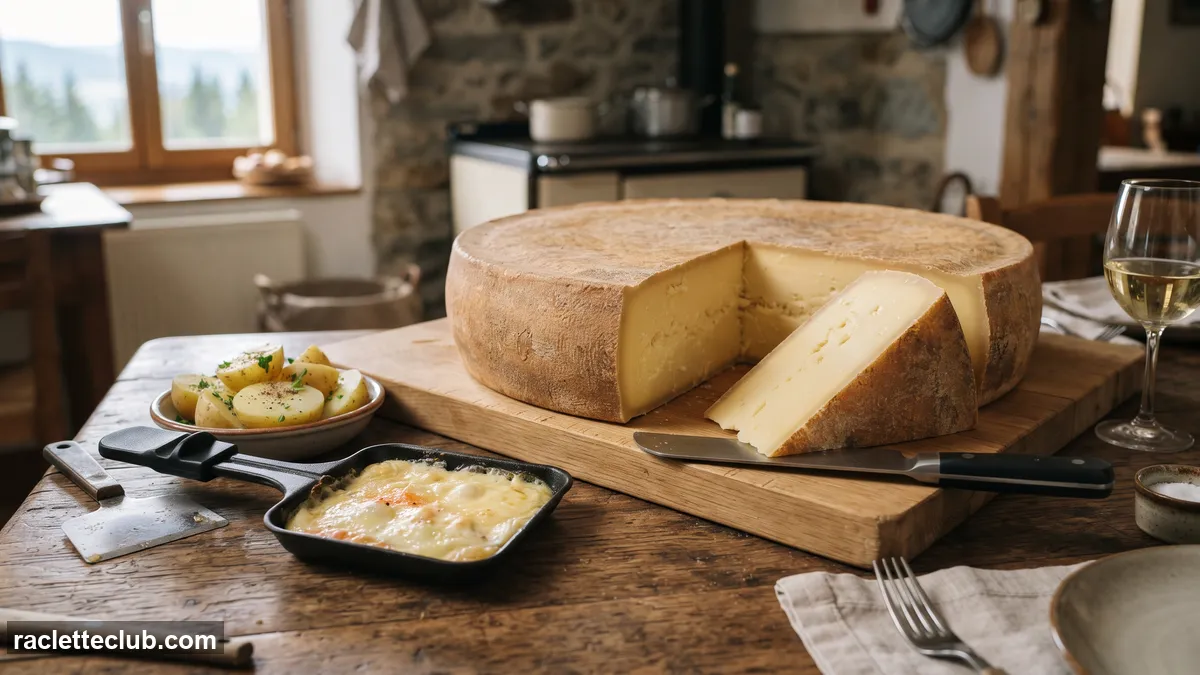
In short: Comté AOP is the great cheese of the Jura Mountains, made from the raw milk of Montbéliarde or French Simmental cows and aged for at least 4 months. It melts well and goes into plenty of fondues, but it isn’t a raclette cheese in the strict sense. Our honest advice: at a raclette, use a fairly young Comté, blended with a raclette cheese, and save the 18- or 24-month Comtés for the cheese board, where they shine without leaking fat into the pan.
This article contains Amazon affiliate links: if you buy through these links, Raclette Club earns a small commission at no extra cost to you. Learn more.
Comté: ID card
| Criterion | Comté AOP |
|---|---|
| Country | France |
| Region | Jura Mountains, between 200 and 1,500 m altitude: Doubs, Jura and part of Ain (INC) |
| Designation | AOC since 1958, European PDO since 1996 (INC) |
| Milk | Cow’s milk, raw, exclusively from Montbéliarde or French Simmental breeds, fed on grass and hay, silage forbidden (DRAAF Bourgogne-Franche-Comté) |
| Paste | Cooked pressed, from the gruyère family: curd heated and stirred at 53 °C for at least 30 minutes (DRAAF) |
| Aging | 4 months minimum on spruce boards; 8 months on average, sometimes 12, 18 or 24 months (DRAAF, INC) |
| Format | Wheel of 32 to 45 kg, 55 to 75 cm in diameter, 8 to 13 cm high on the side (DRAAF) |
| Flavor | Six aroma families (fruity, milky, toasted, vegetal, animal, spicy) and more than 90 nuances; ivory to yellow paste (INC) |
| Meltability | Good, a fondue classic. Very old Comtés melt less evenly |
Eight centuries of fruitières
Comté is a collective cheese. As early as the 13th century, it was made in village cooperatives, the fruitières, where farmers pooled their milk every day. According to the European Commission, the first one was set up in 1253 in Déservillers, in the Doubs. The logic is simple: one wheel takes about 400 liters of milk, the output of some twenty Montbéliarde cows, says France’s National Consumer Institute (INC). No small farmer of old could fill one alone.
The model has held up. Comté is still made in more than 150 fruitières, and with more than 64,000 tonnes in 2014, it was the most produced PDO cheese in France, according to the INC. Each wheel carries a green casein plaque on its side showing where and when it was made. The milk must go into production within 24 hours of milking, and a dairy’s collection area can’t exceed a circle 25 km in diameter (DRAAF).
Flavor and melt: a good raclette cheese?
Let’s be frank. Comté is a magnificent cheese, but it isn’t a raclette cheese. Raclette cheeses are uncooked pressed cheeses, like Raclette de Savoie (white paper on mountain pressed cheeses). Comté is a cooked pressed cheese, drier, made for aging. It still melts well: the French food guide Le Fooding lists it with Beaufort, Gruyère and Emmental among the cooked pressed cheeses favored for fondue.
It all depends on its age. Cook’s Illustrated’s melted cheese tests show that an older cheese, which has lost water, gives more separated fat and more clumps, while a young cheese melts more evenly. To our taste, a young, still mild Comté melts into a supple layer. A 24-month Comté, much more powerful, may “sweat” fat in the pan and lose its subtle aromas under the heat. That would be a shame for it and for your wallet.
Our verdict: on its own, a young Comté makes a flavorful raclette but runs less than a classic raclette. Blended with a Raclette du Valais AOP or a Morbier, it brings a very pleasant nutty fruitiness.
How to serve it at a raclette
- Quantity: our team’s benchmark is 200 g of cheese per person in total, about one third of it Comté.
- Which Comté? Ask your cheesemonger for a young Comté for the pan. Long-aged ones go on the board.
- In thin slivers: they melt at the same time as the slice of raclette underneath.
- The Jura duo: a slice of Morbier, a sliver of Comté, a potato, and a Morteau sausage on the side. The mountains on a plate.
- Before serving: take it out of the fridge a while before the meal so it melts more evenly.
Which wines go with Comté
The terroir pairing is unbeatable, in our opinion: a white wine from the Jura, Chardonnay or Savagnin, whose walnut notes echo those of Comté. For the appetizer, a Crémant, from the Jura if possible, refreshes between pans. And for red, a light, low-tannin Pinot Noir doesn’t overshadow the cheese.
In the pantry
The rest of the board is this way: head back to the raclette pantry. Comté’s cousins have their own guides too: Le Gruyère AOP, Beaufort and Emmentaler.

Frequently asked questions
Can you make raclette with Comté?
Yes, with a fairly young Comté, preferably blended with a raclette cheese. It’s a cooked pressed cheese, less runny than a classic raclette.
How old should Comté be for melting?
A young Comté melts more evenly. Very aged cheeses have lost water and release fat more easily when melted: save them for the cheese board.
How long is Comté aged?
At least 4 months, on spruce boards. Average aging is around 8 months and can reach 12, 18 or 24 months.
Is Comté always made with raw milk?
Yes. The specifications require raw milk from Montbéliarde or French Simmental cows, fed on grass and hay.
Sources
- DRAAF Bourgogne-Franche-Comté (Agreste): Comté PDO fact sheet and specifications (in French)
- French National Consumer Institute: Comté, the secrets of a Jura cheese (in French)
- European Commission: Comté PDO (geographical indication page)
- Le Fooding: a treatise on melted cheese (in French)
- Fromages & Chefs: white paper on mountain pressed cheeses (2016, in French)
- Cook’s Illustrated: why young cheese melts better than aged cheese