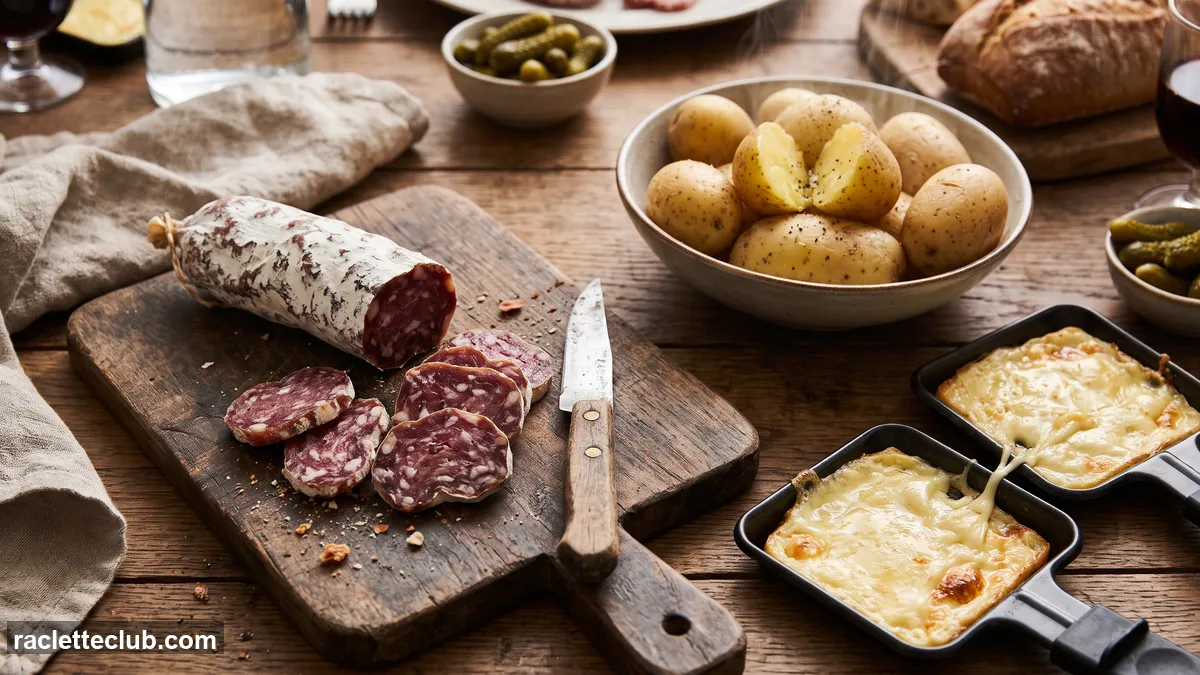
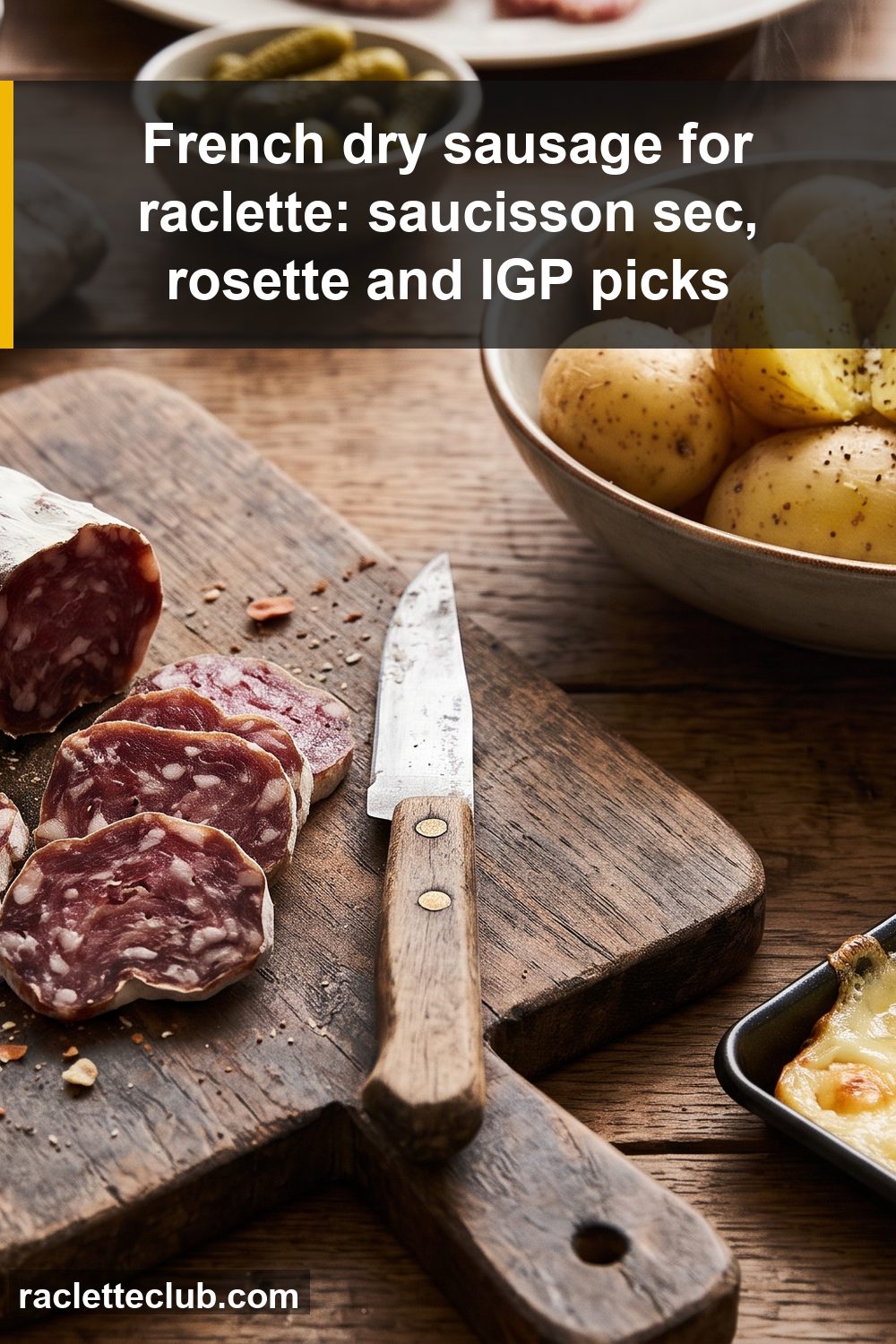
In short: saucisson sec (French dry sausage) is ground pork meat and fat, stuffed into a natural casing, fermented in a warm room and then dried. Rosette and jésus are saucissons named after their casing. For a guaranteed origin, look for an IGP: Saucisson de l’Ardèche, Saucisson sec d’Auvergne, Saucisson de Lacaune or Saucisson sec de l’Île de Beauté. “Saucisson de Savoie” and rosette de Lyon, on the other hand, aren’t in the EU register of IGPs. Cut into thin slices, it brings salt, pepper and crunch to the raclette platter.
This article contains Amazon affiliate links: if you buy through these links, Raclette Club earns a small commission at no extra cost to you. Learn more.
Saucisson sec, rosette, jésus: what are we talking about?
A saucisson sec is a raw cured meat, preserved by salt and drying. The specifications of Saucisson de l’Ardèche IGP sum up the method well: fresh meat and hard pork fat, ground, stuffed into natural pork casing, fermented in a warm room and then dried. During drying, the “bloom” develops, that white down on the surface, natural or obtained by dipping. It regulates the drying and keeps the saucisson from forming a crust.
The casing isn’t a detail: it often gives the product its name. Rosette is stuffed into the last part of the pig’s digestive tract. According to the Office québécois de la langue française, it owes its name to the little collar of flesh left at that end. Its thick casing slows drying considerably, which gives it a particular flavor, notes the Ardèche specifications. Jésus is a big, pot-bellied saucisson stuffed into the cecum (the “sac”). In the Ardèche, it weighs over 400 g and was traditionally served at Christmas, hence its name.
And the regional names? The EU’s eAmbrosia register includes Saucisson de l’Ardèche, Saucisson sec d’Auvergne, Saucisson de Lacaune and Saucisson sec de l’Île de Beauté, all as IGPs. “Saucisson de Savoie” isn’t there: an IGP project was examined by INAO’s national committee in October 2011, but it went nowhere, and as of November 2, 2026, the name doesn’t appear in the register, either as an IGP or as a pending application. Nor does rosette de Lyon: the trade magazine Réussir reported in October 2004 that INAO had approved its IGP specifications and that it had already held a Label Rouge since 2001, but no “Rosette de Lyon” IGP has been registered, and no application is pending in the EU register.
| Name | Status | What sets it apart |
|---|---|---|
| Saucisson sec | Generic name | Ground pork, casing, warm-room fermentation and drying |
| Rosette | Casing name | Thick end casing, slow drying, tapered shape |
| Jésus | Casing name | Big, pot-bellied saucisson in the cecum |
| Saucisson de l’Ardèche | IGP | Pre-salted meat, natural pork casing, made in the Ardèche |
| “Saucisson de Savoie” | No registered IGP | Check the origin on the label |
Why saucisson goes with raclette
Saucisson ticks every box of a good neighbor for melted cheese: it’s salty, peppery, a little tangy when well matured, and its firm texture contrasts with the softness of the cheese. To our taste, a rosette or a fine-grained saucisson goes very well with a Raclette de Savoie IGP or a blend with Tomme de Savoie. A bolder saucisson, with pepper or herbs, holds up well against a smoked raclette. These are opinions, to adjust to your taste.
How to choose your saucisson
- The IGP logo: it’s the only guarantee of a monitored origin and method. A regional name without a logo commits only the producer.
- The casing: look for “boyau naturel” (natural casing) on the label. IGPs like the Ardèche one require it, and it’s what gives rosette or jésus its name.
- The bloom: an even white down is normal, it’s part of the drying. It comes off with the skin.
- Firmness: in our opinion, you want a saucisson that’s firm but not hard as wood. Press gently before buying one at the counter.
How much to plan and how to serve it
Our team’s benchmark: 100 to 150 g of cured meats in total per adult for raclette. If the saucisson sits next to a cured ham and an air-dried beef, 30 to 50 g per person, or one small saucisson for four, is plenty. Santé.fr recommends limiting cured meats to 150 g per week: one more reason to go for quality rather than quantity.
Remove the skin just before slicing, on the diagonal and not too thick. Serve it at room temperature, on a board. Some guests like to put a few slices on the top plate, just until the fat starts to glisten: it’s indulgent, worth trying once. Once cut, keep it wrapped in a kitchen towel, somewhere cool.
Pregnant women: saucisson sec is a raw cured meat. France’s national health insurance (ameli.fr) recommends cooking raw charcuterie thoroughly before eating during pregnancy, because of listeriosis. So it’s best to skip it that night.
Which wine to serve with saucisson?
Saucisson calls for simple, easy-drinking wines. A light Beaujolais is the ultimate bistro pairing, especially with a rosette. A Gamay from Savoie does the same job, Alpine style. For white, a crisp Apremont refreshes the palate between saucisson and cheese. Our advice, nothing more.
In the pantry
Back to the raclette pantry. To round out the board, read our guides to cured ham, coppa, pancetta and speck and Morteau and Montbéliard sausages.
Frequently asked questions
What’s the difference between rosette and saucisson sec?
Rosette is a saucisson sec stuffed into the last part of the pig’s intestine, which gives it its name and its tapered shape. This thick casing slows the drying and gives it a particular flavor.
Is saucisson de Savoie an IGP?
No. An IGP project was examined by INAO in 2011, but it went nowhere: the name doesn’t appear in the EU’s eAmbrosia register, either as an IGP or as a pending application. French dry sausages with an IGP include those from the Ardèche, Auvergne, Lacaune and the Île de Beauté (Corsica).
How much saucisson should you plan for a raclette?
Our benchmark: 30 to 50 g per person if the saucisson comes with other cured meats, within a total of 100 to 150 g of cured meats per adult.
Should you remove the white bloom from saucisson?
This bloom develops during drying and helps regulate it. You simply remove the skin before slicing, and the bloom comes off with it.
Sources
- French Ministry of Agriculture: Saucisson de l’Ardèche IGP specifications (2016, in French)
- European Commission: eAmbrosia register of geographical indications
- INAO: draft specifications for a Saucisson de Savoie IGP, examined by the national committee on October 13, 2011 (archived copy, in French)
- Office québécois de la langue française: “saucisson rosette” entry (in French)
- Réussir: rosette and jésus de Lyon (October 2004, in French)
- French national health insurance: bacterial infections during pregnancy (in French)
- Santé.fr: limiting cured meats to protect your health (in French)