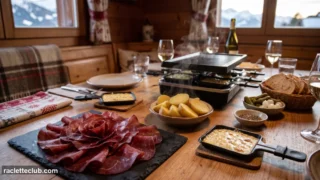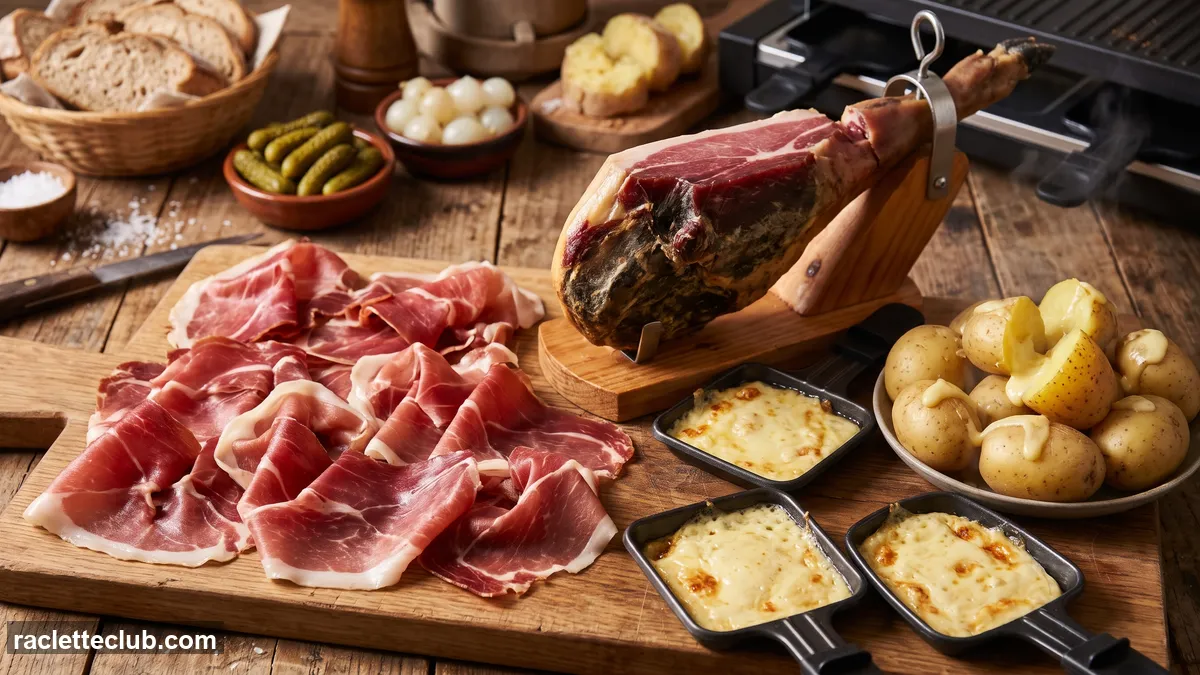
In short: cured ham is the king of the raclette platter. Jambon de Bayonne IGP dries for at least 7 months, Prosciutto di Parma AOP for at least 14 months, and Jambon cru du Valais IGP comes from pigs born and raised in Switzerland. “Jambon de Savoie”, on the other hand, isn’t a protected name: read the label. As a rule of thumb, plan on 2 to 3 thin slices per person if you’re serving several cured meats, and a light red or a mountain white to go with it.
This article contains Amazon affiliate links: if you buy through these links, Raclette Club earns a small commission at no extra cost to you. Learn more.
What exactly is cured ham?
Cured ham is a pork leg that’s salted and then dried, never cooked. Salt and time do all the work, and every region has its own way of balancing them. For Jambon de Bayonne IGP, the specifications require a leg of at least 8.5 kg from pigs born, raised and slaughtered in southwest France, salting with salt from the Adour Basin salt works and at least 7 months of production. By the end, the ham must have lost at least 28% of its weight. The current text was approved by an order dated July 8, 2026.
On the Italian side, Prosciutto di Parma AOP plays the minimalist card. Its specifications ban chemicals, preservatives, additives and smoking: pork, salt and at least 14 months of drying. The pigs come from eleven regions of central and northern Italy, and the curing takes place in a defined area of the province of Parma. Spanish serrano ham is protected at EU level as a traditional speciality guaranteed (TSG). A “Jamón Serrano” IGP project is on hold: in November 2025, the High Court of Justice of Madrid annulled, for procedural flaws, the 2021 Spanish decisions that moved it forward, and the file went back for review (Spain’s Official State Gazette, July 17, 2026).
And Savoie ham? It’s all over the shelves in winter, but it isn’t an IGP. A draft specification for a “Jambon de Savoie” IGP was examined by INAO’s national committee in October 2011, but it went nowhere: as of November 2, 2026, the name doesn’t appear in the EU’s eAmbrosia register, either as a registered IGP or as a pending application. So it’s no guarantee of a controlled origin. For a real Alpine ham with a protected name, look instead to Jambon cru du Valais IGP (registered in 2015) or, across the Great St Bernard Pass, Valle d’Aosta Jambon de Bosses AOP.
| Ham | Status | Key rule |
|---|---|---|
| Jambon de Bayonne | IGP | Adour Basin salt, 7 months minimum, pigs from southwest France |
| Prosciutto di Parma | AOP | Pork and salt only, 14 months minimum, leg of 8.2 to 12.5 kg |
| Jambon cru du Valais | Swiss IGP | Swiss pork, boned, never smoked, 6 to 10 weeks of drying minimum depending on the cut |
| Jamón serrano | Traditional speciality guaranteed | Protected at EU level, IGP project on hold after a court ruling (2025) |
| “Jambon de Savoie” | No protected name | Origin and drying time to be read on the label |
Why cured ham goes so well with raclette
Melted cheese is rich, round and milky. Cured ham brings what it lacks: salt, a texture with a little bite, and the aromas of drying. Parma’s specifications describe a “delicate and sweet, not very salty” flavor. Bayonne defines itself as a dry product that’s “not very salty”, with a cap of 7.5% salt. The result: they lift the potato without overpowering the cheese.
To our taste, a long-aged, delicate ham like Parma pairs beautifully with a raw-milk Raclette du Valais AOP. A bolder ham, Bayonne-style, stands up to a smoked raclette or a peppercorn raclette. With a Raclette de Savoie IGP, Jambon cru du Valais makes a neighborly pairing. These are table opinions, not rules.
How to choose your cured ham
- The logo first: IGP or AOP on the package means a monitored specification. With no logo, look for the origin of the pork and where it was dried.
- Drying time: it’s often shown. Beyond the legal minimum, the flavor gains depth, and so does the price.
- Ingredients: a Parma AOP is pork and salt. On a ham with no protected name, compare the lists: the shorter, the better, in our opinion.
- Sliced to order or pre-packed: at the deli counter, ask for very thin slices, cut the same day. Pre-packed, check the use-by date and the look of the fat, which should stay white or pinkish.
How much to plan and how to serve it
Our team’s benchmark: 100 to 150 g of cured meats in total per adult for a raclette, all types combined. If the cured ham shares the platter with a dry sausage and an air-dried beef, 2 to 3 thin slices per person are enough. For the record, Santé.fr recommends limiting cured meats to 150 g per week: raclette is a party meal, not an everyday menu.
Take the ham out of the fridge about fifteen minutes before sitting down: cold fat has no flavor. Arrange the slices in waves on a board, without stacking them, or they’ll stick together.
Pregnant women: France’s national health insurance (ameli.fr) classes cured ham as raw charcuterie, to be cooked thoroughly before eating, because of listeriosis. For a pregnant guest, a slice grilled well on the top plate or cooked in a cheese pan is the option to go with, and pre-packed products are preferable to those sliced at the counter.
Which wine to serve with cured ham?
Cured ham loves fresh, low-tannin wines. A light red like Pinot Noir goes very well with Parma and Valais ham. To stay in the mountains, a crisp white like Fendant from the Valais or an Apremont from Savoie cleanses the palate between bites of cheese. An amateur sommelier’s opinion: the bolder Bayonne also enjoys a light Beaujolais.
In the pantry
Back to the raclette pantry. To round out the platter, read our guides to air-dried beef from Graubünden and the Valais, saucisson sec and rosette, and coppa, pancetta and speck.
Frequently asked questions
Is Savoie ham an IGP?
No. An IGP project was examined by INAO in 2011, but it went nowhere: the name doesn’t appear in the EU’s eAmbrosia register, either as an IGP or as a pending application. To know where the pork comes from and how long it was dried, you have to read the label.
How long are Bayonne and Parma hams dried?
At least 7 months for Jambon de Bayonne IGP and at least 14 months for Prosciutto di Parma AOP, according to their specifications.
How much cured ham should you plan per person for a raclette?
Our benchmark: 100 to 150 g of cured meats in total per adult. If the cured ham is served with other cured meats, 2 to 3 thin slices per person are enough.
Can a pregnant woman eat cured ham at a raclette?
France’s national health insurance asks that raw charcuterie, including cured ham, be cooked thoroughly before eating during pregnancy, because of listeriosis. A slice grilled well on the top plate is the solution.
Sources
- French Ministry of Agriculture: Jambon de Bayonne IGP specifications (order of July 8, 2026, in French)
- Consorzio del Prosciutto di Parma: specifications (version of May 17, 2025, in Italian)
- Swiss AOP-IGP Association: Jambon cru du Valais IGP (in French)
- Jambon cru du Valais IGP specifications (in French)
- European Commission: eAmbrosia register of geographical indications
- INAO: draft specifications for a Jambon de Savoie IGP, examined by the national committee on October 13, 2011 (archived copy, in French)
- AENOR: Jamón Serrano traditional speciality guaranteed (in Spanish)
- The Objective: court annuls decisions on the Jamón Serrano IGP (January 2026 article, in Spanish)
- Spain’s Official State Gazette: resolution of July 10, 2026 implementing the Madrid High Court ruling on the Jamón Serrano IGP (in Spanish)
- French national health insurance: bacterial infections during pregnancy (in French)
- Santé.fr: limiting cured meats to protect your health (in French)