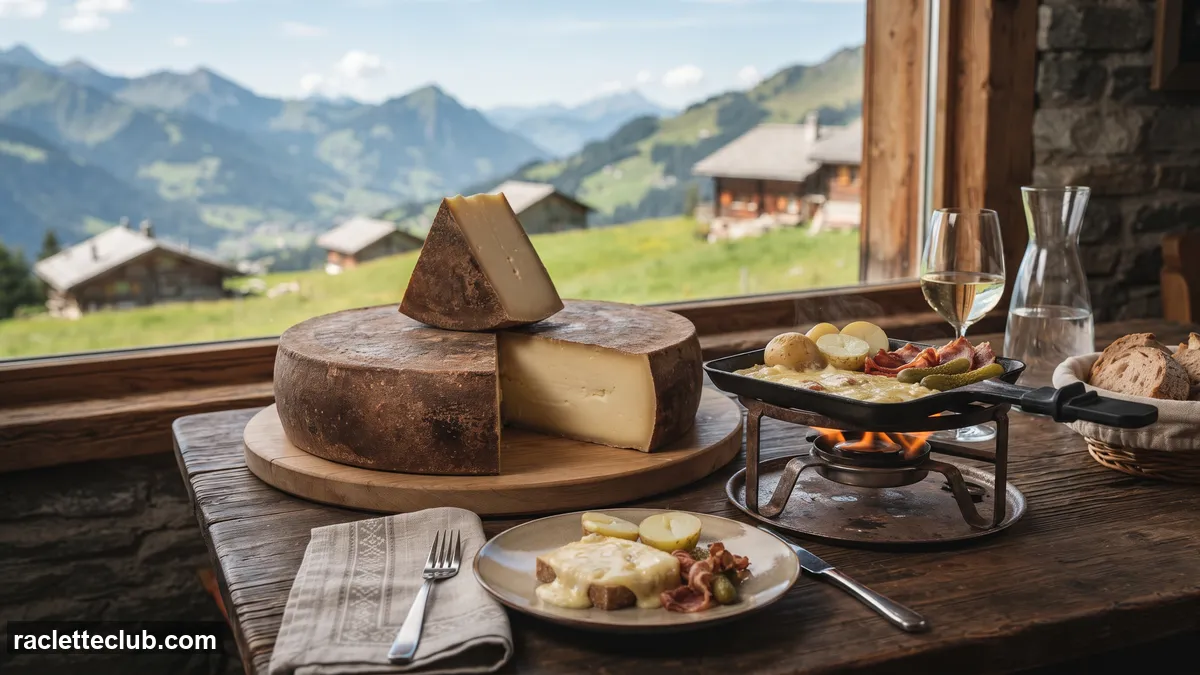
In short: Le Gruyère AOP is a great Swiss raw-milk cheese, a cooked pressed cheese aged for at least 5 months, with a fruity flavor. It melts well (it’s half of the “moitié-moitié” fondue), but it isn’t a raclette cheese in the strict sense. Our honest advice: at a raclette, blend it with a real raclette cheese rather than serving it on its own, and pick a younger one, because a very aged cheese tends to release fat as it melts.
This article contains Amazon affiliate links: if you buy through these links, Raclette Club earns a small commission at no extra cost to you. Learn more.
Le Gruyère AOP: ID card
| Criterion | Le Gruyère AOP |
|---|---|
| Country | Switzerland |
| Region | Cantons of Fribourg, Vaud, Neuchâtel and Jura, plus some districts and municipalities in the canton of Bern (FOAG) |
| Designation | Registered in Switzerland since July 6, 2001; protection extended to the European Union through bilateral agreement from 2011 (Vaud Cantonal Council) |
| Milk | Cow’s milk, raw, no silage, delivered twice a day, collected within a 20 km radius at most (FOAG) |
| Paste | Cooked pressed: curd heated to 54 to 59 °C in an open copper vat (FOAG) |
| Aging | 5 months minimum on spruce boards, at 12 to 18 °C (FOAG) |
| Format | Round wheel of 25 to 40 kg, 9.5 to 12 cm high (FOAG) |
| Flavor | Fruity, backed by a more or less salty note; supple, medium-firm, ivory paste (FOAG) |
| Meltability | Good: it’s a pillar of Swiss fondue. The older it is, the more likely it is to release fat |
Not to be confused with: there’s also a French “Gruyère”, recognized as a protected geographical indication (IGP). According to INAO, it’s made in an arc running from the plateaus of Haute-Saône to Savoie, aged for at least 4 months and, unlike its Swiss neighbor, it must have holes, from the size of a pea to the size of a cherry. Now you’re armed for the next bar-room debate.
A story that begins in 1115
Gruyère takes its name from the county of Gruyère, in the canton of Fribourg. According to the registration file published by the Swiss Federal Office for Agriculture (FOAG), the founding charter of the Cluniac priory of Rougemont mentioned the making of a cooked pressed cheese as early as 1115. The crane (grue in French), the region’s emblem, appears on the coat of arms of Count Rudolf III in 1221, and the little town of Gruyères was known from the mid-14th century for its dairy market.
A tasty detail: in the 16th century, locals simply called it “cheese”. It was abroad that people named it after its region to tell it apart from local cheeses, and the name “Gruyère” took hold in the 17th century. In 1762, the Académie française specified that the word refers to a cheese made in Gruyère. Even today, every wheel carries its production date in casein numbers and the trade organization’s mark, and “Gruyère d’alpage” (summer pasture Gruyère) is protected too.
Flavor and melt: a good raclette cheese?
Let’s be frank: Gruyère isn’t a raclette cheese. Raclette cheeses are uncooked pressed cheeses: that’s the case for Raclette de Savoie, as the white paper on mountain pressed cheeses points out, and the French food guide Le Fooding sums it up by saying that “any uncooked pressed cheese can be raclette-d”. Alongside it, there’s of course Raclette du Valais AOP. Gruyère is a cooked pressed cheese, drier (34.5 to 36.9% water according to the specifications), designed to age for months.
Yet it melts very well: together with Vacherin Fribourgeois, it makes the famous Swiss “moitié-moitié” (half-and-half) fondue. Under the raclette machine, it gives a stringier, more elastic layer than a classic raclette, with a pronounced fruity flavor. The limit is age. Cook’s Illustrated’s melted cheese tests show that an older cheese, which has lost water, gives more separated fat and more clumps, while a young cheese, with a more flexible protein network, melts more evenly. So a very aged Gruyère may “sweat” a little fat in the pan.
Our verdict: on its own, it makes a raclette with character but less creaminess. Blended, it’s excellent. Save aged Gruyère for the cheese board, where it’s at its best, and use a younger one for the pan.
How to serve it at a raclette
- Quantity: our team’s benchmark is 200 g of cheese per person in total. Plan on about one third Gruyère and two thirds raclette cheese.
- Blended in the pan: a slice of raclette, a shaving of Gruyère on top. The raclette brings creaminess, the Gruyère brings fruitiness.
- In thin slices: cut thick, it melts more slowly than raclette. A cheese plane gives you slivers that melt at the same time.
- On the board: a piece of well-aged Gruyère to nibble at the end of the meal, for those who are still hungry (there are always some).
- Temperature: take it out of the fridge a little before the meal, and it will melt more evenly.
Which wines go with Gruyère
A neighborly pairing, in our opinion the most fitting: a Chasselas, like Fendant from the Valais, fresh and discreet, which lets the cheese’s fruitiness speak. Red lovers will pick a light, low-tannin Pinot Noir. And for the appetizer or undecided tables, an Œil-de-Perdrix, a Swiss Pinot Noir rosé, stays true to the country.
In the pantry
To round out the board, head back to the raclette pantry. The other great cooked pressed cheeses have their own guides too: Comté, Beaufort and Emmentaler.
Frequently asked questions
Can you make raclette with Gruyère?
Yes, it melts well, but it’s a cooked pressed cheese, drier than a raclette cheese. It’s at its best blended, about one third Gruyère to two thirds raclette.
Does Gruyère have holes?
French Gruyère IGP must have them, from the size of a pea to the size of a cherry, and that’s precisely what sets it apart from its Swiss neighbor, according to INAO.
How long is Le Gruyère AOP aged?
At least 5 months, on spruce boards, at a temperature of 12 to 18 °C, according to the Swiss specifications.
Why does my Gruyère release fat when it melts?
A very aged cheese has lost water and holds on to its fat less well when melting. For the pan, choose a younger Gruyère or blend it with a raclette cheese.
Sources
- FOAG: summary of the Gruyère registration application (specifications, history, in French)
- Canton of Vaud: Cantonal Council response on the protection of Le Gruyère AOP (2001 registration, 2011 EU extension, in French)
- INAO: Gruyère IGP fact sheet (France, in French)
- Le Fooding: a treatise on melted cheese (moitié-moitié fondue, raclette cheeses, in French)
- Fromages & Chefs: white paper on mountain pressed cheeses (2016, in French)
- Cook’s Illustrated: why young cheese melts better than aged cheese