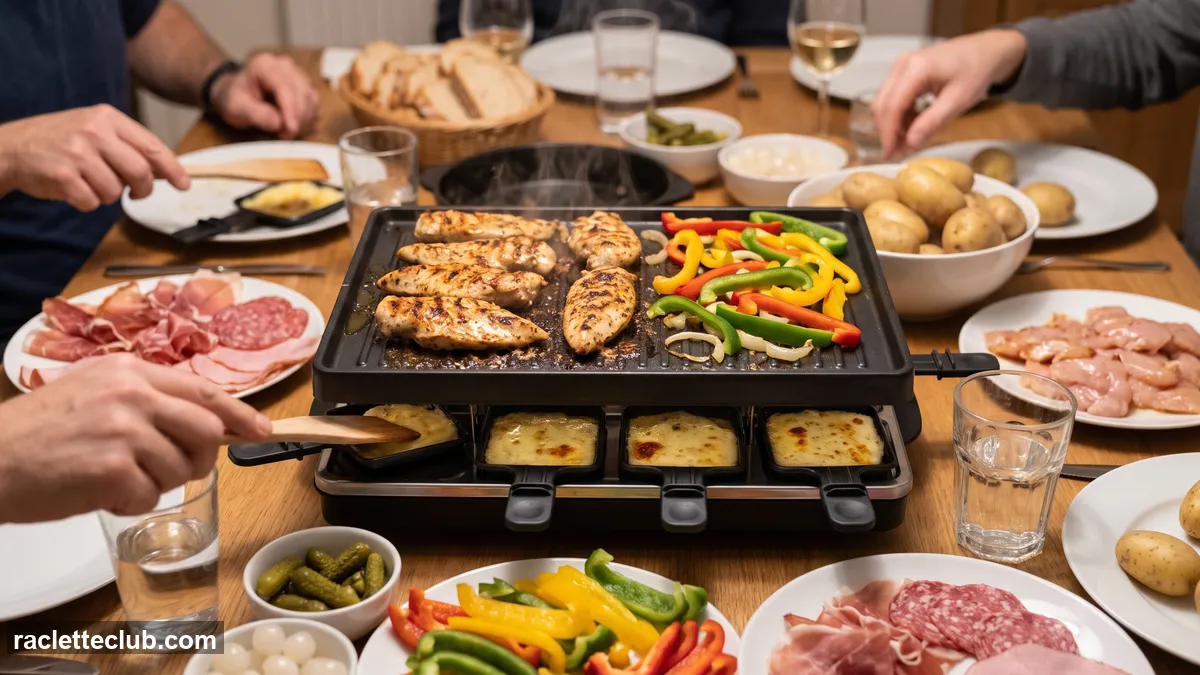
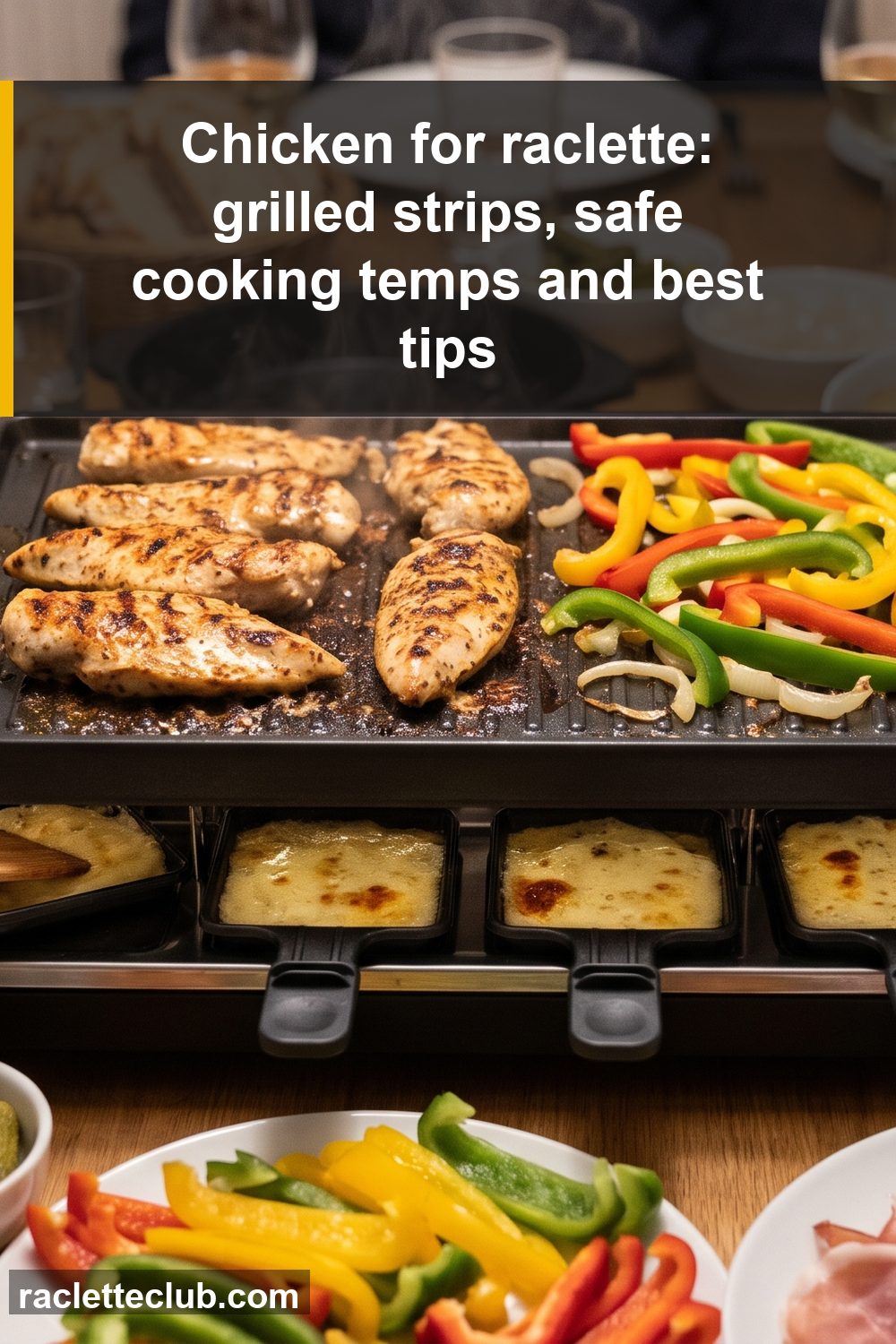
In short: chicken at a raclette night is delicious in thin strips grilled on the top plate and then smothered in cheese. But it’s the one meat on the platter that forgives nothing: poultry is always eaten cooked through, with no trace of pink (Health Canada gives 74 °C for pieces), and raw meat must never touch anything already cooked. With thin strips, a pair of tongs reserved for raw meat and a little patience, it’s a great idea for guests who prefer white meat.
This article contains Amazon affiliate links: if you buy through these links, Raclette Club earns a small commission at no extra cost to you. Learn more.
Chicken at a raclette: what is it?
On a raclette machine with a grill plate or stone, you can cook meat on top while the cheese melts in the little pans below. Chicken works well, as thin slices of breast or boneless thigh. It isn’t a set recipe: it’s the “stone grill” version of raclette, which everyone adjusts to taste.
| ID card | Chicken for the raclette grill plate |
|---|---|
| Cuts | Breast (fillet) or boneless thigh, in thin strips |
| Labels to look for | Label Rouge (raised for at least 81 days, with outdoor access) |
| Flavor | Mild, perfect for carrying cheese, spices or a marinade |
| Cooking | Always cooked through: 74 °C for pieces (Health Canada), no more pink |
| Watch out | Keep raw and cooked strictly apart (campylobacter, salmonella) |
Why chicken goes with raclette
Chicken has a subtle flavor, and that’s exactly its strength here. Grilled and then dunked in a cheese pan, it takes on all the character of the cheese. With a Raclette de Savoie IGP or a Raclette du Valais AOP, it’s simple and comforting. A peppercorn raclette gives it a kick, and a goat cheese raclette takes it somewhere fresher. For kids and guests who don’t eat much cured meat, it’s often the meat everyone agrees on.
How to choose your chicken
- The cut: breast is easy to cut into even strips but dries out fast. Boneless thigh stays juicier on the plate: it’s our favorite.
- The label: a Label Rouge chicken is raised for at least 81 days, with at least 2 m² of outdoor range per bird (Mapa, based on the label specifications). To our taste, its firmer flesh holds up better on the plate.
- The cut size: cut thin, even strips, one centimeter thick at most, so they cook through without burning on the outside. That’s a practical tip from our team.
- Storage: keep the poultry in the fridge until the last minute, in a closed container.
How much to plan and how to cook it safely
As a rule of thumb from our team, plan on 100 to 150 g of chicken per person if it’s the only meat, and about half that if it’s added to a cured meat platter. That’s in the same ballpark as the beef stone-grill recipes from the French beef industry body.
Food safety rules, no negotiating
- Always cooked through. ANSES recommends cooking poultry thoroughly (over 65 °C at the center) and reminds us not to eat raw poultry, even as “carpaccio”. Health Canada sets the benchmark at 74 °C for poultry pieces. In practice: cut a strip open, the flesh should be white and opaque all the way to the center, with no pink.
- Don’t wash the chicken. The Minnesota Department of Health (United States) advises against rinsing raw poultry: the splashes spread germs onto surfaces and onto foods that won’t be cooked, like salad, while cooking alone is enough to kill them.
- Raw on one side, cooked on the other. According to ANSES, bacteria transferred by cutting boards or knives that touched raw poultry are a major risk factor. It advises using separate cutting boards, cleaning “the cutting board, the dish and the utensils” and washing your hands after handling raw meat.
- At the table: one pair of tongs reserved for raw chicken, never the fork you eat with. Cooked chicken goes straight onto the plate or into the cheese pan, never back onto the raw meat dish.
A probe thermometer clears up any doubt. It’s especially useful if you prep thicker pieces ahead of time.
Which wine to serve with chicken and raclette
With white meat and melted cheese, a crisp white is in our opinion the safest choice. An Apremont or a Chignin from Savoie brings the freshness that lightens the dish. If you prefer red, a light Beaujolais served cool goes really well with grilled chicken.
In the pantry
Back to the pantry to put together the rest of the platter. On the grill plate, chicken pairs well with thinly sliced beef and pork. For a different, bolder bird, move on to duck breast.
Frequently asked questions
Can you cook chicken on a raclette machine?
Yes, on the grill plate or the stone, in thin strips. It must be cooked through, with no trace of pink: Health Canada gives 74 °C for poultry pieces.
How do you know the chicken is cooked enough?
Cut a strip open: the flesh should be white and opaque all the way to the center. To be sure, a probe thermometer should read at least 74 °C, Health Canada’s benchmark.
Should you wash chicken before cutting it?
No. Health authorities, like the Minnesota Department of Health, advise against it: the splashes spread germs. Cooking is what kills them.
How much chicken should you plan per person for a raclette?
As a rule of thumb from our team, 100 to 150 g per person if it’s the only meat, about half with a cured meat platter.
Sources
- ANSES: campylobacteriosis (sources, cooking poultry, cross-contamination, in French)
- Health Canada: safe internal cooking temperatures chart (in French)
- Minnesota Department of Health: don’t wash raw chicken
- Food Standards Agency: checking it’s cooked (no pink meat, clear juices)
- Mapa: the Label Rouge for poultry (81 days minimum, outdoor range, in French)
- La-viande.fr (Interbev): stone-grill quantities (in French)