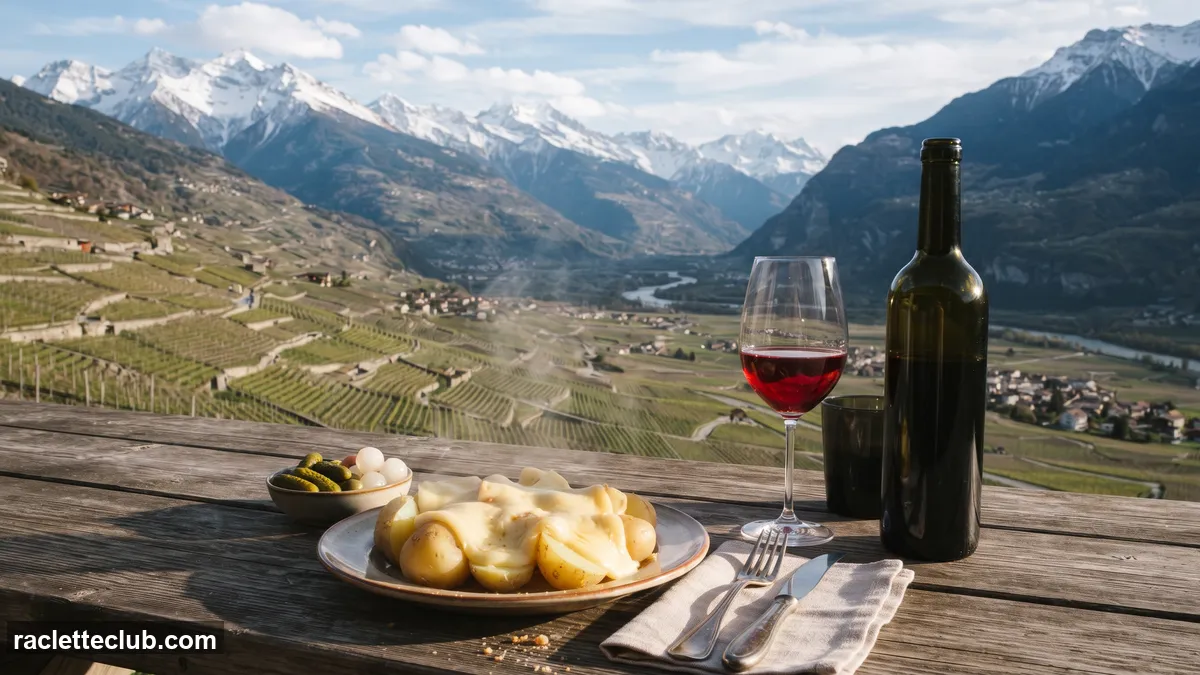
In short: Dôle is the Valais’s signature red blend: pure Pinot Noir, or a blend of reds in which Pinot Noir and Gamay make up at least 51%, with Pinot Noir dominant. Light, with red fruit and round tannins, it’s recommended by the Valais wine body itself “around a raclette with friends”. Serve it cool and young: 2024, with silky reds according to the cantonal enologist, or 2023.
This article contains Amazon affiliate links: if you buy through these links, Raclette Club earns a small commission at no extra cost to you. Learn more.
Why Dôle goes with raclette
Some pairings you defend with arguments, and others come with an official stamp. Dôle is in the second category: in an article published with Terre&Nature, Swiss Wine Valais writes that it “never disappoints”, whether with a Valais platter, a pizza or “around a raclette with friends”. Hard to find a better endorsement.
The explanation comes down to three things: lightness, fruit, round tannins. According to the wine body, Dôle is “a rather light wine”, with red fruit notes and nicely rounded tannins, even more so when aged in oak barrels. A low-tannin red leaves plenty of room for the cheese, where a structured wine would elbow its way in. In our opinion, it’s the most natural red with a Raclette du Valais AOP, and it’s very much at ease with air-dried beef, cured ham and a smoked raclette.
What Valais law says about Dôle
Pinot Noir, Gamay, and a few guests
The Valais ordinance on vines and wine (in its 2026 version) defines Dôle as an AOC Valais wine made “from pure Pinot Noir” or from a blend of red grapes containing at least 51% Pinot Noir and Gamay, a share in which Pinot Noir dominates. Swiss Wine Valais lists among the grapes that can complete the blend Gamaret, Garanoir, Carminoir, Ancellotta, Diolinoir, Merlot and Syrah: some bring color, others structure, others aromas.
That 51% threshold is recent. According to Blick, the opening to the canton’s other grapes dates from 2021, and a “classic” Dôle remained 85% or more Pinot Noir and Gamay. In practice, two Dôles can be quite different. For raclette, we prefer the most classic, fruit-forward versions over very deeply colored, structured blends.
A name, not a grape
Dôle is one of the few Valais wines that can be sold under its name alone, with no grape listed: the ordinance reserves this privilege for Dôle among reds, Dôle blanche among rosés and Fendant among whites. According to Swiss Wine Valais, Dôle is the canton’s first known blend, which appeared in the Valais in 1850.
What about Dôle blanche?
Despite its name (“white Dôle”), Dôle blanche is an AOC Valais rosé, with the same makeup as Dôle, vinified like a white; the ordinance allows up to 10% AOC Valais white wines in the blend. A good idea for a table torn between white and red, just like Œil-de-Perdrix, a Pinot Noir rosé.
The best Dôle vintages
Dôle is drunk young, and it’s when it’s young that it has the fruit that makes it so charming with cheese. The assessments below come from the official vintage presentations by the Valais Office of Vines and Wine, which judge all the canton’s reds. We haven’t found an equally reliable Valais report for earlier years.
| Vintage | Quality / style | Drink |
|---|---|---|
| 2024 | Harvest among the three smallest in more than fifty years. According to the cantonal enologist, slightly less alcoholic, fresh wines; reds combining alcohol and acidity in a subtle balance, with silky tannins. | Now: the ideal style for raclette |
| 2023 | A “winegrower’s vintage”: dense reds that lose nothing of their elegance, with fruity and spicy bouquets and good aging potential. | Now |
| 2022 | A hot, dry year: full-bodied reds with dense, silky tannins. | Now, if you can still find any |
For 2025, the Swiss Federal Office for Agriculture announces “particularly remarkable” wines at the national level, still aging in early 2026. That’s not a Valais assessment: until the official vintage presentation, we’re not giving an opinion. The “Drink” column is our advice for a raclette.
How to serve Dôle
- Temperature: cool. For light reds, Blick advises about 12 to 14 °C, and Dôle belongs to that family. Twenty minutes or so in the fridge before the meal, and you’re good to go.
- Glass: a classic stemmed red wine glass.
- Decanter: unnecessary for a young Dôle.
- Quantity: our benchmark is half a bottle per wine-drinking adult over the evening, counting any white. Open the Fendant first, then the Dôle: that’s the Valais order, and it works.
Other wines for raclette
Back to the complete guide to wines for raclette, or to the raclette pantry. To go further with Dôle’s main grape, read our Pinot Noir page. For Valais whites, see Fendant and Petite Arvine.
Frequently asked questions
What is Dôle du Valais?
An AOC Valais red wine, made from pure Pinot Noir or from a blend of red grapes containing at least 51% Pinot Noir and Gamay, with Pinot Noir dominant, according to the Valais ordinance on vines and wine.
Is Dôle a good wine for raclette?
Yes: light, fruity, with round tannins, it leaves room for the cheese. Swiss Wine Valais even recommends it “around a raclette with friends”.
Is Dôle blanche a white wine?
No, it’s an AOC Valais rosé, with the same makeup as Dôle, vinified like a white. The ordinance allows up to 10% AOC Valais white wines in the blend.
What temperature should you serve Dôle at?
Cool, around 12 to 14 °C, the range Blick recommends for light reds. Never at the temperature of a heated room.
Sources
- Valais ordinance on vines and wine (OVV, RS 916.142), as of April 1, 2026 (in French)
- Swiss Wine Valais: “Dôle, a no-fuss ally” (Terre&Nature, September 2025, in French)
- Swiss Wine Valais: Dôle
- Blick: yes, you can drink red wine in summer (July 2023, in French)
- Valais Office of Vines and Wine and Swiss Wine Valais: 2024 vintage presentation (May 2025, in French)
- Valais Office of Vines and Wine and Swiss Wine Valais: 2023 vintage presentation (May 2024, in French)
- Valais Office and Interprofession of Vines and Wine: 2022 vintage presentation (May 2023, in French)
- Radio Lac / ATS: the 2025 Swiss vintage according to the FOAG (March 2026, in French)