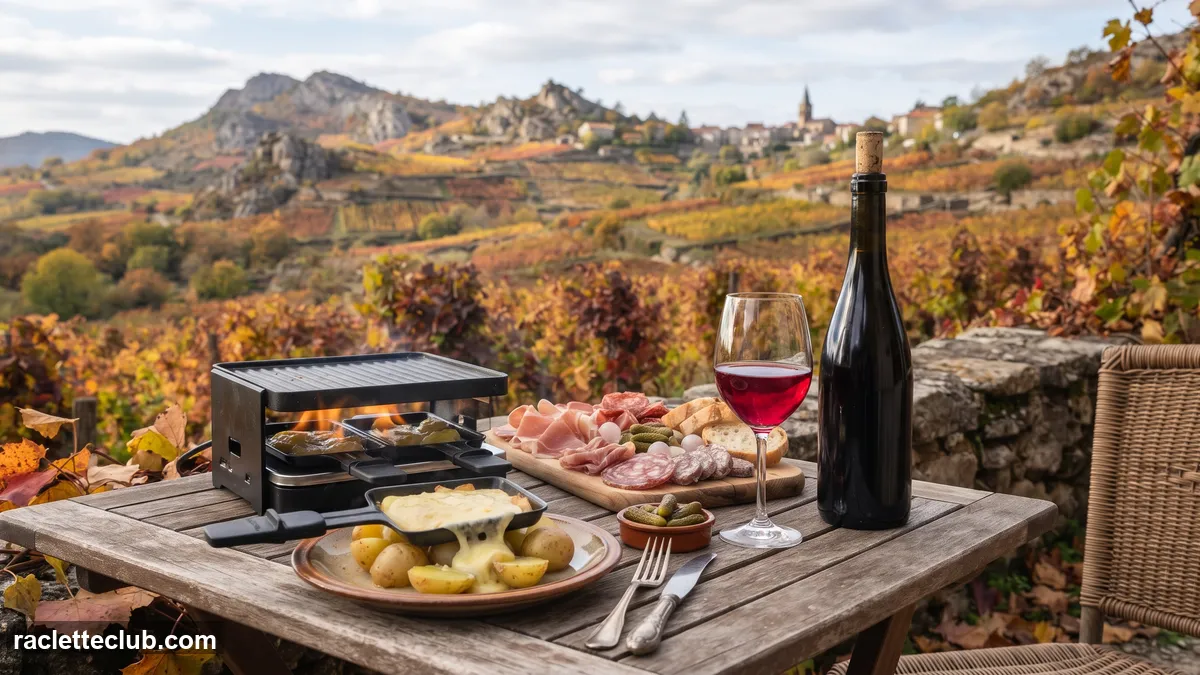
In short: a light Beaujolais (Beaujolais, Beaujolais-Villages or a supple cru like Chiroubles, Fleurie, Régnié or Brouilly) is a perfect red for raclette: fruity Gamay, low tannins, lovely freshness. Drink it young and cool, around 13-14 °C (55-57 °F). The vintages to serve right now: 2024, fresh and light, and 2025, described as fine and easy-drinking by the Beaujolais wine board. Steer clear of powerful crus like Moulin-à-Vent.
This article contains Amazon affiliate links: if you buy through these links, Raclette Club earns a small commission at no extra cost to you. Learn more.
Why light Beaujolais goes with raclette
Red Beaujolais means Gamay. According to The Wine Society, this grape makes juicy, low-tannin wines with moderate alcohol and lots of perfume, best served cool. For raclette, that’s exactly what you need. To our taste, its discreet tannins leave room for the melted cheese, its freshness lightens the fat, and its crunchy fruit bridges the gap to the cured meats.
Light Beaujolais is also the friendliest red there is. You serve it without ceremony, it pleases the uncle who loves Bordeaux as much as the cousin who swears only by rosé, and it takes cured meats, potatoes and cornichons in stride. It goes with a classic raclette as well as a peppercorn raclette. With a smoked raclette, go for a slightly more fragrant cru, like Fleurie.
Which Beaujolais to choose (and which to avoid)
The region has 12 appellations: Beaujolais, Beaujolais-Villages and ten crus. From north to south, they are Saint-Amour, Juliénas, Chénas, Moulin-à-Vent, Fleurie, Chiroubles, Morgon, Régnié, Côte de Brouilly and Brouilly. For raclette, stick to the light end of the range.
Beaujolais and Beaujolais-Villages: the sweet spot
These are Gamay’s everyday wines, all about fruit and easy pleasure. For a big table, a young Beaujolais-Villages is the safest and most budget-friendly choice. And no, don’t confuse it with Beaujolais Nouveau: that one is a “primeur” wine, released on the third Thursday of November. It can do the trick in winter, but a Villages often has a bit more backbone.
The light crus: Chiroubles, Fleurie, Régnié, Brouilly, Saint-Amour
According to The Wine Society’s guide to the crus, Chiroubles is lively and delicate, approachable early. Fleurie is aromatic and floral, with a silky texture. Régnié is vibrant and best drunk young. Brouilly is approachable and fruity, with a floral touch. Saint-Amour is easy to drink and instantly appealing. In our opinion, these are the ideal crus for a slightly more festive raclette.
Young Morgon: the upper limit
Morgon is a serious, concentrated cru with good aging potential, and Inter Beaujolais ranks it among the structured crus. A young, fruity Morgon can work with raclette, but that’s the upper limit. For the same reasons, avoid Moulin-à-Vent (the sturdiest cru, with the longest-aging wines), as well as Juliénas and Chénas, which Inter Beaujolais also ranks among the structured crus. They’re very fine wines, but they belong with a roast chicken more than with a pan of melted cheese.
The best vintages for light Beaujolais
Let’s be clear: a Beaujolais or Beaujolais-Villages is meant to be drunk young (the Guide Hachette gives a red Villages 2 to 4 years of aging). For raclette, pick the last two vintages on the shelf, which today means 2025 and 2024. Beyond that, we only talk about the crus. The assessments below come from the regional wine board and the Wine Scholar Guild’s vintage chart.
| Vintage | Quality / profile | When to drink |
|---|---|---|
| 2025 | An early harvest, “full of promise in quality” but low in quantity, with wines of “great depth” that the wine board compares to 2015 (Inter Beaujolais, August 2025). When the primeur wines were released, its president described wines that are “very easy to drink, very fine, very elegant,” with fleshy, supple, round fruit. | Right now: the first choice for raclette |
| 2024 | A year marked by mildew, black rot and hail, with a sharply reduced harvest (an estimated -35% for Burgundy and Beaujolais combined, according to Agreste). The technical institute Sicarex announced “fresh, light Gamays,” with lovely freshness on the palate. For the Wine Scholar Guild, the best wines are light, fresh and lively, to drink early. | Now: the ideal style for melted cheese |
| 2023 | Delicious wines. The best, most structured crus will age well (Wine Scholar Guild). | Light crus: now |
| 2022 | Remarkable quality: aromatic, intense wines, well balanced despite the heat (Wine Scholar Guild). | Light crus: now |
| 2021 | Incisive wines, full of freshness and vivacity (Wine Scholar Guild). | Light crus: now |
| 2020 | Remarkable quality where the vines found moist clay deep down (Wine Scholar Guild). | Crus only |
| 2019 | The best wines are concentrated and fresh (Wine Scholar Guild). | Crus only |
| 2018 | The best crus will evolve well (Wine Scholar Guild). | Crus only |
| 2017 | Wines bursting with fruit for the growers spared by hail (Wine Scholar Guild). | Crus only |
| 2016 | A harvest of supple, very fruity wines (Wine Scholar Guild). | Crus only |
“Crus only” means that, in our opinion, a Beaujolais or Villages of that age is no longer made for raclette. A well-kept light cru may still be enjoyable, but it will have lost the crunch you want against the cheese. The column gives our table-side advice, not an official aging window.
Serving Beaujolais with raclette
- Temperature: Inter Beaujolais recommends 13 to 14 °C (about 55 to 57 °F) for red Beaujolais and Beaujolais-Villages, 12 °C (about 54 °F) for Nouveau, and 15 to 17 °C (about 59 to 63 °F) for the crus, especially the more structured ones. With raclette, stay at the low end of the range: the coolness of the wine does half the work.
- Glass: a simple stemmed red wine glass. No need to bring out the big glasses.
- Decanter: no need for a young Beaujolais.
- How much: about half a bottle per wine-drinking adult over the evening. Beaujolais goes down easily, so keep a pitcher of water within reach.
The other raclette wines
Back to the complete guide to wines for raclette. Gamay has a mountain cousin, Savoie Gamay, which makes a terroir pairing with Savoie raclette. If you prefer the finesse of Pinot, see our Pinot Noir and Dôle du Valais page. And for those who want white, Fendant is still the benchmark.
Frequently asked questions
Which Beaujolais should I serve with raclette?
A young Beaujolais or Beaujolais-Villages, or a light cru like Chiroubles, Fleurie, Régnié or Brouilly. Gamay, fresh and low in tannins, goes very well with melted cheese to our taste.
Can I serve a Morgon or a Moulin-à-Vent with raclette?
A young, fruity Morgon can work, but it’s a structured cru. Moulin-à-Vent, the sturdiest of the crus, is, to our taste, too powerful for raclette: save it for a meat dish.
Which Beaujolais vintage should I choose for raclette?
The most recent ones: 2025, described as fine and easy-drinking by Inter Beaujolais, and 2024, which gave fresh, light Gamays. A simple Beaujolais is drunk young.
At what temperature should Beaujolais be served?
Inter Beaujolais recommends 13 to 14 °C (about 55 to 57 °F) for red Beaujolais and Beaujolais-Villages, and 15 to 17 °C (about 59 to 63 °F) for the crus. With a raclette, stay toward the low end of the range.
Sources
- Inter Beaujolais: serving temperatures
- LyonMag: start of the 2025 harvest and Inter Beaujolais announcement (August 2025, in French)
- La Télé / AFP: Beaujolais Nouveau 2025, the view of the Inter Beaujolais president (November 2025, in French)
- MaCommune.info: Beaujolais Nouveau 2024, views of Sicarex and Inter Beaujolais (November 2024, in French)
- iDealwine: the 2024 harvest in France (Agreste estimates, in French)
- Wine Scholar Guild: Beaujolais vintage chart
- The Wine Society: the 10 Beaujolais crus from north to south
- French Ministry of Agriculture: the wines of Beaujolais (12 appellations, Beaujolais Nouveau)
- Guide Hachette des Vins: AOC Beaujolais-Villages
- NPR / NHPR: the Dijon study on wine and cheese (November 2016)