In short: a dry, clean Sauvignon Blanc with little or no oak (Touraine, Sancerre, Bordeaux or Pays d’Oc) is an excellent alternative to Fendant for raclette. Its bright acidity cuts through the fat of the cheese. For raclette, go for recent vintages: 2025 is shaping up brilliantly in the Loire, and 2024, fresher and tauter, is already ready to drink.
This article contains Amazon affiliate links: if you buy through these links, Raclette Club earns a small commission at no extra cost to you. Learn more.
Why Sauvignon Blanc goes with raclette
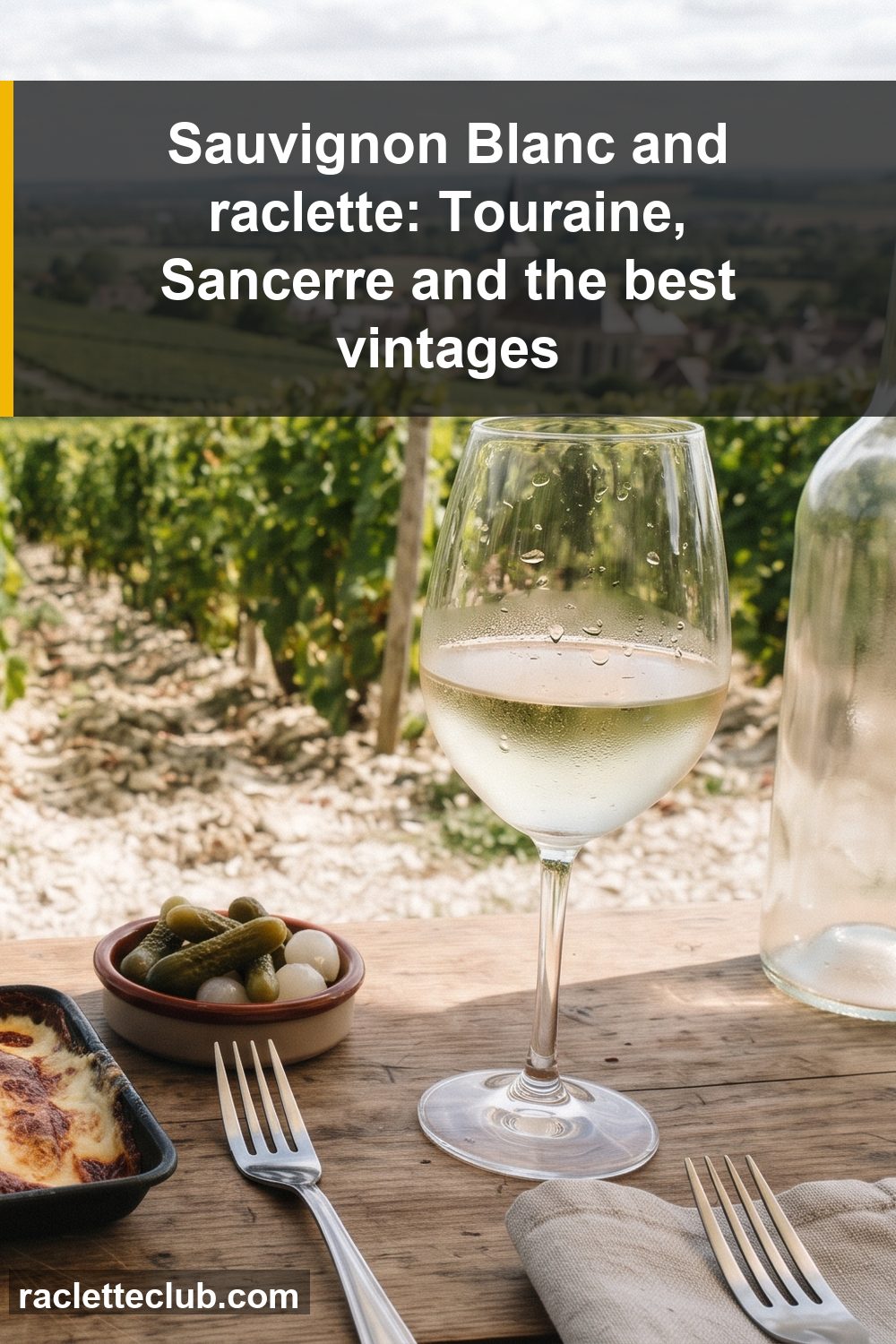
Raclette is fat, salt and heat, served on repeat for two hours. So you need a wine that tidies up between bites. Dry Sauvignon Blanc has exactly what it takes: lively acidity, aromas of citrus, green apple and blackcurrant bud, and a refreshing finish. It won’t replace Fendant in the hearts of the Valais locals, but it has one big advantage: you can find it in almost every wine shop and grocery store.
The trap is a Sauvignon that’s too exuberant (grapefruit fireworks style) or one that’s spent time in oak barrels. Oak and vanilla add fat to fat, and the cheese never asked for that. You want a Sauvignon that’s clean, dry, with little or no oak. It works wonders with a classic raw-milk raclette, with a peppercorn or herb raclette, and it stands up to cornichons and pickled onions. With a smoked raclette, go for a slightly fuller Sauvignon, like a Sancerre.
The best Sauvignon appellations for raclette
Touraine: the everyday Sauvignon
AOC Touraine whites are based on Sauvignon Blanc, with Sauvignon Gris as a secondary grape (at most 20% of the plantings), according to the appellation specification. A word of warning: the Touraine-Amboise, Touraine-Azay-le-Rideau and Touraine-Mesland names produce Chenin-based whites. The Divine Loire guide describes aromas of green apple, gooseberry, white flowers and citrus. It’s the best bang for your buck for a big table. For a raclette with friends, a Touraine Sauvignon is the right reflex.
Sancerre and the Centre-Loire: the haute couture version
White Sancerre is a single-variety Sauvignon Blanc wine. Its terroirs are split between caillottes (very stony limestone, elegant and light wines), terres blanches (clay-limestone, fuller and more structured wines) and silex (flint, with smoky gunflint notes), according to the appellation overview by wine retailer Vinatis. For raclette, a Sancerre from caillottes or a blend of terroirs does the job perfectly. Save the most ambitious flint cuvées for fish: with raclette, their finesse would go unnoticed. The neighboring Centre-Loire appellations, like Menetou-Salon or Reuilly, follow the same taut-Sauvignon logic.
Bordeaux: watch out for blends
According to the Guide Hachette, Bordeaux whites are made mainly from Sauvignon, Sémillon and Muscadelle, with Sauvignon sometimes vinified on its own. For raclette, look for cuvées where Sauvignon is highlighted on the label, and avoid barrel-aged whites. A young, fresh, unoaked Bordeaux Sauvignon is an honest companion for melted cheese.
Pays d’Oc: Sauvignon from the sunny south
In the IGP Pays d’Oc, most wines show their grape variety on the label (WineAlign). Sauvignon Blanc is among the main white grapes there. It’s an affordable option, as long as you choose a young bottle and avoid oaked cuvées. Also make sure the word “dry” isn’t hiding a slightly round wine: raclette loves tension, not sweetness.
The best Sauvignon Blanc vintages
For raclette, Sauvignon is drunk young: you want crunchy fruit and liveliness, not aged notes. In practice, aim for the last two or three vintages. The table below covers the Loire (Touraine and Centre-Loire), the best-documented region. For Bordeaux and Pays d’Oc, simply pick the most recent vintage on the shelf.
| Vintage | Quality / profile | When to drink |
|---|---|---|
| 2025 | An early and very promising year. In Touraine, InterLoire announces “precise, elegant and expressive” wines. In the Centre-Loire, the BIVC describes whites with notes of pear and white peach, with full, crunchy palates. Hail struck about 350 ha in Sancerre on July 23. | Right now: the first choice for raclette |
| 2024 | A “technical” vintage in Touraine (heavy rain, little sun) according to InterLoire, but with very fine aromatic expression. In the Centre-Loire, fresh whites with notes of pear and citrus and lovely tension (BIVC). | Now: lively style, ideal against richness |
| 2023 | A real success in Sancerre and Pouilly-Fumé: classic, balanced wines, without being very concentrated. The season was more difficult in Touraine (Wine Scholar Guild). | Now |
| 2022 | Winegrowers thrilled with the quality: good ripeness, and the Loire’s typical freshness highlights the precision of the wines (Wine Scholar Guild). | Now (Sancerre) |
| 2021 | A year marked by frost, including in Sancerre. The best whites are intense and lively, a notch above the reds (Wine Scholar Guild). | Now (Sancerre) |
| 2020 | An excellent vintage throughout the Loire, for dry whites as well as reds (Wine Scholar Guild). | Age-worthy Sancerre only |
| 2019 | Sancerre was spared by the spring frosts. The dry whites may be even better than in 2018 (Wine Scholar Guild). | Age-worthy Sancerre only |
| 2018 | Winegrowers happy with both quantity and quality, from Muscadet to Sancerre: clean fruit, good ripeness, lively acidity (Wine Scholar Guild). | Age-worthy Sancerre only |
| 2017 | Frost in several Sauvignon areas (Pouilly-Fumé, Menetou-Salon, Cheverny). Intense, lively wines, the best of them set to age well (Wine Scholar Guild). | Age-worthy Sancerre only |
| 2016 | Frost and mildew in Pouilly-Fumé, but not in Sancerre. A fine September produced fresh, classic wines (Wine Scholar Guild). | Age-worthy Sancerre only |
The “When to drink” column gives our advice for a raclette night, not an official aging potential. In our opinion, a Touraine or Pays d’Oc Sauvignon more than three years old doesn’t have much left to offer melted cheese. A great old Sancerre, on the other hand, deserves better than a raclette: serve it at another meal.
Serving Sauvignon with raclette
- Temperature: 8 to 10 °C (about 46 to 50 °F), our rule of thumb. Comptoir des Millésimes recommends 9 to 10 °C (about 48 to 50 °F) for a simple, fruity Sancerre. Take the bottle out of the fridge just before serving, and put it back in the cold between rounds: a room heated by three raclette grills warms up wine in no time.
- Glass: a classic, medium-sized white wine glass, filled a third of the way.
- Decanter: no need for a young Sauvignon.
- How much: plan on about half a bottle per wine-drinking adult over a two-to-three-hour evening, as in our guide. Always keep a pitcher of water on the table.
The other raclette wines
Sauvignon is just one of the options. Back to the complete guide to wines for raclette to compare them all. If you’d rather stick with a mountain white, Fendant du Valais is still the historic pairing, and Apremont from Savoie plays the same freshness card. For a more aromatic white, see our Alsace Riesling page.
Frequently asked questions
Does Sauvignon Blanc really go with raclette?
Yes, as long as you choose one that’s dry, clean and lightly oaked at most. Its bright acidity cuts through the fat of the melted cheese and refreshes your palate between bites. A young Touraine or Sancerre is a very good choice.
Touraine or Sancerre for a raclette?
Touraine, based on Sauvignon Blanc, is the simple, budget-friendly solution for a big table. Sancerre brings more precision and depth. It works well with a bolder raclette, a smoked one for example.
Which Sauvignon vintage should I choose for raclette?
The most recent possible. In the Loire, the regional wine boards describe 2025 as a precise, expressive vintage, and 2024 offers fresh, taut wines that are ready now. Save older vintages for age-worthy Sancerre.
At what temperature should Sauvignon be served with raclette?
Between 8 and 10 °C (about 46 to 50 °F), in our opinion. Keep the bottle cold between pours, because the heat from the raclette grills warms the wine up quickly.
Sources
- InterLoire: “2025 Vintage” press release (November 2025, in French)
- InterLoire: press release on the 2024 vintage (December 2024, in French)
- Centre-Loire wine board (BIVC): 2025 vintage (in French)
- Centre-Loire wine board (BIVC): 2024 vintage (in French)
- Wine Scholar Guild: Loire Valley vintage chart
- Divine Loire: Touraine AOC profile
- Vinatis: overview of the white Sancerre AOC (terroirs, in French)
- WineAlign: IGP Pays d’Oc
- Comptoir des Millésimes: serving and pairing Sancerre (in French)
- AOC Touraine specification (version approved in 2011, online copy)
- Guide Hachette des Vins: AOC Bordeaux blanc
- AOC Reuilly specification (2011)