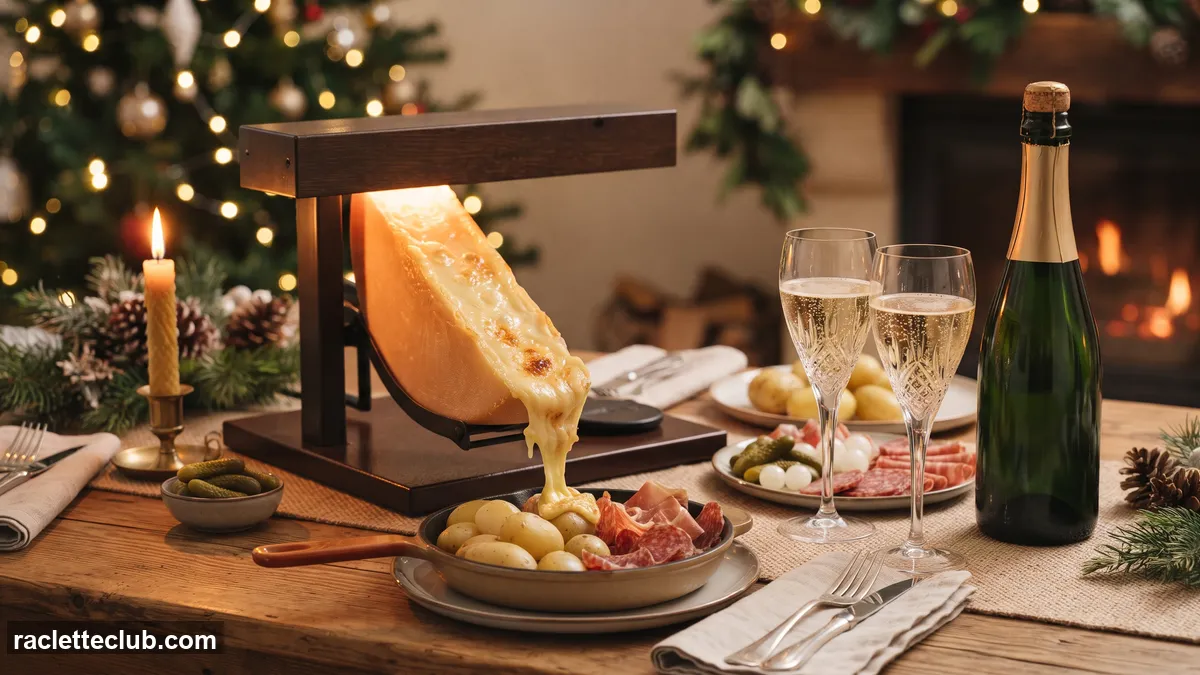
In short: Champagne with raclette works, as long as you choose a dry Champagne. Go for a brut, an extra brut (less than 6 g/L of sugar) or a brut nature (less than 3 g/L), ideally a blanc de blancs for its liveliness. A non-vintage brut does the job perfectly; if you want a vintage Champagne, aim for the years rated highest by Essi Avellan, like 2012, 2013, 2018, 2019 or 2020. Forget demi-sec.
This article contains Amazon affiliate links: if you buy through these links, Raclette Club earns a small commission at no extra cost to you. Learn more.
Champagne with raclette: snobbery or stroke of genius? A bit of both, and that’s exactly what makes it fun. Melted cheese and bubbles get along surprisingly well: just ask anyone who loves gougères. All that’s left is choosing the right bottle, and not serving Uncle Bob’s prized vintage next to the overcooked potatoes.
Why Champagne goes with raclette
Three reasons. First, acidity: Champagne comes from grapes picked in a cool climate, and that liveliness cuts through the richness of the cheese like a knife. Next, the bubbles, which “scrub” your palate between bites and lend a feeling of lightness to a meal that has none. Finally, the brioche and toast notes from aging on the lees, which echo the milky, nutty aromas of a well-aged raclette cheese.
Champagne pairs with just about every raclette: plain, raw-milk, wild garlic, and even smoked if you pick a Champagne with a bit of body (a blanc de noirs or a vintage). It really shines with the aperitif and the first rounds, when you’re still hungry and thirsty for something fresh.
Which Champagne to choose
Sweetness level: brut, extra brut or brut nature
The dosage is the amount of sugar added after disgorgement. It must appear on the label. According to the Comité Champagne, the thresholds are as follows:
- Brut nature (or non-dosé, zero dosage): less than 3 g/L of sugar. Very sharp, perfect for fans of a well-salted raw-milk raclette.
- Extra brut: less than 6 g/L. The best compromise, in our opinion.
- Brut: less than 12 g/L. The most common, always dry, a very safe bet with raclette.
- Extra dry, sec, demi-sec, doux: from 12 g/L to more than 50 g/L. Save them for dessert: sugar and the cheese’s salt don’t make good roommates.
The style: blanc de blancs, blanc de noirs, blend
“Blanc de blancs” and “blanc de noirs” are optional style terms. A blanc de blancs is made only from white grapes, in practice mostly Chardonnay: to our taste the liveliest and most refined, our first choice for a classic raclette. A blanc de noirs, made from black grapes (Pinot Noir, Meunier), has, to our taste, more body and holds up better against a smoked or peppercorn raclette. Finally, a blended brut is the all-purpose choice par excellence.
Non-vintage or vintage?
The vast majority of Champagnes sold are non-vintage bruts (nearly 95% of sales according to iDealwine, a 2011 figure): a blend of wines from the current year and reserve wines, which guarantees a consistent style from one bottle to the next. The appellation rules require at least 15 months in the cellar for a non-vintage, versus at least 36 months for a vintage. The vintage year is an optional label term: it’s the producer who decides to make a vintage, usually in the years they consider the best.
For a raclette, a good non-vintage brut is more than enough. A vintage Champagne has more depth and toasty notes: worth it if you want to turn the evening into a little event, or with a very well-aged raclette.
The best recent vintages
Bottling for the second fermentation can only begin on January 1 following the harvest, and a vintage Champagne must spend at least 36 months in the cellar. So the 2023 and later vintages can’t be on sale as vintage Champagnes yet: for now, they go into the non-vintage bruts. The assessments below come from Essi Avellan MW’s vintage guide (2014 to 2020) and the season reports written by the Comité Champagne (2021 to 2025). The 2019 and 2020 scores are still provisional in this guide, and the “When to drink” column is our advice. Going further back, Essi Avellan also names 2012 (5 out of 5) and 2013 (4 out of 5) among the great successes.
| Vintage | Quality / profile | When to drink |
|---|---|---|
| 2025 | A season that was “calm overall”; fairly modest quantities (frost, hail, scorching) but a “harvest of very fine quality”. Picking in August. | Not before 2029 as a vintage; in non-vintage bruts before then |
| 2024 | A “marathon” season under exceptional rain, a constant battle against mildew, very uneven yields; “the quality is there,” according to the report. | Not before 2028 as a vintage; depending on the houses’ choices |
| 2023 | A season “fairly well managed and without major incident” despite downy and powdery mildew; an unsettled August. Before the harvest, the Comité Champagne announced great quality: a forecast, not a tasting assessment. | From 2027 as a vintage |
| 2022 | A return to a calm year, a “fine harvest”, grape health “excellent”. The general manager of the Champagne growers’ union announced an “extremely high-quality and high-quantity” harvest. | Sellable as a vintage since 2026: one to watch |
| 2021 | A “particularly complicated” season in most areas. No opinion on the quality of the wines, for lack of a reliable tasting assessment. | No general advice |
| 2020 | 4.5 out of 5 (provisional). A very short ripening period, fresher acidity than 2018. | From now on; score still provisional |
| 2019 | 5 out of 5 (provisional). A crop reduced by frost and heat; fine tension and great purity. | From now on; score still provisional |
| 2018 | 4 out of 5. An early, abundant harvest; ample wines, but with distinctly low acidity. | Now |
| 2017 | 1 out of 5. Frost and rot. | Avoid as a vintage |
| 2016 | 3 out of 5. Fruity, generous wines with lively acidity. | Now |
| 2015 | 3 out of 5. A dry year, aromas sometimes debated. | Now |
| 2014 | 3.5 out of 5. A balanced year where Chardonnay shines: a “very solid” vintage. | Now |
In practice: for a vintage blanc de blancs, the years when Chardonnay shone (2014, according to Essi Avellan) are good choices; for an age-worthy Champagne, 2012, 2013, 2019 and 2020 are the highest-rated years in this guide (scores still provisional for 2019 and 2020).
Serving Champagne with raclette
- Temperature: between 8 and 10 °C (about 46 to 50 °F), and up to 12 °C (about 54 °F) for vintages, recommends the Comité Champagne. Allow 30 minutes in a bucket half-filled with water and ice, or a few hours at the bottom of the fridge.
- Glass: a tall glass, rounded and narrowing at the top, rather than a coupe. It lets the wine express its aromas.
- Pouring: pour in two goes, slowly. Close the bottle with an airtight stopper between rounds and put it back in the bucket: the raclette grill and warm bubbles don’t mix.
- How much: for a full meal, in our opinion, plan on roughly half a bottle per wine-drinking adult.
More raclette wines
Back to the complete guide to wines for raclette. For bubbles at a gentler price, see our page on crémants, made using the same method. And for a still wine, Alsace Riesling or Chignin-Bergeron are lovely partners.
Frequently asked questions
Can you serve Champagne with raclette?
Yes. Champagne’s acidity and bubbles cut through the richness of the melted cheese and refresh the palate. Choose a dry Champagne: brut, extra brut or brut nature.
What type of Champagne goes with raclette?
A brut or extra brut blanc de blancs for a classic raclette, a blanc de noirs for a smoked or peppercorn raclette. Avoid demi-sec and doux, which are too sweet next to the salty cheese.
Do you need a vintage Champagne for raclette?
No, a non-vintage brut is enough. A vintage Champagne, which spends at least 36 months in the cellar versus 15 months for a non-vintage, brings more depth. Among recent years, 2012, 2013, 2019 and 2020 are rated very highly by specialist Essi Avellan (provisional scores for 2019 and 2020).
At what temperature should you serve Champagne?
Between 8 and 10 °C (about 46 to 50 °F), and up to 12 °C (about 54 °F) for a vintage, according to the Comité Champagne. During the raclette, keep the bottle in a bucket of water and ice.
Sources
- Comité Champagne: how to read a Champagne label (dosages, label terms; in French)
- Comité Champagne: the Champagne AOC (15 and 36 months minimum; in French)
- Comité Champagne: how Champagne is made (bottling, reserve wines; in French)
- Comité Champagne: serving Champagne (in French)
- Champagne plant health bulletin, 2025 season report (written by the Comité Champagne; in French)
- Champagne plant health bulletin, 2024 season report (in French)
- Champagne plant health bulletin, 2023 season report (in French)
- Champagne plant health bulletin, 2022 season report (in French)
- L’Info Durable (AFP): Champagne, a “sunny” 2022 vintage (in French)
- The Finest Bubble: Champagne Vintage Guide, by Essi Avellan MW
- Yumda (dpa-AFX): the Comité Champagne announces a 2023 vintage of great quality
- iDealwine: vintage and non-vintage brut Champagne
- Que Choisir: how to choose a bottle of Champagne