Table of Contents
Why Proper Cleaning Keeps Your Raclette Machine Running for Years
After a lively raclette night, the last thing anyone wants to do is tackle a crusty grill. But knowing how to clean a raclette grill correctly — and what absolutely not to do — is what separates a machine that lasts a decade from one that warps, stains, or stops heating evenly after its first few uses. I’ve cleaned dozens of raclette machines over the years, and the techniques below are the ones that actually work without damaging delicate non-stick coatings or the electrical elements you must never submerge.
What You Need Before You Start
Good raclette grill cleaning requires almost nothing fancy. Gather these before you begin:
- Soft sponge or microfibre cloth (no steel wool, ever)
- Mild dish soap (pH-neutral)
- White vinegar and baking soda for stubborn spots
- Wooden or silicone spatula to loosen baked-on cheese
- Paper towels for initial grease absorption
- A small soft-bristle brush (old toothbrush works) for coupelle crevices
Never use abrasive scouring pads, metal utensils, or spray oven cleaners — these strip the non-stick coating and leave your trays rough enough to make every future meal a sticking disaster. Looking for the right tool to start with? Our guide to the best raclette grills covers models whose surfaces are easiest to maintain long-term.
Step 1 — Let the Machine Cool (But Not Completely)
Timing is everything. Switch off and unplug the machine as soon as dinner is over, then wait about 10–15 minutes. You want the surface warm, not scorching — warm enough that fats are still liquid but cool enough to touch safely. Cheese residue that has solidified in the cold is far harder to remove than slightly-warm softened fromage. If you’ve completely forgotten and the grill is stone cold, a brief damp-heat trick works: lay a damp cloth on the grill plate for two minutes to re-soften the deposits.
Step 2 — Cleaning the Non-Stick Grill Plates
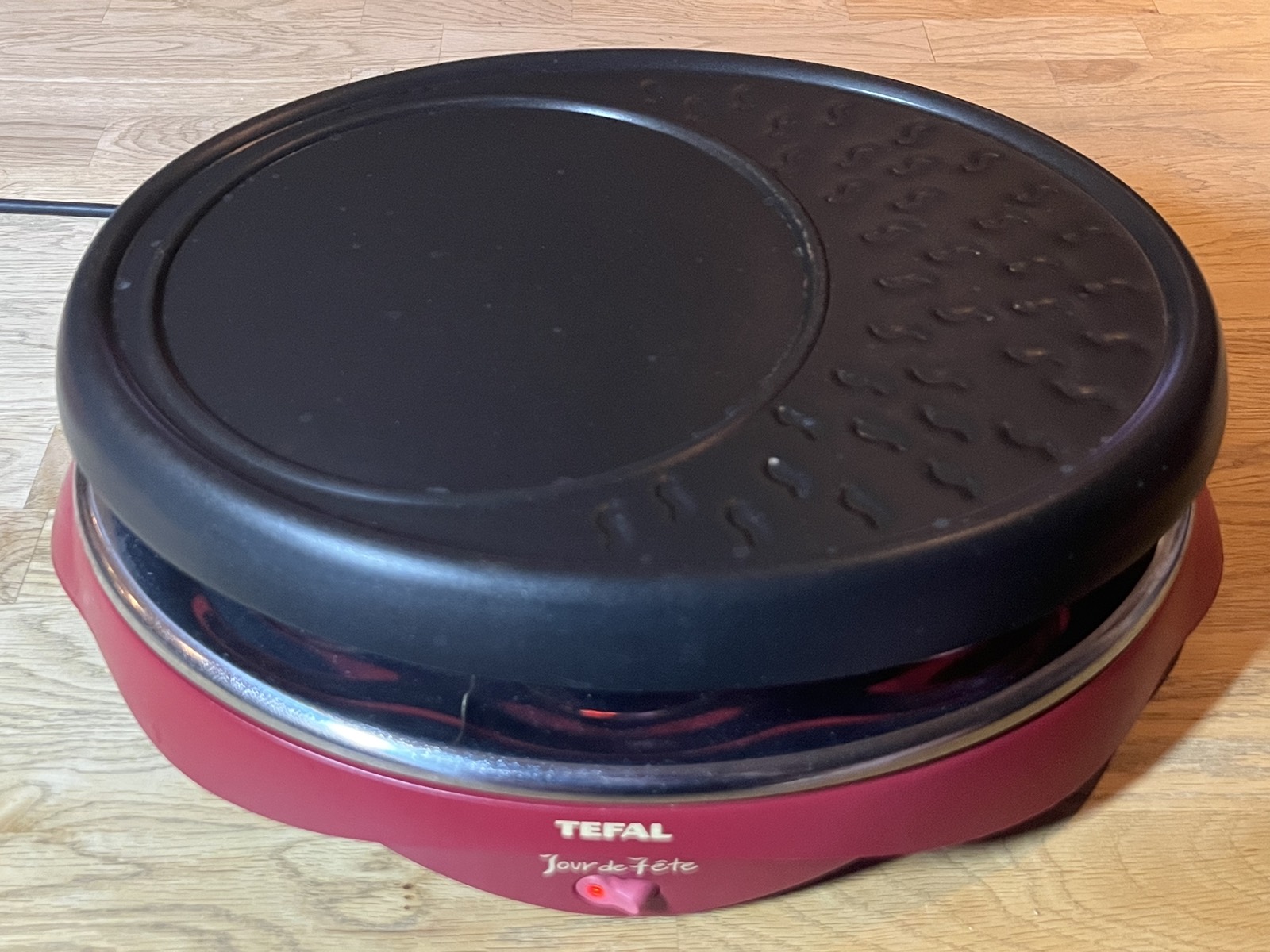
Most modern electric raclette machines — especially 8-person models — have a reversible grill plate with a smooth non-stick side and a ridged grill side. Here’s the correct approach for each:
Smooth Non-Stick Side
- Use a folded paper towel to blot up any liquid grease first.
- Apply a few drops of dish soap to a damp soft sponge.
- Wipe in gentle circular motions — never scrub back and forth aggressively.
- Rinse the sponge and wipe again with plain water to remove all soap.
- Dry immediately with a clean cloth; moisture sitting on the coating accelerates wear.
Ridged / Stone Grill Side
Ridges trap more debris. After the paper-towel step, use your wooden spatula at a low angle to push char out of the grooves, then follow with the sponge. For stubborn grilled residue, pour a small amount of white vinegar directly into the grooves and leave for 3–4 minutes — the acetic acid breaks down carbonised proteins without scratching. Wipe clean and rinse. If your machine has a natural stone or granite grill surface, skip the soap entirely (it permeates the porous stone); use only warm water and a stiff but non-metal brush. Let stone surfaces air-dry fully — at least 30 minutes — before storing, since trapped moisture can cause cracking during the next use.
Step 3 — Cleaning the Coupelles (Individual Cheese Trays)
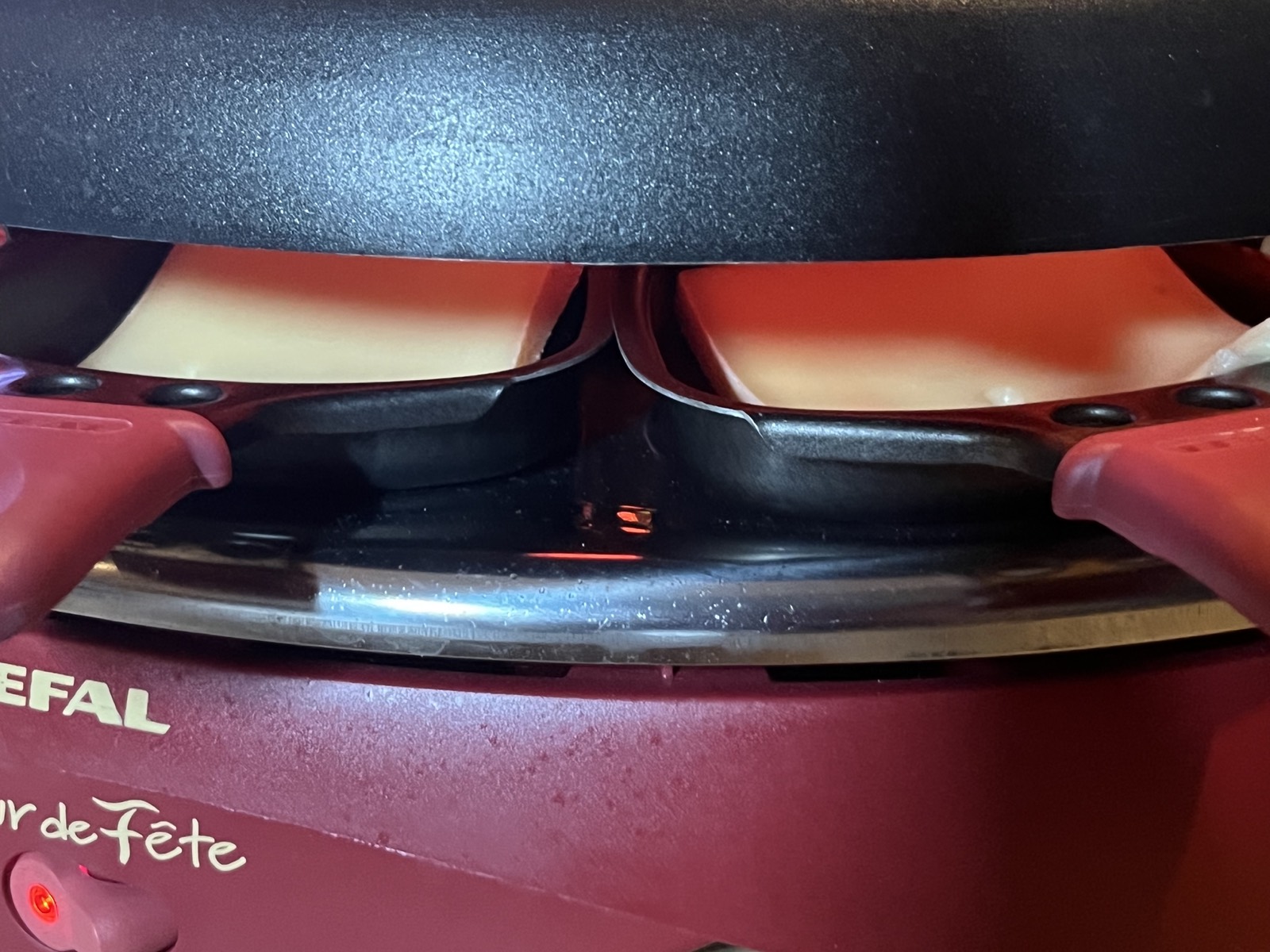
The little coupelles — or raclette trays — take the most punishment since raw cheese melts directly inside them. Fortunately they’re almost always dishwasher-safe (check your model’s manual, but most non-stick coupelles tolerate the top rack). If washing by hand:
- Fill a bowl or the sink with warm water and a squeeze of dish soap.
- Drop the coupelles in and let them soak for 10 minutes — this is the single most effective step.
- Use a soft brush or sponge to remove the loosened cheese.
- For baked-on burnt patches that survive the soak, sprinkle a pinch of baking soda on the coupelle, add a few drops of water to make a paste, and leave for 5 minutes before rubbing gently.
- Rinse thoroughly and dry before stacking.
Never stack wet coupelles — water trapped between them can cause mould in storage and degrade the coating faster. Want tips on what goes in those coupelles in the first place? Browse our picks for the best raclette cheeses that melt cleanly and leave the least residue.
Step 4 — Tackling Burnt Cheese (The Hard Cases)
Burnt cheese is the villain of raclette cleanup. The protein and fat matrices caramelise and bond hard to the surface. Force is not the answer — chemistry is.
The Vinegar Soak Method
Pour undiluted white vinegar onto the affected area and let it sit for 5–10 minutes. The acidity softens the carbonised crust so it can be lifted with a wooden spatula or silicone scraper. Follow with a warm-water rinse.
The Baking Soda Paste Method
Mix one tablespoon of baking soda with just enough water to form a thick paste. Apply to the burnt zone, wait 10 minutes, then scrub lightly with a damp sponge. The mild alkalinity neutralises grease and lifts char without scratching. This combo — vinegar then baking soda — works on the worst cases, but apply them sequentially (not together, which just makes foam and cancels the effect).
The Warm-Cloth Compress
For the most tenacious carbonised crust on a fully cold grill, lay a cloth soaked in near-boiling water over the area for five minutes to reheat and soften the deposit before using the methods above.
What You Must NEVER Do
Cleaning mistakes are responsible for most raclette machine failures:
- Never immerse the electrical base — water reaching the heating element causes irreparable short circuits and is a serious safety hazard. Only the removable plates and coupelles go near water.
- Never use steel wool or abrasive scouring pads — they permanently scratch non-stick coatings, making food stick more and creating particles you then eat.
- Never use aerosol oven cleaners — harsh alkaline agents attack non-stick polymers and leave chemical residues that transfer to food.
- Never put the grill plate in the dishwasher unless your manual explicitly says it’s safe — many grill plates are hand-wash only despite the coupelles being dishwasher-safe.
- Never store while still damp — rust on metal parts and mould on rubber feet can occur within days.
Maintaining good habits also means choosing the right accessories in the first place — our roundup of raclette accessories includes silicone spatulas designed to clean coupelles without scratching.
Natural Cleaning Methods: Vinegar and Baking Soda in Practice
Many people reach for commercial degreasers out of habit, but for a raclette machine white vinegar and baking soda handle 95% of situations safely and cheaply:
- White vinegar (5% acidity): cuts through fat, dissolves mineral deposits from hard water, and deodorises. Apply neat or diluted 1:1 with water depending on severity.
- Baking soda: mildly abrasive (far less than any scrubbing pad), alkaline enough to saponify grease. Combined with moisture it produces a gentle fizzing action in crevices.
- Lemon juice: a useful substitute for vinegar on light deposits, and leaves a pleasant scent — particularly effective on stone grill surfaces.
Avoid bleach-based cleaners near food surfaces. And never use essential oils thinking they will deodorise — some are slightly acidic and can affect certain coatings.
Drying and Storage: The Often-Overlooked Final Steps
Cleaning is only half the equation. Improper drying and storage degrade your machine faster than poor washing technique.
- Dry all surfaces immediately with a lint-free cloth — don’t leave things on a drying rack for hours.
- Leave the machine disassembled for 20–30 minutes in a ventilated space to allow any residual moisture in seams to evaporate.
- Store the grill plate and coupelles in the original box, a cloth bag, or stacked with paper towels between them — prevents scratches and micro-chips on the coating.
- Keep the machine away from high-humidity areas (under the sink, near the stove) to prevent corrosion on any uncoated metal parts.
- If you’re storing for the season, a light wipe with a drop of cooking oil on the non-stick plates protects against oxidation — wipe off the excess with a dry cloth.
Quick-Clean Routine vs. Deep Clean: When to Do Each
Not every raclette night requires a full deep clean. Use this schedule as a guide:
- After every use (quick, 5 min): warm-wipe of grill plate, soak coupelles in soapy water, wipe exterior with damp cloth.
- Monthly or every 3–4 uses (deep, 20–30 min): full vinegar or baking soda treatment of plates and coupelles, inspect heating element area for drips, check rubber feet for mould.
- End-of-season (once a year): full deep clean, dry thoroughly, light oil protect, store in original packaging.
Regular maintenance also preserves the evenness of heat distribution — a film of carbonised fat acts as an insulator and causes hot spots that cook your raclette vegetables unevenly on the grill.
Frequently Asked Questions
Can I put raclette grill plates in the dishwasher?
It depends on the model. Coupelles (individual cheese trays) are usually top-rack dishwasher-safe, but the main grill plate often isn’t — high heat and harsh detergents in dishwashers accelerate coating breakdown. Always check your specific model’s manual. When in doubt, hand-wash.
How do I remove burnt black marks from a raclette grill?
Apply undiluted white vinegar to the black marks and let it sit for 10 minutes, then use a wooden spatula to lift the crust. Follow with a baking soda paste (baking soda + a few drops of water) scrubbed gently with a soft sponge. Rinse well. Avoid all metal tools and abrasive pads.
Is it safe to use baking soda on non-stick raclette trays?
Yes, used as a paste in moderation. Baking soda’s abrasiveness is comparable to toothpaste — far gentler than any scrubbing pad. Apply it wet (as a paste), scrub lightly, and rinse immediately. Don’t leave dry baking soda on a non-stick surface and scrub dry — that’s when micro-scratches can occur.
How often should I clean my raclette machine?
Clean it after every single use — even a quick warm-wipe prevents residue from baking on during storage. A proper deep clean (vinegar/baking soda treatment) every 3–4 uses keeps the surface performing like new. An annual full-service clean before or after the season ensures long-term food safety and even heating.
Image credits: “Appareil électrique à raclette Tefal” © Benoît Prieur, CC0 1.0 · “Raclette-Grill mit Zutaten” © Raclette-Rezepte, CC BY-SA 4.0 · “Deux poelons dans un appareil à raclette” © Benoît Prieur, CC0 1.0 — via Wikimedia Commons.